A Nurse with a Gun

Wednesday, October 17, 2007

The Pre-Model 10

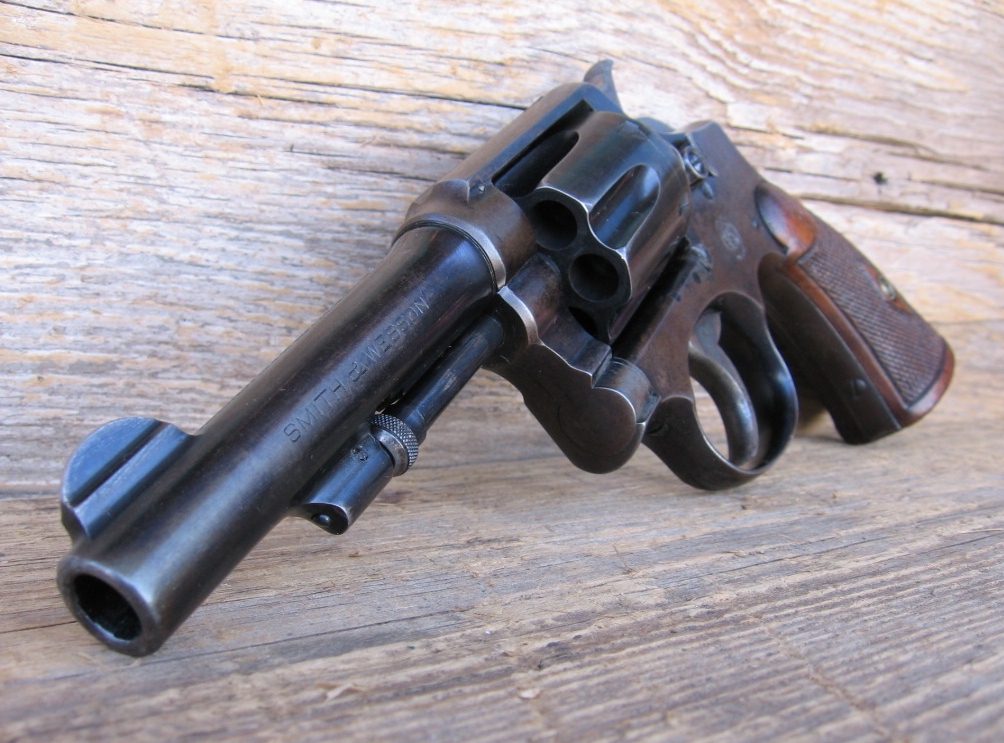
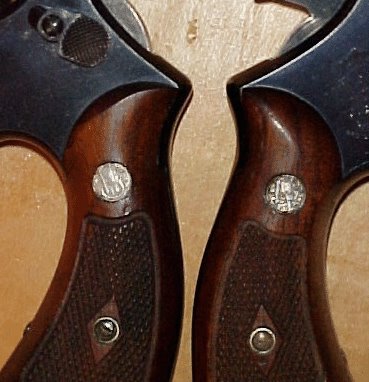
The Smith & Wesson Pre-Model 10 M&P was produced just after WWII. It has the best qualities of the Pre-War M&P, as well as the later improvements. Click to enlargeFor many Smith & Wesson shooters, it is a zenith of revolver design. These revolvers have the half moon front sight, the silky smooth long throw hammer action, and an effective hammer block safety. They are stocked with the transitional diamond magna grips. The blued finish on the Pre-Model 10 revolver is more understated than previous or subsequent variations.

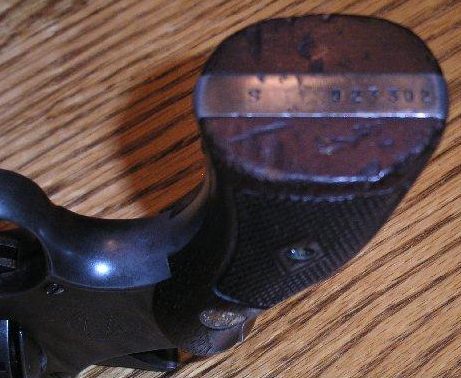
Serial number S811120 began in 1945. Some aficionados say the S prefix began as early as December 27, 1944 around serial number S769000. Almost certainly, at serial number S990184, on April 7, 1948, the short throw hammer was introduced. On March 22, 1948, the serial number prefix was changed to a letter C and began anew with C1. The Pre-Model 10 officially became the Model 10 in 1957 with the assignment of model designations by Smith & Wesson. This example, S8419XX sports an uncommon five inch barrel and it's original diamond magna grips. I purchased it off a pawn shop shelf along with it's holster for $89. It is an excellent shooter.

Labels: ,

Saturday, October 13, 2007

The Nickel M&P

Click to enlargeBetween 1927 and 1930, a small number of Smith & Wesson M&P revolvers were purchased by the Texas State Prison system. These revolvers were chambered in .38 special, nickel plated and they had five inch barrels. They are marked "Texas State Prison", and are known to be between serial numbers 500000 and 630000.

This Smith & Wesson M&P revolver is serial 5446XX. I purchased it at a pawn shop for $125.

Labels:

Friday, October 12, 2007

S&W Model of 1905 Cylinders

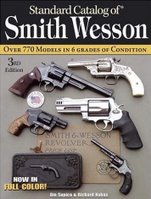
Click to enlargeHeat treatment of the Model of 1905 4th Change .38 Special cylinders began at about serial number 316648. This information from Supica's Standard Catalog of Smith & Wesson is important to know, even if it is an educated guess. Serial numbers prior to that figure may not be safe to use with modern .38 special ammunition. This change occurred in September, 1919. The corresponding heat treatment serial number for the .32WCF (32/20) Model of 1905 4th Change was 81287.

Labels:

Monday, September 03, 2007

A Model of 1905 4th Change Oddity

I learned a bit this morning. I had always considered this particular revolver to be Pre-Depression. A curious reader raised an incongruity in it's appearance. (Update: It's actually OK, it is pre-depression.)
Click to enlarge
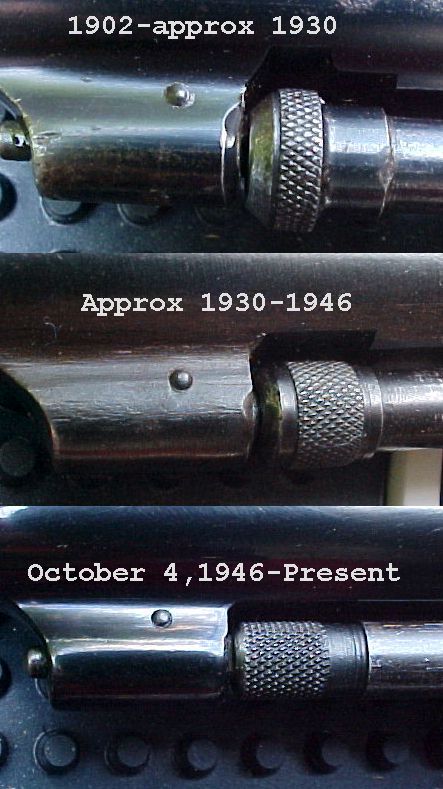
According to the mushroom shaped ejector knob, this revolver would date prior to 1930.

According to the "Made In USA" mark on the frame, it would date post-1938 after May, 1922.

There is no indication that the gun was ever tampered with. Odd indeed, until one considers the .32WCF caliber.......Ah ha! This is a Model of 1905 4th Change in .32-20 also known as .32WCF. 78,983 of these revolvers were manufactured between 1915 and 1940, compared with 758,296 of the .38 Special version during the same time period. The .38 Special saw a production run roughly ten times as large as the .32WCF!

Thus, it is highly likely that a surplus of .32WCF barrels and cylinders were manufactured prior to 1930, when the chambering was presumed to be the hot item. The pre-1930 barrels had a notch cut to accommodate the mushroom ejector knob. Click to enlargeThus, the older style knob continued to be used on later .32WCF M&Ps long after it was discontinued on the .38 Special M&P.

The frame of the .32WCF M&P, however, was the same as the .38 Special version, with serial numbers contained within the same range. The "Made In USA" mark dates the frame with certainty after 1938 after May 1922. Thus, the revolver must have been produced post-1938 May 1922 (and there really isn't an issue). .32WCF production was discontinued with WWII, and this revolver has a six digit serial, 1087XX which places it late in the production run.

Thus, what I originally had determined to be a Pre-Depression era M&P, is indisputably not. A firearm is dated by it's frame, not it's ancillary bits, but this .32WCF Military & Police revolver is still correct. Apparently, stockpiled pre-depression .32WCF barrels and cylinders were used to produce .32WCF revolvers much later, using the later Military & Police frames. Because of it's scarcity compared to the .38 Special M&P, Supica's Standard Catalog of Smith & Wesson lists this revolver at about $400 in it's present condition.

I purchased this Model of 1905 4th Change revolver at a gunshow a few years back. I had made the rounds, and saw nothing on the tables that I could not leave without. I was watching for walkers (private sellers) meandering about the crowds. Finally, I spotted a weathered old hayseed farmer in coveralls, complete with a battered straw hat. He was pulling what appeared to be a Smith & Wesson M&P from a canvas tote sack to show to a dealer. Like a leopard, I drew closer and overheard the farmer trying to sell the revolver for $200. The dealer counter offered $100. The sunburned old coot wasn't having any of it.

When the farmer walked away disgustedly, I approached him and asked to examine the gun. I had thought it was a .38 Special, and I was disappointed to find an unfamiliar caliber. I offered what I felt was a fair price, minus a bit due to the oddball caliber......$150. The farmer refused, and stuck the gun back in his tote sack. We went on our separate ways ambling about a rather boring show.

The farmer and I ran into each other again several hours later. I had done pretty well selling off a couple of pairs of stag grips and a Kart barrel for a 1911. I asked the old gentleman if he still had his revolver. He did. I asked to see it again. As I saw the hope emerge in his grizzled and wrinkled face, my haggling skills were dulled. With a twinkle in his eye, he removed the old faded blue revolver from his sack. He gave it to me with a wink and a yellow smile. I spontaneously decided to transfer my good fortune over to him. With a handshake and a smile, I gave him two crisp Franklins for the old Smith & Wesson. I'm glad I did. The karma has come back to me.

Epilogue: It appears I had some spurious information somewhere, so I went to the expert resource, the S&W Forum and Neal & Jinks. There, I found the "Made In USA" stamp actually appeared in May, 1922. Thus.......The oddity was not an oddity at all. There are 8 years of wiggle room. I've corrected the erroneous information I relayed. Thank you to my readers who set me on the straight and narrow.....

Labels: , ,

Tuesday, September 26, 2006

Smith & Wesson Grip Styles


Pre-war and wartime, square butt Smith & Wesson walnut grips.

Labels:

Saturday, August 26, 2006

Marcas Registradas

In May, 1948, Smith & Wesson changed their simple "Made In USA" rollmark to a more complex four line bilingual version. This was to combat the many Spanish counterfiet revolvers being produced.

For collectors, the 4 line rollmark indicates a definite post war gun.

The "Made In USA" mark appeared in May, 1922. Prior to that date, there were no markings placed on that area of the frame by the factory.

Labels:

Sunday, July 02, 2006

K Frame Serial Number Prefixes

After WWII, target sighted K frames had a K prefix from 1946 until 1970, when S&W began to place a number before the K prefix.

A V prefix denotes a "Victory" Model, or a fixed sighted K frame produced during wartime. Fixed sighted K frames were given an S prefix from 1945 until 1948. Then they assumed a C prefix from 1948 until 1967 when the prefix changed to a D. The D prefix was used until 1977. The D prefix was continued until 1978, when a number began to precede the D.

Labels:

Sunday, June 25, 2006

Dating a K Frame


Dating a K frame by the ejector rod

Labels:

Tuesday, December 06, 2005

Separating the Diamond Magnas

One of the finer points of S&W wheelgun collecting is making sure your purchase is correct and original. One item that is frequently overlooked on pre-model number guns is the transitional magna grips. Later magna grips can be diamond grips, but there is a fine difference. Once you see it, you do not forget it. The difference is the top edge of the grip. The early magnas, introduced on some models as early as the 1930s had a less rounded edge on the upper curve of the grip. At some point in the early 1950s, the later, rounded style appeared. Diamond grips should have the revolver's serial number stamped into one side. If this is not the case, look deeper.

Labels:

Sunday, December 04, 2005

Pinned & Recessed

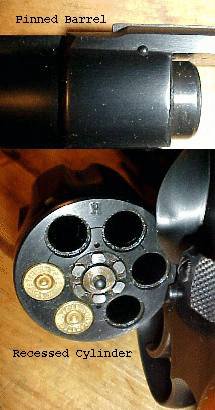
Click to enlargeI'm occasionally asked by someone what pinned & recessed means. It's a term used by Smith & Wesson afficianados.
A pinned barrel is one in which a pin runs through the frame to secure the barrel once it has been screwed into place. The pin positively prevents the barrel from turning out of place from the bullet's torque.
A recessed cylinder is one in which the chambers are counterbored, allowing the cartridge to fit flush in the cylinder. This provides protection in the event of a casehead rupture, but it also looks more finished.
Neither of these refinements are truly necessary in a revolver.
Smith & Wesson discontinued them both years ago in a cost cutting measure to insure the company's survival. These refinements endure, however, as indicators of a revolver that was skillfully crafted by artisans who loved their work.

Pinning of barrels and recessing of cylinders ceased in 1982.

Labels: , ,