When a person asks me to teach a them how to shoot, the first step is that I require them to memorize the
Four Rules. This request performs two functions. First, it gives them the minimum knowledge needed to be safe with a firearm. Second, it demonstrates that they are serious about learning. It is a simple test of willingness and open mindedness.

If they balk at learning the Four Rules prior to going to the range, then I will not instruct them.
Once they can recite the Four Rules, we get together with an unloaded Ruger MKII, usually at the new shooter's home to provide them with a comfortable environment. I do not bring ammunition, only the first gun they will shoot. I demonstrate how to hold and operate the firearm, how to check the chamber, and how to make a safe weapon. I focus on safety and responsibility as well as the basics of handling the gun. I assess the student's anxiety level, which at times may be quite high. I want them at ease handling a firearm. We talk about
eye dominance, and I check them to see which eye is strongest. I draw a diagram to illustrate the basics of sight alignment, and I allow them to dry fire the pistol, with the expectation that the gun will be handled safely. When it is not, we back up and start again.
I ask them why they want to learn to shoot. Almost always, the reason is self protection. I explain that a person must be willing to take a life to save their own if they are to successfully employ a firearm in self defense. I make it clear that the time to come to that epiphany is well prior to an attack. Realizing the need once an attack commences is often futile. If the person has a pressing specific need, I try to help them towards a more immediate solution, explaining that gun skills develop into a means of effective self defense over time, and that a firearm is not a magic wand to make bad guys go away.
I explain that to realize the benefit of a handgun in saving ones life, the shooter must be able to hit what they intend. I explain that that a shooter who is unable to hit their target may as well be tossing lit firecrackers at their attacker. They have a noisemaker, not an effective tool to stop an attack. Marksmanship matters. Only then do we go to a range and load a weapon.
I prefer to use my
four inch stainless Ruger MKII as an initial training tool.

The low noise and recoil of the pistol allows the new shooter to concentrate on marksmanship. I recommend double hearing protection and safety glasses to prevent bad habits such as flinching from the beginning. The cheap 22 caliber ammunition allows the new shooter to learn on the cheap.
I like my stainless Ruger because I do not have to worry too much about it getting knocked around. The single action trigger allows the new shooter to achieve success faster. The pistol is well balanced, very "pointable," and reliable. I do not want my burgeoning shooter to have to fight equipment. I take only the Ruger MKII with us to the range. I shoot with it just as my student does. I do not want to give the impression that they are shooting a firearm that I would not. I emphasize that I return to basics with the Ruger anytime I feel myself slipping. I also emphasize that good marksmen are not highly skilled in tricks. Superior marksmen simply perform the basics better and more consistently than other shooters.
I have the shooter shoot at paper plates from a distance of about 15 feet, building confidence as we go. I keep a close watch on muzzle and trigger discipline, and am firm and clear with my corrections if need be. I teach sight alignment, and then flash sight pictures. Rather than focus on precision, I concentrate on the new shooter's ability to hold the sights on target while squeezing the trigger.
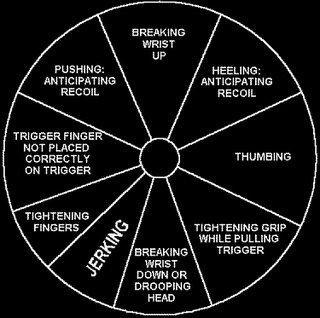
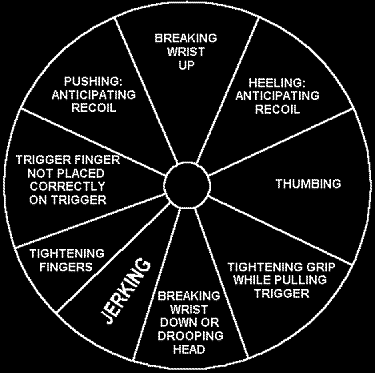
This ability is fundamental to marksmanship. I place the paper plate targets on a cardboard backing. The goal of the first range lesson is two fold. I look forward to the new shooter conquering their fear of the handgun, and I expect them to be able to get all ten rounds consistently on the paper plate. I have a printout of the "Wheel of Corrections" handy so self motivators can refer to it themselves. Sometimes we shoot at the wheel of corrections itself.
If the new shooter tires before they reach their goals, we stop. I want to keep it fun. I am as much interested in building confidence, a joy of shooting and competence as I am in building marksmanship at this point. I never want the training to become drudgery. If I find the new shooter to be a prodigy or a hard charger wanting to just shoot and shoot, I will set up multiple targets or I will increase the distance to keep them challenged.
Only when the new shooter is hitting their target consistently with a MKII will I discuss another firearm, and never on the first range session. I make the point over and over again if necessary that it is not the gun that matters, but what the shooter can accomplish with it. I refrain from shooting very much myself. I am there because my student wants me to instruct them, not to demonstrate what an accomplished pistolero I am. The instruction is about them, not me.
To determine which direction the training will take, I again talk with and listen to my student after the initial range trip. I have found that many new shooters, influenced by Hollywood, shun revolvers. I present the revolver as a viable option for self defense, one with
it's own advantages over a pistol. We discuss the merits of various platforms. I talk about the role of the handgun's weight in absorbing recoil. We discuss the need to stop an attack immediately through incapacitation. I explain the role of a significant caliber in performing this task. The next choice will be an slight increase in caliber, a double action trigger, or perhaps both.

If the student feels ready for a change, I allow the shooter to hold, manipulate and learn to operate their next choice of handgun away from the range, without ammunition, the same as before.
If the student decides on a revolver, I move them to a Smith & Wesson Model 17 and we continue to work on trigger control. Eventually they will move towards a four inch .38 special, and then to a .357 magnum or a snubbie revolver, depending on their needs.
If the student chooses a pistol, a full sized 9mm double action gun is the next step, possibly with a .40S&W or a .45ACP in the future. At this point, I want the shooter to learn to control the double action trigger. Again, I focus less on sight alignment, and more on smooth trigger control. By now, the student should have sight alignment down. We continue as before, with double hearing protection and paper plates at 15 feet, increasing the difficulty through distance if necessary. I usually see the marksmanship evaporate, and I must remind the student to concentrate on the basics they acquired with the Ruger MKII. If their confidence starts to slip, we return to the Ruger to regain it.
During this range trip, I again keep the number of firearms available to a minimum, requiring the student to work with their new choice or revert back to the Ruger. I want the new shooter to be able to clear the hurdle of a different trigger or a larger caliber, but I want them to be able to take the basics they learned and apply them to achieve competence and confidence. I reiterate that it is their skill with the basics that makes for effective marksmanship, not a magic weapon. After this session, I encourage the new shooter to grade their progress and reassess their goals.

This independent introspection is fundamental in maturing as a shooter. We talk about the best tool for the job. If they want a firearm strictly for home defense, I propose a shotgun for consideration. If they want to swap from a pistol to a revolver or vice versa, we plan on doing so for the next session.
After this point, the instruction becomes much too individualized to provide a guide. The student has taken control of their own learning, and I allow them to set the direction and progress. I encourage the student to begin thinking about obtaining their own handgun. I will bring multiple firearms to the range for them to try out. I am open at this time to allow the student to try out a 1911 or a Glock. I will allow them to go up again in caliber if they want to see what a specific round feels like. By this time, the student is no longer a new shooter. They have become a person in control of their own destiny and they only need guidance as to how to fulfill their individual needs. They are now one more advocate for the right to keep and bear arms.
Todd G's thoughtsLabels: Gun Advocacy, Neophyte Shooters, Teaching New Shooters