David Armstrong has some incisive thoughts up on tactical reloads. If you are a reader who carries a gun and contemplates effective personal security including lethal force, I suggest you give David's blog, The Thinking Gunfighter a read. Quick, smooth tactical reloads are impressive, especially when performed running and gunning. But are they a viable lifesaving skill in a real gun fight struggle to save one's life?
A while back, I showed a series of photos on how to perform a 1911 reload in this post, and I am fairly proficient at getting the job done. My preference for a handgun reload though, is the shotgun I fought myself to. If I am still in need of ammunition with the smoking shotgun in my hands, I hope there will be another shotgun nearby, or a half empty firearm on the floor.
My thoughts on David's article are in the comments. Thinking Gunfighter.... an apt name to that blog. I'll still carry a spare magazine opposite of the piece on my belt though. A balanced gun belt is a good thing.
Todd G has complied several salient thoughts on training with a 22 pistol as a substitute for your carry gun. With the present economic crunch and ammunition costs, a 22 pistol may seem like an attractive alternative.
I still advocate teaching new shooters marksmanship with a 22 pistol. I also advocate training with what you carry. When I still traveled into "Indian Territory" on a daily basis to see patients, I would pop into an indoor range each day to run one magazine (or cylinder) through my carry gun. That amounted to 60-70 rounds a week, sometimes less if I carried a revolver that week. Round counts do not build proficiency. Familiarity builds proficiency.
I do not disagree with Todd, I still shot some weekend volume at the range as well. Failure drills are important, as is shooting with either hand. Being able to shoot accurately on the move with an adrenaline dump is the skillset to strive for though. This comes from being as familiar with the gun as we are with our automobile. Each day we get in a car and perform complex tasks based on time and space, often within mere feet of injury or death. We do it easily, without thinking. How? We do it every day, a little at a time, not by driving 500 miles once a month.
I sometimes wish I still had the time each day to shoot a magazine. With my present job, unfortunately, I do not. My risk is lessened, and my time is more precious now. I do, however, make certain that I stay intimately familiar with the gun I rely on, and I still benefit from the time I shot them that frequently. But give Todd's article a read. It's good food for thought.
I tend to send a lot of lead down range from seven to ten yards. I rationalize shooting at this distance, and practicing from the concealed holster on the move, because I shoot for self defense. Beyond that range, I tell myself it would be difficult to defend an argument of self defense. Unless my attacker had a rifle. Inside that range, I would be forced to defend, even against a knife.
Targets look better at short ranges. As the bullseye becomes more distant, holes in the cardboard spread out, and the shooter's deficiencies become more apparent. One thing I have never done shooting at 25 yards is blame the gun for my failings. Hell, I know shooting a pistol across a quarter of a football field and making cloverleaf groups is difficult. I'm proud to say that most of my guns can do it, but I can't. Oh, I occasionally get lucky, but I can not consistently group tight at 25 yards. With practice and sharp eyes, I might get there, but it isn't my goal any more. Fast hits from concealment at bad breath distance are.
Todd G has penned a piece concerning shooters blaming the gun. If you find that your handgun shoots 6-12 inches low at 21 feet, 10 inches low at 25 feet, or two feet low at at 25 yards, especially with factory fixed sights, take a hard look in the mirror. It ain't the gun.
In a recent blog post, Carteach0 discusses the importance of movement in the defensive shooter's repertoire. As usual, Carteach0 does an excellent job of discussing the theory and mechanics of the skill. I hope he does not mind if I toss a few thoughts out there.......
The photo of Carteach0 that I chose to illustrate this post with ironically is one that he uses to illustrate what not to do. Movement and balance are as individual as people. Some shooters will be dangerous as Plaxico if they cross their feet. Others can move with the grace of Marcus and Karen Hilton doing the Tango. I personally do not feel concerned about crossing my feet while moving. Of course, I am not moving and shooting on packed snow and ice like Carteach0. I also have a background in ballroom dance. Oddly, I would advise anyone interested in developing footwork independent of torso movement to take ballroom dancing. I never thought about it before, but there it is. Ballroom dancing is all about complex integrated footwork with control of the torso.
One other thought..... Training to move laterally is good. Diagonally is better. But the best way to train by far is to move towards cover. Handguns do not have an infinite supply of ammunition. When used in self defense, a handgun often expends it's ammunition at an alarming rate. An extra magazine or speedloader is handy, to be sure, but one must remember that it is far better to reload behind cover than reload in the open. We will fight as we train. If we do not train to move towards cover we may very well find ourselves reloading in the open when we least want to.
I suppose I should say it, although it should be apparent without my doing so..... If a shooter decides to train with movement, they should advance slowly, and practice movement while dry firing first. If they have laser grips on their handgun, it can be an effective tool to evaluate exactly how well they are making progress. Safety is paramount.
"The point of carrying a weapon for self defense is it’s there when it’s needed. Predicting exactly what will be happening when that need arises is nearly impossible. If one could predict every dire situation, one could then avoid them. Almost by definition the defensive situation a CCW holder might face will be a surprise, and come on rapidly. If it were any other case then it would probably be better to escape than fight."
Carteach0 has an excellent post up regarding defensive shooting. I am fortunate to have access to a private range where I can shoot as I like (as long as it's in the right direction). Being able to draw and shoot accurately at close range while moving, at a moving target, is a fundamental skill of the well prepared armed citizen. Ask around. Get to know your Range Officers. Seek out professional instruction. Chances are, there is some place near by that responsible gun owners in the know go to to practice reality based defensive shooting. Being able to put all the elements of defensive shooting together in rapid succession is essential to building overall competence.
But if such a place is unavailable to you, and if your range has rules prohibiting holster draws and movement, there are still techniques you can try. At the very least you can shoot from low ready while shifting your weight from side to side at targets as close as possible. Ask if you can staple two targets at different heights on the same frame. If permission is given, practice transitioning from one target to the other between shots. If even these practices are prohibited, then working with dry fire in the home remains an alternative, although the feedback of holes in targets is largely absent. For defensive training anything is better than aimlessly punching holes in paper in a frozen Isosceles stance.
Crimson Trace laser grips are endorsed by some well known and celebrated shooters in the gun world. Several readers have written asking me my opinion of lasers on handguns, and in particular, Crimson Trace's laser grips. I am no where near the level of experience or accomplishment as some of the advocates of laser sights, but I have owned and used the product. I'm not sure why my opinion is worth much, but for what it's worth, here it is.
I own one pistol with Crimson Trace laser grips, a Beretta 92FS. I rarely shoot the pistol any more, but because it was the first gun I bought after leaving the US Navy, I have kept it. Mel Gibson was shooting bad guys in Lethal weapon with a laser sight at the time, and as soon as I could obtain laser grips, they went on my black Italian high capacity blaster. Years later, I purchased a used SW1911 that wore Crimson Trace laser grips. I quickly sold off the laser grips to lower the total price I paid for the pistol.
I have kept the laser grips on the Beretta so people I take shooting can try them out if they like. Laser grips have a few advantages. They are another sighting option besides conventional sights. What they are not is a panacea for poor marksmanship skills. If you can not hold the front sight on target as you pull the trigger towards sear break, a laser will not help you. There are no laser guided bullets, and the bullet will still go where the muzzle is pointed when the primer ignites the charge.
Laser sights do help a shooter to see what is happening during their trigger pull when used with dry fire practice. The red dot bouncing all over the place as the muzzle twitches around is undeniable proof that the shooter needs to work on trigger control. Laser grips can be the reality check that spurs the shooter in the right direction towards marksmanship.
Many people harbor a childhood fear of the dark, but darkness can be a friend and a great equalizer if used to tactical advantage. Advantages in low light are quickly negated by the improper use of the laser or a flashlight. While demonstating how these tools can be used in conjunction to engage a threat in a dynamic environment, it is easy to forget one of the most important principles of survival. Keep it simple. I have to wonder if a low light situation might have a higher survival rate if the defender holds a position and depends on their dilated pupils to see an approaching threat, and then suddenly illuminating it to identify and blind it while the decision is made whether to fire. House clearing with a handgun is complicated enough in a crunch. Placing flashlights and lasers in the mix does not make it less complex or more survivable.
Being able to accurately shoot on the move is one of the most essential skills to surviving a gun fight. One must not only be able to shoot accurately while closing and escaping a threat, but also while moving laterally to it. When exposed in the open, a shooter's own movement is what helps protect them from being shot. Although it is possible to contine the fight once shot, a defender's ability to persevere drops dramatically if they take a bullet. In my experience, if a person can not hold the sights on target while moving, they will not be able to hold a red dot on target while moving. Again, the laser might be a useful teaching tool, but it is not a substitute for the skill needed.
Some cite the advantage of being able to shoot around corners, and from your back with the laser as an advantage. Shooting around corners is a tactical problem, not an equipment problem. I figure if I'm on my back, my attacker is on top of me, and I will either be at close enough range that the laser will not make a difference. I will shoot to stop the attack in progress, or I will be getting to my feet and seeking cover. Of course, anyone can be surprised and end up fighting from the ground. This is when alternative skillsets come in handy, and a laser can not replace them.
Most advocates of laser sights cite the "shit in the pants" factor a thug supposedly receives when he realizes a red dot is placed on his breastbone. This may or may not be true. Thugs are individuals and may not react like normal people. The red dot on the chest may have the same effect as the sound of hand cuffs clicking or a pump shotgun chambering a round. The stimulus that compels one thug to comply may cause the next thug to attack. Red dots don't stop threats.
And another thing..... When holding a gun on a threat, assuming a civilian even has the occasion to do so, conventional wisdom states that the finger should be off the trigger, especially when using a single action firearm such as a 1911. This is done to prevent an unintentional discharge that may kill a compliant person who was previously a threat. I personally index my trigger finger alongside the frame of the gun to prevent a startle reflex from initiating a sympathetic trigger pull that could result in an avoidable tragedy. The Crimson Trace laser is frequently obscured when the trigger finger is indexed in this way. I encourage every shooter considering this product to also consider how it will be used, and how it fits into the training they have already cemented into their psyche. It is that training they will revert back to in a crunch, and the new gizmo they are dependent on may not work as they expect.
Recently, I have looked through a series of advertising videos with the byline "The One with the Laser Survived." In fairness, I have embedded these videos here. I embedded these videos not to dispute the conclusions of the distinguished luminaries advocating laser grips, but simply to allow their views to be heard as well. The end decision is up to the individual shooter. I may very well purchase a set of Crimson Trace laser grips for my Model 649 Bodyguard. Heck, if I don't need the laser, it isn't there. I use the gun for training though. If the laser can help me with training, and perhaps help in a crunch, why not?
But as far as the person with a laser being the person who survives? I challenge anyone to point to a person who was mortally wounded in a gun fight because they lacked a laser sight. One conclusion appears over and over again when considering laser grips. They are not a replacement for basic marksmanship or tactics. A shooter must integrate the laser into their training if they are to use it effectively. Expecting a laser to perform a magic trick in lieu of proper training is a recipe for disaster. In my experience, the person with awareness, training and a bit of luck on their side will be the one who survives. You can't buy that at the gun counter.
After several nights of dry fire practice from my pocket holster, I took the two Bodyguards back to the range to have another go. I had lost some of my smoothness of drawing, and I wanted it back.
My goal is to get shots on target as quickly and efficiently as possible. Always. That is what allows a person to survive a lethal confrontation. I want to get shots on target before my attacker shoots me.
Drawing a gun and firing it is a gross motion comprised of many smaller movements. Smoothness of the draw is important, but so is getting behind the sights quickly. I draw to a quick elbows up position, with my right arm almost as though I am drawing a bow. This allows the handgun to be shoved forward in my line of vision which is already on the target. My finger goes onto the trigger when the handgun is shoved forward towards the threat. As soon as the front and rear sight are aligned on the target, I smoothly pull that trigger whether my arms are fully extended or not. My goal is fluidity. I do not want any discernible pauses in the motion from the removal of the gun to the pulling of the trigger.
Yes, I pull the trigger. This is double action shooting, getting hits on target as quickly as possible and I don't trouble myself with semantics. I wrap my finger around that trigger to the first knuckle, and I pull it to the rear at a consistent steady rate. I have found that getting my elbow up and shoving the gun forward in my line of vision gets shots on target for me faster than raising my handgun into my line of vision from my side and having it bob up and down. It also allows for better retention of the handgun.
I am certain that some will say "My God, what about the cylinder blast?" That concern is valid. The risk of cylinder blast to my face and eyes is the reason my finger does not go onto the trigger until the gun is shoved forward. My goal is to get a first hit consistently on target, to shoot an attacker before I am shot. I have found that this draw allows that.
The difficulty inherent in this draw stroke is that the arm must change direction as the elbow reaches it's apex and the gun is shoved forward. To change direction, the arm must stop movement for a split second. This is where jerkiness can enter the equation, making for an extension with the sights not aligned with the eye. One must think of the motion as singular and curvilinear, not a collection of straight motions. Flowing, not spurting. Xingyiquan, not Muay Thai. Violins, not drums.
"Be extremely subtle, even to the point of formlessness. Be extremely mysterious, even to the point of soundlessness. Thereby you can be the director of the opponent's fate." ~Sun Tzu
This draw is not always the best solution, but it is a good technique to have in one's repertoire. A competent gunman should practice different draw strokes, to allow for maximum flexibility and advantage. The most important criteria in a gun fight though, is to get shots on target before your target gets shots on you.
Target fixation....... In defensive shooting it obscures other targets and threats in a dynamic environment. In cycling, it obscures other dangers in a dynamic environment as well. Not good in defensive shooting, and not good in cycling. More here.
These kind of stories hit home to a bike commuter:
May 16, 2008, The Seattle Times: The recent mugging of a man who was riding his bicycle through the Interstate 90 Mount Baker Tunnel has prompted police and the Cascade Bicycle Club to urge bicyclists to always be aware of their surroundings and travel with others.
Bob Cornwell was pedalling home from work through the Mount Baker Tunnel last week when he was attacked by three teenagers who knocked him off his bike, slammed him against a wall and stole his wallet, money and bike bag. The Seattle University professor said he was lucky to escape with only a few bumps and bruises. Initially, he didn't want to report the incident to police. "I didn't want to make a big thing of it," he said.
But a colleague and fellow member of the Cascade Bicycle Club encouraged him to call police, and warned others of the May 7 assault through a posting on the club's message board. The posting was forwarded through the local biking community. According to a police report, the strong-arm robbery occurred shortly before 5 p.m. near the entrance of the tunnel from Sam Smith Park, on the lid of I-90 at Martin Luther King Jr. Way South.
As a group of people, bicycle commuters are used to enduring the scorn of drivers, often having curses and even trash hurled at them as they pedal down the street. With the increase of people taking to pedal power, a more significant crime is certain to increase, however. Muggings of cyclists will no doubt increase both in frequency and severity.
To decrease the likelihood of being victimized, it is imperative that the cyclist understand the motives for these attacks. A cyclist may be attacked through road rage, as juvenile entertainment, or in a strong arm robbery attempt. Only rarely is there a personal vendetta.
Criminals do not attack randomly. They select victims after formulating a plan. Frequently it is a plan that has worked for them in the past. They set up an ambush site and wait for a likely target. The victim may have been chosen beforehand, or the victim may be an unwitting target of opportunity.
If you are targeted before hand, the attack will likely come as you have your back turned, kneeling down and your attention taken by the task of locking or unlocking your bike. Situational awareness is crucial at this time. Choose a well lit area with frequent passersby to mitigate the risks. Scan the areas for loiterers. Have an alternate site to lock up at if conditions do not seem safe at the primary spot. By locking up where you are secure, the bonus will be your bicycle secured in a more theft resistant location.
Attacks can occur while riding as well. It is difficult for a cyclist to divide his attention between the traffic around him and the potential threats that lurk between parked cars. Get the iPod out of your ears. Listen to what is going on around you. Watch the movements on the sidewalks, as well as the traffic ahead of you. A cyclist can be brought to an abrupt stop with a broomstick jammed into the spokes of his bike. After getting up from the pavement battered, he will be quickly beat down again in a robbery attempt. Cyclists can be tackled from the side, clotheslined from the front, or beaten across the back with bludgeons. The key to surviving such an attack is to recognize it in it's infancy and avoiding it all together. It will originate from the sidewalks as you approach. Avoidance of attacks and the potential confrontations that may precede an attack is crucial. If the cyclist is brought down while riding, he will be forced to defend himself while already injured.
The bicyclist has the advantage of speed. If speed and maneuverability are combined with situational awareness to keep distance between potential attackers and the cyclist, evasion is academic. Knowing how to bunny hop curbs, how to maneuver through traffic, how to use traffic as a screen and how to evade approach without getting smacked by an automobile are all tools in avoiding an attack from street thugs.
Of greater importance is having several routes that can be taken, both to eliminate patterns and also to escape an attack. Territorial disputes between gangs and road rage from drivers demand that the cyclist use his knowledge of the areas traveled to take the path of least resistance. It is far better to take an extra four or five blocks pedaling than accept twelve hours on the pokey and a court date, much less an endotracheal tube and a ventilator for support. Avoid conflicts and altercations. Ride where your attackers cannot go. If you must pass through an area or situation, keep to the center of the streets. Force any attacker who may be on foot to enter the street to get to you. Be willing to pedal through stop lights if a safe opportunity presents itself. The key, after avoidance, is to keep moving but know when you must stop and defend. Maneuver around those who try to stop you. If, regardless of your efforts, you can not avoid contact, get your feet on the ground and your hands off the handlebars. You do not want to have to physically defend yourself immediately after taking a fall from your bike at speed.
If a cyclist is unable to avoid conflict, and is brought down by force, he will be fighting while already injured. His helmet and gloves will take on new importance in allowing him to avoid significant injury so that he might fight for his life if need be. If one must fight, knowing how to fight with non-traditional weapons is beneficial. Do not use a bike as a weapon, it's too unwieldy. Carry a U-lock, it's a great defensive weapon, as is a bike mounted tire pump. I solidly recommend Marc MacYoung's Guide To Improvised Weapons For Self-Defense for learning how to use a U-lock or a tire pump to best effect. Get the backpack off your back and into a basket on the bike. One reason I do not wear a backpack is I do not want it strapped to me if I am forced to defend myself.
Pepper spray is an effective non-lethal weapon. I currently carry Fox Lab's Mean Green spray with a cone nozzle. The cone gives me the advantage of being able to spray predatory humans and aggressive dogs on the fly if need be. I carry it in a clip on holster secured on the bike's basket behind me. Carried there, it cannot spray me in an accident, yet it is readily available for dogs of all types. If the cyclist has a CCW license, a firearm can be carried in a fanny pack, in a belly band, or even in a converted knee brace. Lycra riding clothes are generally out if a person wants to conceal a firearm. I have found pocket carry (one of my preferred modes of carry) to be too risky on a bicycle, unless the pocket has a zipper to close it. Smith & Wesson J frame revolvers and the KelTec P32 make good portable biking firearms.
If you are going to carry a firearm on your bicycle, it is imperative that you train with it. Train with it on your bike. Learn how to take a fall, how to keep your bike between you and your target, and how to get hits from the ground, wearing your cycling gloves. Find a range that will allow you to practice, or if that is impossible, practice the maneuvers through dry fire in your garage. Being able to draw safely and shoot quickly and safely from your back with your lower body towards the target is crucial. If you have the opportunity to observe bicycle police training, learn all you can from watching them.
Finally, if you are assaulted on your bicycle, report the crime. Carry your cell phone. Do not fall victim to the embarrassment that Bob Cornwell felt. You were victimized, and it was not your fault. If you were forced to employ pepper spray or a firearm, or even if the presence of the device deterred the attack, report the attack. You do not want your attacker reporting you as a crazy person threatening them with a weapon.
Robb Allen has a compelling piece to read when considering mechanical safeties on defensive weapons. Forgetting to disengage the mechanical safety on a defensive weapon when the adrenaline spurts and the vision tunnels is an oft cited rationale for the trigger safety on a Glock pistol. The argument has merit.
My argument is that we fight as we train. If a person goes to the range and loads and shoots their pistol without ever disengaing the safety........Because they never engaged the safety, the liklihood is fair to high they will forget to disengage the safety in a crunch.
However, if a person loads their pistol, chambers a round, engages the safety, and then holsters the weapon prior to drawing and shooting.......Every time they fire the weapon, then disengaging the safety becomes as natural as placing a finger on the trigger to fire the gun. If holster draws are not allowed at your range, load the pistol, chamber a round, engage the safety and table the weapon. Step away. Clear your head. Then step forward, pick up the weapon, bring it on target, disengage the safety and fire the pistol.
The answer is not one of safeties that disengage when a finger presses the trigger. The answer is one of training.
"Howdy. I read your blog on that Clark 1911, and noticed that it had the extended slide stop/release. I've searched THR a few times, and the general consensus is "don't get them." Now, I am well aware that a Clark Custom job would be hard (if not impossible) to match with "drop in" parts, but would you say that such a modification is handy to a 1911, or would you say that, lacking Clark's touch, the extension is more trouble than it is worth? I'm toying with picking up a Colt Series 70 repro this coming summer, and have toyed with putting in a similar part for various reasons, none the least of which is that I currently cannot easily reach the standard slide stop mechanism on a basic 1911."
Eightball
I despise extended slide stops on 1911s. The extra weight of an extended slide stop frequently counter balances the upward push of the magazine spring, especially a weak one, preventing the magazine follower from raising the slide stop into the notch on the slide to lock the slide open after the last shot is fired. As a result, the slide fails to lock back. I do not like that at all. It impairs quick reloads.
The only......only reason my Clark gun has an extended slide stop is because old man Clark put it there himself, fitting it with his own hands. I just feel it would be wrong of me to replace it on that pistol. Even J.E. Clark's extended slide stop can fail to lock the slide open on the last round, especially if the magazine is dirty, or the mag spring is weak.
The way I manage the standard 1911 slide stop is a pretty common technique. You never shift your right hand's grip during a reload. Use the right hand's thumb to drop the magazine while reaching for the spare mag with the left hand. The pistol is recovering from the recoil of the last shot. The empty magazine should fall free under it's own weight. The pistol's sights stay roughly on target, the pistol vertical.
Insert the spare magazine into the pistol with your index finger along the front to guide it.
Use your palm to smack it home, keeping your fingers outstretched to prevent them from getting pinched between the magazine and grip frame.
Now here's the trick. Watch closely.......Your left thumb depresses the slide stop and releases the slide as the left hand resumes it's grip on top of the right. The slide strips the first round off the full magazine, chambering it.
As the slide closes, the left hand curls around the right, the left thumb drops off the slide release, and the right thumb resumes it's position on top of the thumb safety. Notice that the pistol never changed position in the web of the strong right hand. The pistol's sights never left the general direction of the target.
I have yet to see an extended slide stop work as well as a standard version used correctly. Even on Jim Clark's gun. As far as I'm concerned, they are a crutch to compensate for a non-existent problem.
In Orange County, Florida the owner of a convenience store shot and killed a burglar Friday morning. Having been burglarized before, the owner was sleeping in the closed store overnight. At approximately 2:15 AM the snoozing owner was startled awake by glass shattering. "That woke me up one hundred percent," he recounted. The owner felt the immediate need to defend his life.
"I fired I think fourteen shots, and I, I was not very sure if I, if I shot him or not. And as soon as I finished all of my bullets, I think he really quickly jumped out of the window," stated the store owner as he described his spray and pray technique of life preservation.
The burglar was later found dead across the street. When asked if he regretted shooting the man and killing him, the store owner replied "No. Because this is the way it had to go down. His days were numbered, by the way. His days were numbered. If not me, he would have gotten somebody. If he had a weapon I would have gone down or he would have gone down."
Neighbors are supporting the store owner, but it is still uncertain whether charges will be filed.
This is yet another fine example of a person buying a gun and apparently never training or learning the law. Many gun owners hold a belief that a firearm is a magic talisman against crime, and they resort to their level of training in a crisis. They spray and pray. Guns do not prevent criminals from plying their trade like crosses affect vampires. Sound tactics and a plan prevents victimization.
While Florida is a "stand your ground" state, it is not a "lie in wait" state. The store owner freely admits he was sleeping in the store with a gun because he was burglarized before. Better, visible security may have been preferable. Two German Shepherd Dogs turned loose in the store when locking up for the night would have been just such a visible deterrent. The goal is not to change the burglar's life, but rather to make him choose an easier target elsewhere. The German Shepherd Dog is not a talisman against evil either, but unlike the firearm, a German Shepherd Dog comes ready with tactics to protect it's territory. A dog can lie in wait and escape with impunity when it protects it's territory. One can only hope a human will have the same ability in Florida.
A gun, ammunition, a concealed carry permit. Often, people believe this is all a citizen needs to carry a gun. Some recommend a cell phone, and a less than lethal means of self protection as well. It is true that to legally carry a concealed firearm, all that is needed is a valid permit. To gain this permit in most states, an applicant must have no felony record, pass minimum standards of marksmanship, perhaps attend an NRA sanctioned course, and submit affidavits attributing to their psychological well being. Many holders of a CCW believe this is enough, and legally, not much more can be required.
I, however believe that the responsible CCW holder should go further. What the law requires is the minimum standard. The mature person realizes that protecting oneself involves making quick decisions under extreme stress. When a firearm is introduced, the stress is often that of imminent death. This is an inherent and inescapable factor of self defense.
Many honest citizens have never actually faced violent criminals. Most people, are not familiar with the stresses that occur when they are facing immediate death or incapacitating injury to themselves. Indeed, most are not familiar with the stress that occurs when others nearby are facing immediate death. The mind short circuits, pares down perceptions to those needed to survive or escape. The body flies out of control as the sympathetic nervous system takes over. This is foreign mental territory for many.
Imagine driving down a tortuous highway at 75 MPH and suddenly losing the steering in your automobile. Now imagine accurately shooting your firearm under the same circumstances. Next, imagine making the decision to draw and fire your gun under the same circumstances. The decision whether to draw, let alone the ability to accurately hit your target is severely compromised by the threat of immediate death. What quickly becomes apparent is the importance of never losing your steering in the first place. Thus, preventing the escalation of conflict is more important than groupings from your pistol.
Several cases I have recently attempted to blog factually on, illustrate why I believe training under stress is important. Garrett Mallot recently became so stressed in a verbal altercation on a Houston bus that the shot his assailant. He now faces murder charges. At the very least, his life as a free man will be forever stigmatized. At worst, he will never walk free again. The facts of the Charles Chieppa case are still foggy, although he has been acquitted of any wrong doing. He will likely live the rest of his life as the man who shot someone in the back. The case of Jamie Buck is much more cut and dried, but an attacker does not always give his victim the luxury of being attacked with a sledgehammer in his own home in the middle of the night.
As carriers of firearms, CCW holders possess the means of taking a life to protect their own. This ability does not bestow any extra authority on the carrier, just extra responsibility. Death is an irreversible phenomena. Taking a life irreversibly changes the lives of many others. Thus, good judgment under extreme stress is something every mature carrier of a firearm should strive for.
How does one achieve this ability? Some advanced trainers train students under stress. They PT their students, introduce a verbal barrage of conflict, and expect them to hit their targets. The stress of an instructor yelling in your ear does not equal the stress of impending death, nor do the scrapes of rolling on the ground among gravel and shell casings. Simunitions and paintball are often used in force on force training. The sting of non-lethal rounds does not equate when the practitioner knows he will soon be eating his dinner instead of receiving a toe tag at the morgue. Martial arts and boxing teach a person to function in unarmed conflict with a given set of rules, but rarely with an opponent of superior strength and skill who obeys no rules.
All of these training techniques help, but they leave out an important ingredient. Familiarity with lawlessness and death is that ingredient. I believe the best way to learn to face criminal activity and potential death itself is through stress inoculation. Contact your local Sheriff to see if he has a ride along program for citizens, and then join a deputy on patrol. Volunteer at your local hospital's emergency department. Watch and learn how professionals deal with extreme, life altering conflict every day. Experience the finality of death. Know what it is like to continue to function according to protocol and law when logic screams run or fight like hell. Then train hard with your firearm. Expect no quarter to be given, no laws to be followed, and try to avoid the conflict to begin with.
1. Bring a gun. Preferably, bring at least two guns. Bring all of your friends who have guns. 2. Anything worth shooting is worth shooting twice. Ammo is cheap-life is expensive. 3. Only hits count. The only thing worse than a miss is a slow miss. 4. Someday someone may kill you with your own gun, but they should have to beat you to death with it because it is empty. 5. Always cheat, always win. The only unfair fight is the one you lose.
Blah blah blah.
Over the years firearms instructors have relied on cute little quips like these when a student asks how best to survive a gunfight. Without the experience needed to truly teach this subject (and very few have extensive first hand experience) the quips are accepted as truth in an atmosphere of mutual ignorance. These witticisms do hold seeds of truth, but they are intended to be entertaining, not informative, and they ignore several important truths.
Defensive firearms training has long been based on police training. The law enforcement base gives firearms training the credibility it needs for the marketplace. In truth, civilian self defense and law enforcement training could not be more different. Civilians do not have a need to apprehend criminals and stop crime. Civilians need only to avoid crime and survive another day with minimum injury and legal entanglements. This simple fact is often foreign to law enforcement oriented instructors. I'm going to revise some of these gunfighting witticisms, basing them on my own limited, but actual experience.
Rule #1 Don't Get Shot! When people get shot, they get hurt. When people get hurt, their survivability dwindles. With each bullet that enters their body, their ability to survive another minute evaporates. Not getting shot is the crux of the matter. The witticisms seem to accept the idea that a gunfight is unavoidable. In fact, the opposite is true. Many conflicts that end in death are avoidable. Therefore:
Corollary #1 Don't get into gunfights! If you can avoid a gunfight, avoid it. People get killed in gunfights. They are not healthy environments to be in. The risk factors with lead flying past you are greater than the risk factors of most other endeavors. Compromise. Let the other guy win verbal challenges. Walk away with hoodlums heckling you. If you do not have to engage others in a lethal conflict, do not do so. It may be your last day on Earth, and you just don't know it yet. Luck plays a huge part in gunfights. A lifetime of building shooting skills of every type can be blown away with just a smidgen of luck, good or bad. Because you are right does not mean you will survive a gunfight. The goal in a gunfight is to survive, not to win, and not to prove you are right. People get the idea that being right is more important than being alive. It isn't. You can prove the veracity of your argument some other time, but not if you are dead. Avoid gunfights if at all possible.
Corollary #2 If you are getting shot at, make it to where you are NOT getting shot at. This may involve running away. There is no shame in running away from things that might kill you. Ferocious animals do this all the time. It is the instinct that allows grizzly bear cubs to become big bad ass grizzly bears, who may still chose to run away rather than become injured in an unnecessary fight. Distance is a target's best friend. A shooter's skill is negated by distance. The more an opponent has to chase and hunt, the quicker he will lose interest.
Movement is another great friend of a target. Perhaps one in ten shooters can consistently hit a laterally moving target. Being able to return accurate fire while on the move is important. Even a little lateral movement can negate most shooter's abilities. If you are able to return effective fire under these conditions, you will persevere.
If you are unable to return fire while moving, seek effective cover quickly. Cover is something that will stop bullets. Once you have cover, seek better cover farther away while remaining concealed. Concealment is often confused with cover. Concealment will not stop bullets. Concealment merely hides you for a few moments until you can find cover.
There are, of course, times when retreat is not an option. Under those circumstances, a choice must be made between an attack and an ambush. If escape is not an option, and a person is hidden with limited resources, the ambush is the better solution. A counter-attack should only be used when the ambush is not an option. The counter-attack is the one strategy that drastically lowers the defender's chances of survival. There are times that a counter-attack is necessary, but it is not the solution to all defensive problems.
That, in a nutshell, is what the gunfight witticisms ignore, and instructors seldom teach. Self preservation in a lethal encounter involves much more than simple marksmanship. People will pay money to attend shooting classes. Rarely will the same person pay money to attend classes on conflict resolution. It's a shame that these realities are glossed over with wisecracks masquerading as truth. A person's survival may someday depend on what they learned in a self defense class. If they possess the skills to blow holes in targets but do not know how to disengage and leave an escalating conflict, they may very quickly find their skills lacking in the realities off the firing range.
The Tueller Drill is a self defense training exercise used to demonstrate vulnerability against a short range knife attack when armed with a holstered handgun. Many people believe that a gun beats a knife every time. Sergeant Dennis Tueller, of the Salt Lake City, Utah Police Department, showed emphatically that it is not that simple. The officer pictured in the image hidden on the left also learned it was not that simple. The fact that his assailant slashed rather than stabbed is all that saved this officer's life.
A common test of handgun skill is to start with one’s hands at shoulder level with a holstered gun and place two shots on a target 21 feet away within 1.5 seconds. Typically, those well trained with handguns can complete the drill in about one and a half seconds, although a select few can place the two shots on target in under one second.
Over two decades ago, Sgt. Tueller wondered how quickly an attacker with a knife could cover those same 21 feet. So he measured as volunteers raced to stab a target. He determined that the distance could easily be crossed in 1.5 seconds. These results were first published as an article in S.W.A.T. Magazine in 1983 and in a police training video by the same title, “How Close is Too Close?”.
A person armed with a holstered handgun has a dilemma. If he shoots too early, he risks being charged with murder. If he waits until the attacker is definitely within striking range so there is no question about motives, he risks injury and even death. The Tueller experiments quantified a “danger zone” where an attacker presented a clear threat.
The Tueller Drill combines both parts of the original experiments by Sgt. Tueller. There are several ways it can be conducted.
The “attacker” and shooter are positioned back-to-back. At the signal, the “attacker” sprints away from the shooter, and the shooter unholsters his gun and shoots at the target 21 feet in front of him. The “attacker” stops as soon as the shot is fired. The shooter is successful only if his shot is good and if the runner did not cover 21 feet. A more stressful arrangement is to have the “attacker” begin 21 feet behind the shooter and run towards the shooter. The shooter is successful only if he was able take a good shot before he is tapped on the back by the “attacker”. If the “shooter” is armed with only an ASP Red Gun, a full-contact drill may be done with the “attacker” running towards the “shooter”. In this variation, the “shooter” should practice side-stepping the attacker while he is drawing the gun.
If you are unfamiliar with the Tueller Drill, but carry a gun, become familiar quickly. Do not educate yourself at the school of fast slashes like this officer did.
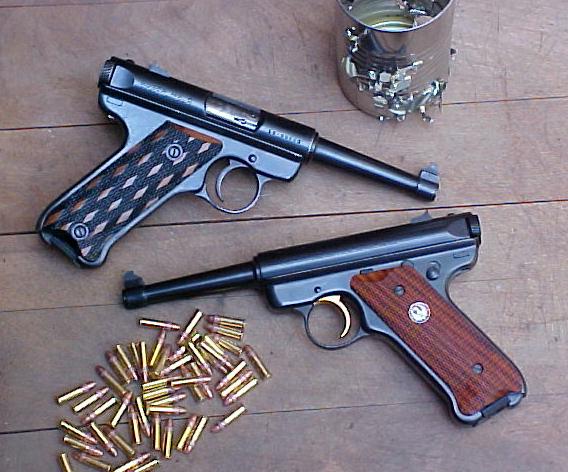
There is a sublime beauty to the .22 semi-auto pistol. It is often thought of as a training gun, and indeed, it is the perfect trainer. If the person is unable to hit what he or she aims at, then the gun in their hand is little more than an expensive noisemaker. If a shooter has not learned safety, it is a dangerous noisemaker. The best option for learning marksmanship is an accurate and reliable .22 pistol. Ammo is cheap, meaning a novice can shoot a lot, and not have it eat a hole in their wallet. The instant feedback one recieves from shooting is much more effective than dry firing. Recoil is minimal with a .22 pistol, meaning a new shooter will not develop bad habits such as flinching. A flinch is a difficult problem to eradicate. It is better to not develop a flinch in the first place.
Even after a person becomes an adept marksman, the .22 pistol retains it's allure. Five holes shot by a .45ACP can be touching and measure an inch across. Five touching holes of .22LR is half that. In short, an accurate .22 pistol is a precision instrument that demands the best in a shooter. If a man can shoot one hole groups with a .22, he can shoot one hole groups with anything!
I was at the range today training a new shooter with a Ruger MKII when the typical air bag wandered up and began his diatribe about the takedown power of a .44 magnum. He asked my student if she would like to shoot a "man's gun". She politely declined, batting her eyelashes, and we sat back on the bench to watch our antagonist pepper his target with a 24 inch group. We then went back to shooting one inch groups with our little gun. He never did get the picture.
If you are new to handguns and want to learn marksmanship, seriously consider a .22 pistol such as a Ruger MKII. In my opinion, the Ruger MKII is the best overall .22 package out there to learn on. A used one will run under $200. Ammo is around 2 cents a round. It will give you lots of practice to build your proficiency quickly. That proficiency will transfer directly to every handgun you shoot. Later you can use the MKII to instruct new shooters with. I prefer the Ruger MKII, but that is because I like to customize my guns. The MKII offers the most options for that. I have a lot of parts, and the aftermarket is only exceeded by the 1911. The Ruger 22/45 is actually a better choice if you are looking for a trainer gun. Reassembly of the Ruger, often touted as akin to neurosurgery, is not that difficult once you learn what to do. It's kind of like a secret handshake, once you learn the trick, it will never confound you again. Both the MKII and 22/45 are durable, and accurate. I would avoid the MKIII types until the bugs are worked out.
Browning also makes a good gun in the Buckmark. The Buckmark is the only alternative .22 auto pistol I would buy in this price range. All the others are not the first line gun of the company. They are "me too" guns, and IMHO not that well done. The Ruger MKI and MKII are great pistols, very durable, and will likely never wear out if cared for. It is neglect that kills these guns, not use. If they are reasonably cared for, they will last generations, training hundreds of new shooters the joys of precision marksmanship.
Xavier is a Registered Nurse who specialized in complex wound care. He has practiced for over fourteen years in his community. He often provided nursing service in areas where law enforcement refused to enter without back-up. Xavier now works in surgery.
Xavier has been an avid shooter for over 30 years. He strongly supports the 2nd Amendment, opposes gun control of any sort, and carries a weapon 24 hours a day.
Xavier is known on various internet gun forums as XavierBreath. He is married with three children, and is moderated by an apathetic one eyed cat, a goofy Golden Retriever, and a stalwart German Shepherd Dog. One day, he hopes to be deserving of them all.
Domari Nolo
Xavier can still be emailed at
treatmewithbenignneglect@gmail.com
He might read your email.
He might delete it on sight.
He might publish it and comment on it.
The Five Rules of Concealed Carry
1. Your concealed handgun is for protection of life only.
2. Know exactly when you can use your gun.
3. If you can run away -- RUN!
4. Display your gun, be prepared to go to jail.
5. Don't let your emotions get the best of you.
 I suggest you give David's blog, The Thinking Gunfighter a read. Quick, smooth tactical reloads are impressive, especially when performed running and gunning. But are they a viable lifesaving skill in a