Morning Coffee

posted by Xavier at 6:09 AM
10 comments

A Nurse with a Gun
 I would not turn down this Colt Commander if it were offered to me at a fair price. However, it would not last 24 hours without a few modifications.
 Labels: 1911's
posted by Xavier at 10:16 PM
9 comments
 The Hogue wrap around "Good Year" grip stopped my Pavlovian response though. I hate those things.
  The thumb safety did not ping when the hammer was pulled back. The feed ramp had not been touched. The bore was like new. The barrel fit well, as did the slide. The magazine was a no name stainless steel mag, but it looked decent enough.
  I used a pair of vise grips and a screwdriver to free the trapped bushings from the fat rubber grip, and then I set them back into the receiver with red LocTite.
  I had passed them by at $400. Now, it is a fortunate man who finds one for that price, in almost any condition. I stuffed the Colt M1991A1 and some ammo in my range bag for a trip to the range.
 Labels: 1911's, Colt, Gun Tradin'
posted by Xavier at 8:54 PM
14 comments
 Paraordnance has long been an innovator in the 1911 world. They were the first company to mass produce a double stack 1911, and they still have a viable double action only 1911 with the LDA series of guns.
  The "upgraded" Armscor guns are just as ugly too.
  There will be some who purchase this pistol thinking they are getting a GI styled gun. They are ignorant. There will be gun writers gushing over the latest ordnance from
  GI Expert from our neighbors from the North, this is what a real deal GI 1911 looks like. Take a good look, a close look.
 Labels: 1911's, Paraordnance
posted by Xavier at 10:02 AM
25 comments
 All the work I performed on it was done to enhance the shootability, reliability and durability of an already accurate firearm.
  The barrel bushing is a thin unit, and through the rigors of prolong use, the lug on the recoil plug has been known to shear off. When that occurs, the plug and recoil spring are launched down range, and the gun becomes an amusing club. I wasn't going to have that on a carry gun.
  For $22.50, the EGW Melt bushing is another hefty piece of steel. It is designed to extend to the edges of the slide to prevent a seamless blend on the muzzle of the pistol if it is radically dehorned, or "melted." along with the EGW bushing, I ordered the bushing wrench necessary to turn it. The bushing required fitting to both the slide and the barrel, but the specs were so close that I was able to achieve a close tolerance fit with emery cloth and a bit of oil and elbow grease. The bushing extends out past the barrel's crown a bit, effectively protecting it. Between the Clark reverse plug and the EGW bushing, the pistol has all the reliability of a ball peen hammer,
 Labels: 1911's, Carry Guns, Colt, Gunsmithing
posted by Xavier at 10:28 PM
21 comments
 With a polished blue slide and a stainless frame, it is an elegant handgun.
 Now, Hartford has re-introduced the pistol. The good news is it has a fitted beavertail and a swept back Novak style rear sight. It also has the skeletonized hammer and a three hole trigger. The neato *Combat Elite* rollmark is carried over with the blued slide and stainless frame combination.
posted by Xavier at 6:17 AM
3 comments

I put up a target and loaded the pistol. I got into my stance, consciously controlled my breathing, and thought, "Okay. Strong grip. Sights lined up. Front sight focus." I was having a little internal monologue to calm myself. "Shhhh," I told myself. "Breathe. Slow down." I squeezed the trigger...Breda falls in love............ Go read.
Labels: 1911's
posted by Xavier at 10:21 PM
5 comments

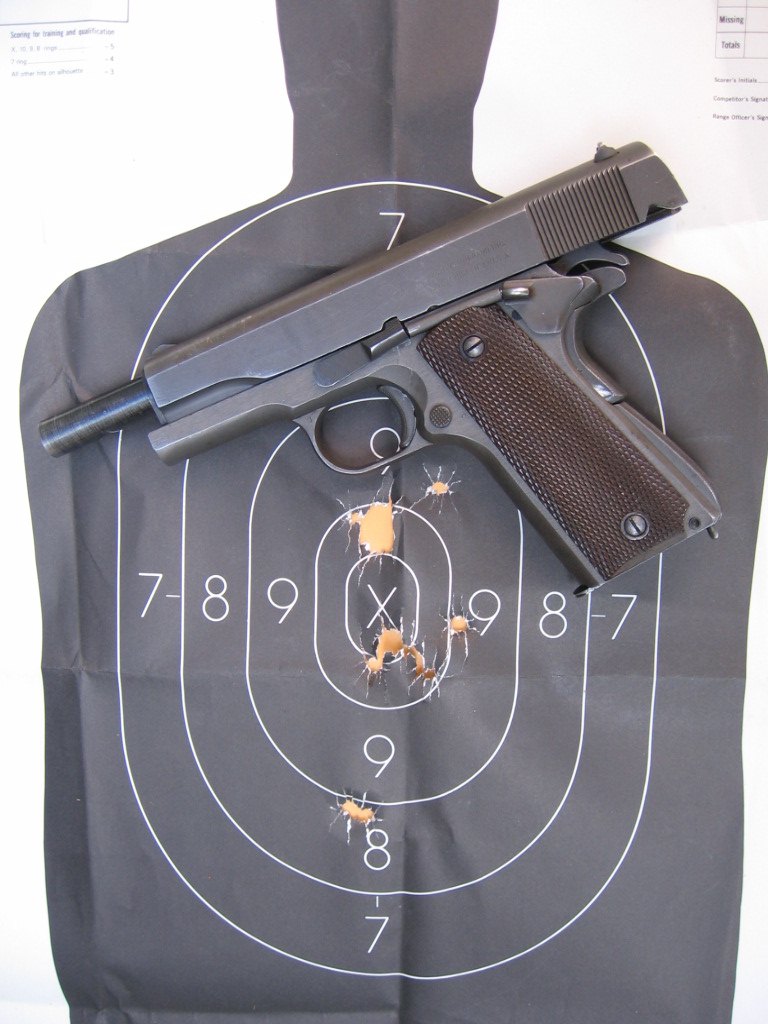
One of these things is not like the others,
One of these things just doesn't belong,
Can you tell which thing is not like the others
By the time I finish my song?
Did you guess which thing was not like the others?
Did you guess which thing just doesn't belong?
If you guessed this one is not like the others,
Then you're absolutely...Right!
Labels: 1911's, Range Journal
posted by Xavier at 6:36 PM
7 comments
"My next purchase would like to be a 1911, What do you recommend as a first 1911?"It's not unusual for my opinion to be requested by people who are considering buying a 1911 for the first time. In many ways, the 1911 is emblematic of the gun world. It has it's aficionados, it's true believers, and it's know-it-alls. There are few experts. I often wonder why people ask my opinion, but it happens often enough that it must seem valuable to some. I want to quantify this blog post by stating I am no expert. I have owned a lot of different 1911 style pistols. I have shot a lot of 1911 style pistols. I carry a 1911. Those are my qualifications. I have not owned or shot them all though, and I'm certain there is much I do not know. This, however, is my opinion and advice, if you think it may be valuable, take it. It's your's. If you think it's opinionated crap because I don't fall to the altar of your particular brand of gun, you are welcome to your own opinion.
 It is a weapons platform. The original patent expired years ago, and almost every major firearms manufacturer has produced at least one 1911 style pistol, often several. Some manufacturers, at any given time, can deck out an entire gun store in multiple variations of the 1911. Gun stores are unable to carry every possible variation, and they need to sell what they have in stock. The guy behind the counter will give you his opinion. He may be a seasoned shooter of the 1911, or he may be a know-it-all true believer of a particular brand. Unless you know him personally from the range, it's difficult to determine if he knows what he is talking about when your own knowledge base is spotty. He may have vested interests, and that's a bad thing when it's your money being spent.
  Saying "I want a 1911" is like saying "I want an automobile." You should invest some time in research, and you have to look within yourself.
  If these are your reasons, then a military styled 1911 is your meat. Look for parkerized Government Models with small fixed sights a lanyard loop and high ejection ports. In order of expense, these include: Rock Island Armory, Springfield, Colt, and genuine GI guns. Each of these manufacturers make a GI styled 1911, and they will float your boat if you want a GI styled 1911. Such a pistol will serve admirably as a carry gun, although the finish must be oiled, the sights are small, and it requires a bit more effort in concealment.
  You will have to buy used, unless you are extremely lucky and find the last bug free Kimber for sale on a dusty gun store shelf in Nowheresville.
 Avoid those like the plague. Finding magazines will be a pain in the neck. Many of the mini 1911s also have proprietary recoil assemblies that wear out quickly and cost money to replace. Reliability goes down as the slide and barrel shorten to less than four inches. Consider lightweight frames in a Commander sized pistol instead. Colt, Kimber and Smith & Wesson are all producing the 1911 in lightweight carry versions. Colt seems to make the most reliable micro 1911s. Springfield versions have less than stellar reports. Consider stainless pistols for corrosion resistance if you plan to carry your 1911. Think fixed sights. You will not have time to dial them in on your attacker, and you don't want them knocked out of adjustment on door frames.
 Many 1911 guys sneer at these pistols, but they can present an attractive means of determining whether you like the weapons platform. I have never owned one of these pistols, but many shooters are quite happy with them. Rock Island Armory seems to make some of the most reliable 1911s in this class. They are available in GI versions as well as updated versions. One issue that I have regarding these pistols is quality control of the castings and long term durability. Products from third world nations invariably have touch and go quality control. It's just the nature of the beast. One year, the quality may be adequate, the next, abysmal. Caveat emptor. Resale value on these guns is low, but then, you don't pay much for them to start with. Upgrading them is possible, but do not expect to recoup the investment if you sell.
  The frames are forged, the fitting is good, and the warranty is second to none. If you want to know my usual recommendation for a person new to 1911s, that's it. The Mil-Spec is durable, accurate enough, and upgradeable if you have the inclination.
  In this range you will find beavertail grip safeties, dovetailed sights, a wide choice of sights, a variety of finishes, different calibers and more. Many of the small parts, and even barrels, are out sourced to aftermarket suppliers. The question is which ones. You will have to decide whether you can live with forward slide serrations, firing pin safeties, bushingless systems, full length guide rods and skeletonized hammers. Make peace with MIM or resolve to slowly purge it from your pistol piece by piece.
  What the buyer of these guns should expect is superior fit and finish, and extraordinary customer service. In the domain of diminishing returns, the proof of these guns is on the paper. These guns shoot, and they shoot accurately. Most shooters will never harness the potential that these guns possess. Indeed, to demonstrate this accuracy, the guns are benched or locked in a Ransom Rest. Many people love these guns. They worship them, they crave them, they swear by them. They compete with them, and God help the man who disses their gat.
 Of course, if they were going to order such a gun, they would be expected to inform the gunsmith of exactly what they want. That is where buying and shooting one of the other 1911s comes into play. You will not, you can not know what you want and need unless you shoot the gun, and shoot it over a number of months if not years. Still, if you want to spend this kind of scratch on a first 1911, give Nowlin or Clark Custom a call. You might be pleasantly surprised.
  The usual calibers you will find available though are .45 ACP and possibly 9mm and .40 S&W. The 1911 was designed to shoot .45 ACP. It seems to be most reliable with that load. If the price of ammunition is a concern, consider ordering a 9mm 1911. Other than that, in my opinion the first time buyer is best advised to stick with .45 ACP.
 Labels: 1911 Basics, 1911's
posted by Xavier at 4:45 PM
28 comments
posted by Xavier at 2:18 PM
2 comments


Labels: 1911's, M1911's, Springfield
posted by Xavier at 1:22 PM
28 comments
 My response:
The least expensive but still durable option is a Springfield GI45. Swap out the goofy US grips for genuine GI grips (about $15) fit a genuine GI thumb safety, ($10) and Bob's your uncle. If you want to get fancy, swap in a GI mainspring housing to get rid of the ILS. Take a quick look at this pistol. This gets you into the game for $600 or so, including taxes. There are cheaper guns available, but they are cheaper.
Next up is a shooter grade M1911A1. These can be Colts, Ithacas, Remington Rands, or occasionally Union Switch & Signals. Sistemas fit in here too. These are the real deal historical guns. What you want is a pistol with enough finish wear or mixed GI parts to take it out of the collector's realm. These start at $600-800 and go up as high as the seller thinks possible.Know your stuff here. Experts and good info are available at the USGI section of the 1911 Forum. Register and learn. Read up on The Sight M1911A1 for good info.
Next will be the Colt M1911 or M1911A1 repro. These start at $1000. Occasionally you can find one for less, maybe $850-900. People think they are instant collectibles. If they are, all Colts are. Buy one and shoot it. These are fairly close to the real deal. Swap out the trigger on the WWII repro with a genuine GI trigger. The M1911 is fairly close on the small parts.
Finally, there is the M1911A1 itself.Expect to pay $1500 and up for an original Very Good unrefinished condition Remington Rand, Colt, Ithaca or Union Switch & Signal M1911A1. The good thing is it will hold it's value, and indeed become more valuable if you take care of it and just shoot it. If you want a Colt M1911 (not A1) in this condition, think $2000. These pistols are one of the best investments in the gun world, if you can afford one. Again, be wary of fakery, and know your stuff. A year or two spent on the USGI forum reading and educating yourself is beneficial. If you get into this area, be aware that just about everyone gets burnt once, some multiple times.
Remember, always buy the gun, not the story. Money spent on books will be recouped when you evaluate a pistol. Use my Pre-Owned 1911 Checkout to check out any prospective purchase. Lastly, have fun in your search.
posted by Xavier at 8:47 AM
10 comments

Honest old Colt 38 Super. Gun was in family 4 generations(Great-Grandpa's pistol).Serial in low 10,000 range. Only 30,000 Supers produced before the WWII. Gun shoots great. The 38 Super was most powerful handgun until .357 Mag came along. All prewar 1911's are highly sought after with 38 Supers being especially prized.Somehow, I find unwanted guns like these to be rather sad. Maybe I should establish an orphanage for old Colts......
Labels: 1911's, Gun Auctions
posted by Xavier at 8:00 PM
8 comments

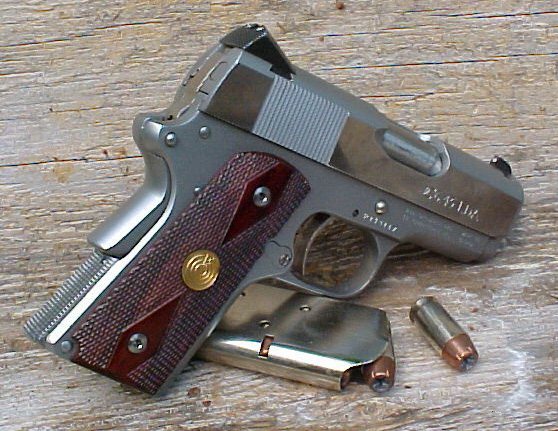 So is a Kimber Rimfire. A hard chromed high capacity hologram sighted multi quadriwhizbang Leatham-Jarrett Special with an ejection port the size of Texas, holes drilled all in it, and a funnel on the bottom? Yeah, that's a 1911 too.
Labels: 1911's
posted by Xavier at 7:49 PM
11 comments
 Strictly a target gun, it was converted to a long slide pistol by cutting and welding two separate slides together. After the addition of a six inch barrel a Bomar sight rib was installed. Underneath the wrap around grips is the barbed wire style stippling that old man Clark was famous for.
 Labels: 1911's, Clark Guns
posted by Xavier at 7:59 AM
0 comments
 This pistol is an Ithaca M1911A1 with a Clark Slide Guide installed. It has a Bomar rear sight with an undercut front sight. The front strap stippling is typical of a Jim Clark Sr. gun, as are the period grips.
 Labels: 1911's, Clark Guns, Gun Auctions
posted by Xavier at 10:04 PM
2 comments
I own an H&K USP .45 ACP and I have been wondering for a long time now... Why do people prefer the 1911 over all other .45 ACP.I own two HK USPs, and quite a few 1911s. I chose to carry the 1911s and relegate the USPs to the safe and range gun status.
 I shoot the USP OK, it fits my hand OK, but even the USP compact carries like a clock radio strapped under your jacket. It seems these pistols were not designed for CCW but many owners try to press them into that role. Fully loaded, they are heavy and they print like a bobcat in your britches. That's been my experience, even using good leather, trying to carry a HK USPc unobtrusively. I'm a 6'1" 250 pound male with years of experience concealing handguns. If I can't keep the thing hidden, it's fair to say there is a problem.
  The entire Colt pistol can be tailored to the shooter, in fact. If done properly, the pistol will remain reliable. If done on some gun hack's kitchen table, the pistol will be turned into an unreliable lump whether Colt or HK. But I digress.......The Colt product carries extremely well. With the right leather, it's about as obtrusive as an iPod. In fact, even with mediocre leather it conceals and carries very well. The only HK pistol that carries as well is the P7 series.Rather than devote myself to learning a weapon that fails to meet my other criteria for an effective defensive pistol, namely the ability to carry it concealed and have it in my hands when I need it, because I could easily carry it, I simply relegated the USP to my pile of pistols that did not make the cut. That doesn't mean it's a bad pistol, it just means I found a pistol that serves me better for my intended use. No offense intended to the guys who prefer the Universelle Selbstladepistole.
Labels: 1911's, CCW, Heckler and Koch
posted by Xavier at 10:33 PM
13 comments

"Howdy. I read your blog on that Clark 1911, and noticed that it had the extended slide stop/release. I've searched THR a few times, and the general consensus is "don't get them." Now, I am well aware that a Clark Custom job would be hard (if not impossible) to match with "drop in" parts, but would you say that such a modification is handy to a 1911, or would you say that, lacking Clark's touch, the extension is more trouble than it is worth? I'm toying with picking up a Colt Series 70 repro this coming summer, and have toyed with putting in a similar part for various reasons, none the least of which is that I currently cannot easily reach the standard slide stop mechanism on a basic 1911."
Eightball


Labels: 1911 Basics, 1911's, Training
posted by Xavier at 4:53 PM
27 comments
 Some were men of honor, others had no scruples about taking advantage of a widow and two toddlers. Such is often the case when a gun owner passes to the 500 yard range in the sky where bulleyes are granted by divine intervention.
  I was likely the first to open the slide and check the chamber. It was empty. I looked the Colt over knowingly, having spent a couple of years researching the cosmetic flaws that sometimes appeared on them. The recoil tunnel was spot on. The rollmarks were precisely done. The finish was immaculate and beautiful.
 Labels: 1911's, Colt, Gun Tradin', M1911's
posted by Xavier at 7:44 PM
24 comments

Xavier is a Registered Nurse who specialized in complex wound care. He has practiced for over fourteen years in his community. He often provided nursing service in areas where law enforcement refused to enter without back-up. Xavier now works in surgery. Xavier has been an avid shooter for over 30 years. He strongly supports the 2nd Amendment, opposes gun control of any sort, and carries a weapon 24 hours a day. Xavier is known on various internet gun forums as XavierBreath. He is married with three children, and is moderated by an apathetic one eyed cat, a goofy Golden Retriever, and a stalwart German Shepherd Dog. One day, he hopes to be deserving of them all.
Domari Nolo
Xavier can still be emailed at
treatmewithbenignneglect@gmail.com
He might read your email.
He might delete it on sight.
He might publish it and comment on it.

The Four Rules
1. All firearms are always loaded
2. Never let the muzzle of a firearm point at anything you are not willing to destroy
3. Keep your finger off the trigger until you are ready to shoot
4. Be sure of your target and what lies beyond it
The Five Rules of Concealed Carry
1. Your concealed handgun is for protection of life only.
2. Know exactly when you can use your gun.
3. If you can run away -- RUN!
4. Display your gun, be prepared to go to jail.
5. Don't let your emotions get the best of you.












© 2009 Xavier Thoughts
All Rights Reserved
ΜΟΛΩΝ ΛΑΒΕ