A Nurse with a Gun

Monday, June 21, 2010

Checking a Used 1911 with a Purchase in Mind

There are many advantages to buying guns used. Not only is the price lower, but the selection is more varied. You can often tell the functional quality of the gun by examining wear patterns on it. It is not uncommon for the seller to allow the buyer to shoot the gun. That is the ultimate test, and no NIB gun seller can match it.

Prelude: Make sure the pistol is unloaded. Lock back the slide and check the chamber. Put a finger on top of the magazine follower and across the chamber. Look again. Make sure the pistol is unloaded. During all of this inspection process, keep the muzzle in a safe direction.
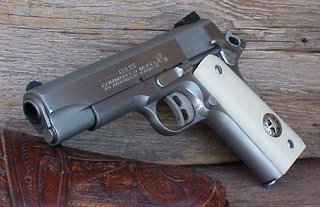
#1 Check Originality.

Know what the pistol should look like. Know what the markings on the frame and slide should be and where they should be located. There are many mix master pistols out there, and some are quite good. Essex is not a secret Colt foundry in Area 51 though. Non-original small parts that can be recified do not necessarily lower the price of a pistol, nor do well installed aftermarket parts that work right if the buyer wants that modification. However, they do show that someone has been monkeying around with the pistol, and other inspections should be carried out more stringently. On a collector's piece, they DO lower the value, and should have replacement cost deducted from the price accordingly. We are talking buying shooting pistols here though, not collector's guns.

#2 Check For Damage

The seller should let you field strip the pistol. If he does not, pass on it. Period. There is no reason to refuse this on a used gun except to conceal damage.

Once inside the gun, bring the frame and slide rails up to eye level and check them for straightness like you would a piece of lumber. A bulge on both sides of an area means this gun has suffered a KaBoom. Likewise, run the barrel between your fingers, checking for bulges. Check the bore. Check the barrel and slide lugs for damage and peening. Check the barrel seat for proper fit and signs of impact. Check the breech face and barrel hood for peening. Check the slide for cracks at the beginning of the recoil plug tunnel. Check the frame for cracks at the beginning of the dustcover and the slide stop hole. Some guns with a hole where the rear of the slide stop enters the frame will be cracked in the frame rail above the hole. This is so common that many newer guns have the rail cut out here. A crack in this area is not a cause for alarm in a shooter, but can be a bargaining chip on the price. It is easily repaired by cutting out the crack. Look for signs of an incompetent person using tools inside the pistol. The finish should show normal wear on the rails, breech face, barrel and slide lugs, and other moving parts. Holster wear is OK. In fact, it is a common sign of a gun that works as advertised. Signs of impact from tools, especially around the right slide stop hole are signs of incompetent monkeys with tools in possession of this pistol. A stripped magazine lock screw is a sign of the same.

#3 Check Functions

The slide should pull back easily, without any change in resistance along the length of it's travel. It should lock back quickly and positively with the magazine inserted. Try this both with and without the magazine checking for smoothness of travel.

A Wilson Combat or genuine Colt magazine should insert and lock positively, and fall free upon release, without resistance. It should not rattle in the gun. You may want to bring your own along for this check, as used guns are often sold with cheapo magazines. If the gun has an extended ejector, the magazine should not touch it when inserted.

Ask if it is OK to release the slide from slide lock. This will not harm a 1911 if not done over and over. If it is OK with the owner, remove the magazine with the pistol at slide lock. Place your left thumb on the slide lock and release the slide. The hammer should not follow the slide. Check this one more time. Then, with the hammer still cocked and your finger off the trigger, try to push it off the sear. If the hammer falls in any of these instances, the gun is not safe to load with live ammo until repaired. If the seller balks at this test, pull a snap cap out of you pocket to perform it with. The test will not be as stringent with a snap cap, but if the gun fails with a snap cap, it will certainly fail without one. If the seller balks at the use of a snap cap for the test, pass on the gun.

The thumb safety should snick on and off without resistance in either direction with the hammer cocked. The hammer should not move when engaging the thumb safety. Once engaged, press on the trigger a couple of times with the grip safety depressed. Then raise the rear of the pistol up to your ear and slowly pull back on the hammer. Listen for a little tink sound. If you hear this sound, the thumb safety is allowing the sear to move on the hammer hooks while engaged. Replacement of the thumb safety or sear will be in order.

The grip safety should not allow the trigger to be moved when not depressed. When depressed, it should offer no resistance to the trigger. Depress the grip safety, pull the trigger back and hold it. Release the grip safety. Then release the trigger. The trigger and grip safety should both pop back out quickly and smoothly.
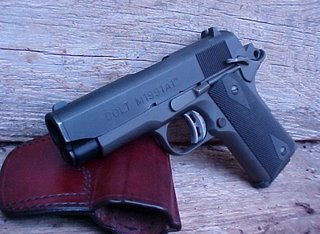
With the hammer cocked and thumb safety off, use your weak hand to hold the slide about 1/8 inch out of battery while pulling the trigger. The hammer should not fall. If it does, the disconnector is worn or monkeyed with, and you may be holding a full auto 1911.

Ask to dry fire the gun. The trigger should release the hammer at a poundage suitable for your likes or greater. Greater poundage than required can be reduced without parts replacement. Making a light trigger heavier often involves new parts. The trigger should be smooth throughout it's travel, and the sear should break cleanly. Once dry fired, lock the slide back and take a look at the breechface. The firing pin should be retracted.

Insert a Bic-Stick type ball point pen into the barrel, plastic end first. Cock and drop the hammer with the barrel pointed straight up. The pen should fly out of the gun at least two feet. Any less is a sign of a weak mainspring, or a sign of firing pin damage.

#4 Check Fittment

On some pistols, such as a Colt, some lateral movement of the slide in battery is acceptable. Unless it is a match grade top of the line gunsmithed pistol, it is expected. The pistol may rattle a bit if shook vigorously from side to side and still be accurate. Other pistols, such as a Les Baer are expected to lock up tighter than Fort Knox.

The rear of the slide should blend smoothly into the frame. Neither the ejector nor the extractor should be above or below the surface. The trigger should not flop around sloppily in it's track. The magazine release should be flush on the right side with a magazine inserted.

Many people evaluate barrel lock-up by pressing on the barrel hood in battery. Movement is considered to be bad. While a firm lock-up is nice, of greater importance is whether the barrel returns to the same location with each slide cycle. The muzzle end of the barrel should not move within the bushing. The slide should not have wear on the muzzle end that passes into the dustcover on recoil.
#5 Evaluating Modifications

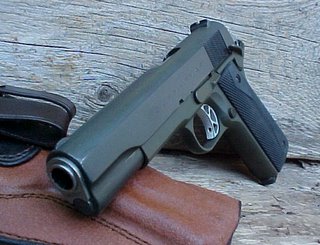
If the pistol has any modifications, they should be well done.Custom Sistema I look at the fit of aftermarket grip safeties, especially the way the lines of the pistol was blended into the line of the grip safety. If the rear of the frame has humps in it where it was blended, the gunsmith did not have an eye for quality. The gap between grip safety and frame should be no greater than the thickness of a piece of paper. The grip safety should not rub on either side of the frame.

If it has an aftermarket bushing, I remove it and check that for fit too. A correctly fit bushing should not require a bushing wrench for removal. It should not require a hammer for installation.

Aftermarket extended thumb safeties should snick on and off without mushiness or resistance. I check the underside of the left side of the slide to see if the thumb safety has been battering it. The apex of the thumb safety should be at least 1mm below the slide at rest.

An aftermarket barrel should have no peening on the hood, or the lugs. The slide of such a gun as well as the frame should be checked as well. A well fitted, quality aftermarket barrel (assuming good rifling) is always a plus for me.

Look at the sights. Quality sights with a professional installation are a big plus for me. Sights that look like Bubba bought them on sale at a gun show and installed them with a rock are not. Adjustable sights that are off center make me wonder why.

A refinished gun is not necessarly an indicator of a worn out gun. Gold Cup National MatchMany pistols are refinished after customization is completed. Some finishes, such as hard chrome enhance the durability of the gun. Others like a home baked Gun Kote job may not last long. One thing to consider is that a refinish (assuming it's not 24 kt. gold) should never add to the cost of the gun, but a bad refinish can subtract from it. A good finish is expected. The same applies to grips. If the price is being jacked up because of them, ask to buy the gun without them, unless they are factory ivory. If you want them, and they are not ivory, they should not add to the price of the gun. Ugly or dinged up grips subtract from the price.
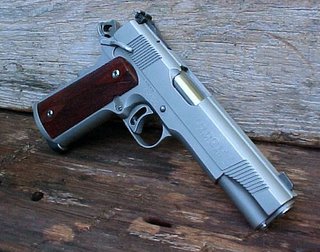
A non-original full length guide rod and an extended slide stop are red flags to me. They tell me the last owner did not understand this pistol very well. Conversely, a pistol that came with a FLGR but now presents with a GI set-up tells me the last owner knew the gun. Known cheapo aftermarket parts (they are easy to spot) tell me the last owner had a ghetto mentality about the gun.

Often I will be told "This gun was done by (insert name of reknowned 'smith")". It pays to be able to recognize quality work, and to know what different people's work often looks like. Suffice to say, a gun that has passed through a reknowned gunsmith's hands should have an appearance and function several degrees above what the factory puts out, regardless of who makes the gun. It should NEVER look worse than a top of the line gun. These men do not put out trash. Many less than stellar gunsmiths do. Which brings us to item #5.
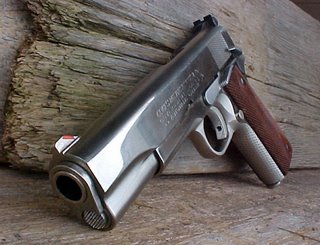
#5b Spotting Incompetent Work

People love to fiddle with a 1911. It's hard not to. It looks so easy. It's not. JE Clark 1911It is easier to screw up a 1911 than to "improve" one.

The first thing that jumps out at me is buggered up grip screws. If a man cannot use a screwdriver, he is not mechanically equipped to open up a 1911. 'nuff said.

Next I look at the feed ramp with the slide locked back. There should be about a 2mm step between the bottom of the barrel and the top of the feed ramp on a Government Model. Incompetent gun hacks love to take a Dremel to the feed ramp of 1911's. If this step is not present, the gun will never feed ammo properly, and it cannot be repaired for less than the cost of a frame replacement.

I look at lowered ejection ports for the straightness of the lines. The scallop behind the ejection port should have smooth edges and be in the right place.

I look at the sights for signs of heavy handed handiwork. Punch marks around the sights and the slide stop hole, as well as stripped mag release screws and pins inserted backwards are red flags.

#6 Shooting the Pistol

One of the advantages of buying used is the ability to test fire the gun without lowering it's value in the marketplace Many sellers will allow you to fire their gun if they percieve you as a serious buyer. It never hurts to ask. 9mm CommanderOffer the owner a "test target" to help him in his sale if you do not buy. Expect to buy the ammo, and no +P ammo. No reloads from your Brother-in-Law Bernie. Only clean factory ammo, and some JHP if it's a defensive weapon. Somewhere between 50 and 100 rounds. Buy the ammo from the seller if he is a dealer. If he will only let you shoot one magazine "out back" make it your preferred JHP and try your darndest to create a jam. Offer to clean the gun when you are done. The combination of a high dollar guaranteed ammo sale, a decent test target, and a clean gun is often to much to resist if the seller trusts you. Heck, invite him along to shoot your prize Python while he waits.

Once at the range, I first load three rounds of JHP and shoot them to see if I get hammer follow or a full auto effect. I do this twice, at different speeds.

Then I load a magazine full of JHP and empty it into a target as fast as I can with a limp wrist. For once, I do not care about groups. I am trying to jam the gun. I note where the empties fly. I pick one or two up and check them for centered primer strikes and dents in the case. Then I load up another magazine with JHP and do the same limp wrist procedure, except this time holding the pistol upside down. I do this often enough that the Range Officer knows I am in a buying mood.

I try to fire the pistol with the thumb safety engaged. I try to fire it with the grip safety released. I allow my thumb to ride the slide to see if I can initiate a malfunction.

If the pistol continues to work as advertised, Combat EliteI load up some target rounds and shoot for accuracy. I am not a bullseye shooter, so I usually shoot from sandbags at 15 yards. As long as the pistol performs better than me, I figure it is accurate enough. I shoot several groups of five rounds, and compare consistency as well as accuracy. I try to eliminate any of my own shortcomings from the equation.
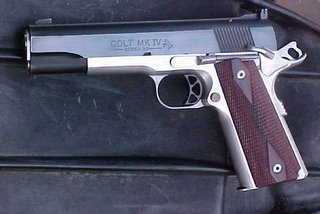
If the pistol has no failures, I clean it, and get to re-examine the interior, but this time with the advantage of fresh soot and cleaning fluid. If the job is done carefully, it can reveal damage that is invisible to the naked eye. Liquified soot will travel right to a crack. A piece of cloth dragged over a part can snag on a burr the finger can not feel.

Finally, let me say that the price of the gun should be agreed on at the counter, before the test fire. You should never use the test fire as a bargaining chip to lower the price. If you do that, the seller will likely never allow you to test fire a gun again, and you might like the next gun even more. The test fire should be seen only as a means to eliminate a potential problem gun before a transfer of ownership. You should only request a test fire if you are prepared to buy right then. If you find a problem that eliminates the gun, explain what you found in good humor. Above all, do not become hostile, but do not waver. If the owner offers a lower price, consider it and take it if you like, but never, never, make him think you are trying to get him to lower the price. At the range, a change in price should always be the seller's option. One more thing, if the seller has gone this far to sell you a gun, he deserves your loyalty. He is an honest seller, the type all gun buyers look for. The ability to buy a gun you have shot first is valuable. It is a valuable consideration when you are haggling at his counter. Don't forget that.

Labels:

Thursday, August 28, 2008

1911 Sizes

I got away from the hospital around noon today After biking home, I realized I had time to go to the range. Click to enlargeI packed up a menagerie of firearms, and then realized that all I had was the 1911 platform. No matter, suits me.

It was hot and humid at the range. Even though Gustav is still near Jamaica and the Cayman Islands, the humidity can already be felt in North Louisiana. That's going to be a bad one, and it looks like it's planning to check Bobby Jindal's resolve. At the hospital, we are already planning to take in evacuees from down South.

I shot OK, but the heat was getting to me. As I was waiting out a target swap, talking to another shooter, I realized that I had the means of demonstrating the different 1911 sizes right before me. I waited around until everyone had left except myself and another shooter I knew. Then I broke out the camera. The 1911 comes in three basic popular versions, the Government, the Commander, and the Officers. If you have ever wondered just what those names mean, but were afraid to ask, here we go.

The Government Model

The Government Model is the original size of the 1911, as mandated by US Army stipulations for the M1911 and in 1924, upgraded to the M1911A1. When the pistol was placed into commercial production, it was simply called the Government Model. It has a five inch barrel, and a full sized grip that carries a single stack seven round magazine, or an eight round magazine of modern design. Click to enlargeThe Government Model is the timeless 1911, the one most people think of when old slabsides is mentioned.

The "Gubmint" is a balanced handgun with an optimal ratio of grip length to slide length. It shoots easily, transmitting a push like recoil to the shooter's hands. The full sized 1911 was meant to be a pistol carried on the hip. It can be concealed rather easily due to it's slim profile. Many find that the longer slide helps keep the butt of the gun tucked into the kidney region, making it disappear underneath a jacket.

Virtually every manufacturer of 1911s makes a Government Model. It is the standard by which other 1911s are judged. It comes in target sighted versions, fixed sighted versions, and almost any permutation a buyer could imagine. Springfield calls their version the "Full Size." Kimber does not have a specific designation, nor do other manufacturers, except Colt, who still uses the term Government Model. The Government Model just is.

The Commander

The Commander was introduced in 1952 by Colt. It has a four and a quarter inch barrel, and a full size grip. The original Colt commanders had an aluminum grip frame. They were chambered in .45 ACP, 9mm, and .38 Super. In 1970, Colt introduced the Combat Commander, which was basically the same pistol, but with a forged steel frame.

Because the Commander has a full sized grip frame, it shares grips, magazines, mainspring housings and grip safeties with the Government Model. Click to enlargeAll parts with the exception of the barrels, slides bushings and recoil springs, plugs and guides swap out between the two. Although on a quick inspection, it appears a Commander slide can be placed on a Government Model frame to convert the gun, the dust cover of the Commander frame is shorter to correspond with the shorter slide. The slide will fit, but the dustcover will be too long. If the reverse swap is done, the recoil spring will be exposed.

The Commander was originally designed to be a lighter pistol of military issue for officers, but the military never proceeded with the idea. Instead, Colt pushed the Commander into commercial production, and one of the finest carry guns ever designed was born. The Commander carries extremely well, with all the favorable aspects of the Government Model, with less weight and more importantly, a shorter slide/barrel combination that makes sitting with the pistol on your hip effortless. Many shooters find the Commander to be quicker out of the holster and on the target.

The Commander has a bit more snap to the recoil than the Government Model, but the recoil is not excessive. Springfield calls their version the Champion, Kimber calls their's the Pro. Kimber's version is an even four inches.

The Officer's Model

The most diminutive of the 1911 pistols is frequently called the Officer's ACP or "Officer's Model." The original Officer's ACP was introduced in 1967 with a three and a half inch barrel, and an attenuated grip frame housing a six round magazine. Click to enlargeSubsequent versions would have the barrel length trimmed even more, to three inches total.

Because the grip frame is of a different length, the Officer's Model uses it's own magazine and grips. It has it's own mainspring housing. The grip safety thumb safety and fire control parts are the same as that of other 1911s, however. Many of the three inch 1911s have proprietary parts that do not swap over to other pistols, even those 1911s of similar size. To achieve a functional pistol of this size, each manufacturer had to incorporate their own tricks, and the parts interchangeability reflects that. Also, as the barrel length falls below the Commander's length, the timing of the recoil cycle is altered and the reliability becomes more hit and miss. Some versions will be reliable, others will not.

Springfield calls their little 1911 a Micro or an Ultra, while Kimber designates it the Ultra. Colt's version is the Officer's ACP, the Compact or the Series 90. Each manufacturer has had varying degrees of success with the mini 1911s, but it seems as though Colt has discovered the right formula in the Series 90. The smallest 1911s are concealed carry guns meant for dep concealment. They have a recoil impulse that can be too stiff for some shooters. Many have lightweight frames to enhance carry, and this, too, increases perceived recoil. They are not pistols to acquaint a new shooter with the 1911 or the .45 ACP.

Summation

There are other combinations and lengths of the 1911, although they are not as pervasive. Click to enlargeOf note is the six inch "Long Slide," and the Colt CCO, a combination of a Colt Commander slide on an Officer's frame. The three size combinations here are the most common though. Each decrease in barrel length shares common characteristics, benefits and detriments.

If a person new to the 1911 were asking which pistol to buy, my first advice would be a Government Model. If they were planning on carrying the pistol concealed, I would suggest a Commander, with the caveat that they should learn the 1911 platform well first. Only when they are familiar with the pistol, and only if they need a gun that can be deeply concealed would I suggest the smaller pistols.

Labels: ,

Sunday, July 27, 2008

Choosing Your First 1911

"My next purchase would like to be a 1911, What do you recommend as a first 1911?"
It's not unusual for my opinion to be requested by people who are considering buying a 1911 for the first time. In many ways, the 1911 is emblematic of the gun world. It has it's aficionados, it's true believers, and it's know-it-alls. There are few experts. I often wonder why people ask my opinion, but it happens often enough that it must seem valuable to some. I want to quantify this blog post by stating I am no expert. I have owned a lot of different 1911 style pistols. I have shot a lot of 1911 style pistols. I carry a 1911. Those are my qualifications. I have not owned or shot them all though, and I'm certain there is much I do not know. This, however, is my opinion and advice, if you think it may be valuable, take it. It's your's. If you think it's opinionated crap because I don't fall to the altar of your particular brand of gun, you are welcome to your own opinion.

I do not mean to disparage anyone's pistol of choice here, only relate my experiences. This is not a blog post about what a 1911 is and is not. If you want to read my opinions concerning that, go here. In this blog post, "1911" and "1911 style pistol" are synonymous.

The problem with choosing a first 1911 is there are so damned many of them. The 1911 is not just a pistol. Kimber Aegis 9mmIt is a weapons platform. The original patent expired years ago, and almost every major firearms manufacturer has produced at least one 1911 style pistol, often several. Some manufacturers, at any given time, can deck out an entire gun store in multiple variations of the 1911. Gun stores are unable to carry every possible variation, and they need to sell what they have in stock. The guy behind the counter will give you his opinion. He may be a seasoned shooter of the 1911, or he may be a know-it-all true believer of a particular brand. Unless you know him personally from the range, it's difficult to determine if he knows what he is talking about when your own knowledge base is spotty. He may have vested interests, and that's a bad thing when it's your money being spent.

Realize too, that your first 1911 may not be your last 1911. Some people feel like they got burned when the 1911 they chose did not live up to their expectations. The truth is, they just chose poorly. This blog post is about how to make the right choices for that first 1911, and how to continue to make subsequent wise choices on the next ones.

Explore the Possibilities

When one considers the myriad variations of the 1911, including custom guns, the problem of selecting only one quickly becomes apparent. There are too many possibilities to check them all out. The mind quickly becomes overwhelmed. Not having shot the pistol, it's difficult to know what you want. It's even harder to know what you need. But, to buy wisely, a person needs to know what they want, and have an idea of what they need. Saying "I want a 1911" is like saying "I want an automobile." You should invest some time in research, and you have to look within yourself.

Like an automobile, the 1911 is often called an expression of a shooter's personae, and it's easy to get caught up in the expression of one's self when a person does not yet know their specific wants and needs. The difference is, with a mature 1911 shooter, the 1911 arrives at that expression honestly, over time. The trick is to get ahead of the "I just want a 1911" idea. Get some hands on research done. Try some 1911 style pistols out. If you have a rental range near by, go there and rent several 1911s to shoot. Try different sizes, calibers and examples from different manufacturers. Ask your shooting buddies if you can shoot their 1911s. Ask their opinions. If you are unable to shoot a few 1911s before buying, at least know what you do not want. Go to a gun show. Handle as many variations as possible. See what feels good, and what comes to sights readily for you.

Know your Purpose

The first problem of choosing a 1911 is narrowing down the field of bewildering candidates. It's a process of elimination. The 1911 performs many shooting tasks extremely well, but it is often modified from it's basic format to perform some tasks better than others. Knowing your reasons for wanting a 1911 as well as your intended purpose for it's use can narrow the field of candidates quickly.

Do you want the 1911 to have one in your collection? Yes, that's a valid reason. Do you admire the tradition and the history? Another valid reason. Click to enlargeIf these are your reasons, then a military styled 1911 is your meat. Look for parkerized Government Models with small fixed sights a lanyard loop and high ejection ports. In order of expense, these include: Rock Island Armory, Springfield, Colt, and genuine GI guns. Each of these manufacturers make a GI styled 1911, and they will float your boat if you want a GI styled 1911. Such a pistol will serve admirably as a carry gun, although the finish must be oiled, the sights are small, and it requires a bit more effort in concealment.

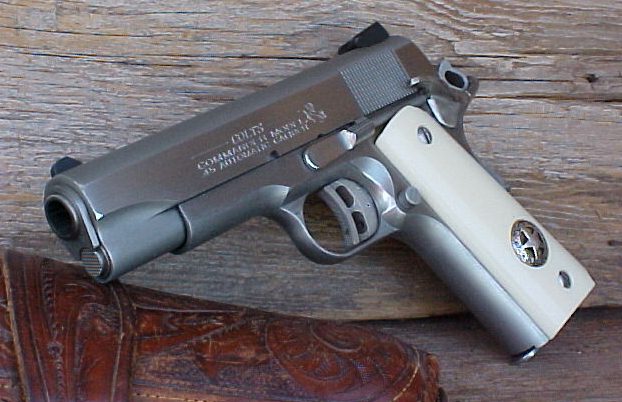
Do you want a general purpose gun? Are you someone who just can't leave the tools in the tool box when you buy a gun? Do Brownell's and Midway regularly send you flyers? Are you looking for a gun to "grow with?" Look towards the Springfield Mil-Spec and the Colt 1991. These are pistols that are frequently purchased and later upgraded. If you already know you want a beavertail grip safety and swept back sights, consider a Smith & Wesson 1911 and a Kimber Custom as well. Not the Custom II, the Kimber Custom. Just Custom, no Roman numeral II. No external extractor, and no Swartz firing pin safety. Combat Elite and Gold Cup, Click to enlargeYou will have to buy used, unless you are extremely lucky and find the last bug free Kimber for sale on a dusty gun store shelf in Nowheresville.

Do you want a range gun? Is this gun one that will travel in a box to the range and shoot targets at a wide variety of distances? Then consider a 1911 with adjustable sights. In my opinion, this is the only reason to have adjustable sights on a 1911. You might consider a long slide gun for the greater sight radius and reduced recoil, and you may also want to consider a beavertail grip safety for ease of shooting for extended periods.

Will this gun be a carry gun? The Government Model is a pistol that carries very nicely in the right leather. If you are planning to pack your 1911 though, consider the smaller versions. The Commander has a shorter slide, but the same length grip frame, allowing you to use standard magazines. The Officer's Model has both a shorter slide and a shorter grip frame, and must use a shorter magazine. Avoid any pistol outside of these parameters. Occasionally a manufacturer will produce a version of the 1911 with an odd grip frame length that demands proprietary magazines. Click to enlargeAvoid those like the plague. Finding magazines will be a pain in the neck. Many of the mini 1911s also have proprietary recoil assemblies that wear out quickly and cost money to replace. Reliability goes down as the slide and barrel shorten to less than four inches. Consider lightweight frames in a Commander sized pistol instead. Colt, Kimber and Smith & Wesson are all producing the 1911 in lightweight carry versions. Colt seems to make the most reliable micro 1911s. Springfield versions have less than stellar reports. Consider stainless pistols for corrosion resistance if you plan to carry your 1911. Think fixed sights. You will not have time to dial them in on your attacker, and you don't want them knocked out of adjustment on door frames.

One thought to consider is the 1911 is a weapons platform requiring specific training. In my opinion, your first 1911 should not be chosen for the purpose of being a carry gun. You should learn the weapons platform first, under experienced instruction, and then make the decision whether you want to carry it on your hip. If your first 1911 becomes your carry gun over time, great. Just don't choose a lightweight three inch 1911 and then complain because the recoil is to strong for you.

Will this be a gun to compete with? You need more specific instruction than I can provide here. Knowing the rules, regulations and needs of your form of competition is paramount. I advise you to consult with shooters who are already using the 1911 in your choice of competition. I will say this. Shoot the guns of other competitors. Do your research, and consider true bespoke custom guns. They are money well spent if the gunsmith is widely recognized. There are off the rack "semi-customs" from the likes of Wilson Combat, Les Baer, and Ed Brown among others, and then there are true bespoke custom guns from the likes of Clark Custom, Nowlin and other notable gunsmiths. Remember, repeatable accuracy costs money, and spending your money in the right place to start with is wiser than taking your pistol back and forth to Joe the neighborhood gun hack time and again.

Set Your Budget

The 1911 is an expensive pistol. The frame and slide can not be popped out of a mold like polymer guns and quickly assembled into a functional firearm. There seems to be several dividing lines in the price ranges of 1911 pistols. Sticking with your budget is important. Extending it a bit to get what you want may be more important. If you must wait an extra pay day or two before you can purchase the right gun, then do so. The right gun in a month costs less than the wrong gun now. The sting of a high price tag hurts less than the ache of a poor choice due to financial expediency.

Below $500 you will find pistols that have cast frames and slides, often manufactured in the Philippines. Many 1911 guys sneer at these pistols, but they can present an attractive means of determining whether you like the weapons platform. I have never owned one of these pistols, but many shooters are quite happy with them. Rock Island Armory seems to make some of the most reliable 1911s in this class. They are available in GI versions as well as updated versions. One issue that I have regarding these pistols is quality control of the castings and long term durability. Products from third world nations invariably have touch and go quality control. It's just the nature of the beast. One year, the quality may be adequate, the next, abysmal. Caveat emptor. Resale value on these guns is low, but then, you don't pay much for them to start with. Upgrading them is possible, but do not expect to recoup the investment if you sell.

In the $500-$700 range, Springfield is the prime supplier. Their offerings include the GI45 for the traditionalists, and the Mil-Spec for those who want updating. For a general purpose 1911 in this price range, it's hard to beat a Springfield Mil-Spec. Click to enlargeThe frames are forged, the fitting is good, and the warranty is second to none. If you want to know my usual recommendation for a person new to 1911s, that's it. The Mil-Spec is durable, accurate enough, and upgradeable if you have the inclination.

Other manufacturers sometimes offer upgraded 1911s in this entry range. Remember though, if they have an offering here, they cut costs somewhere. The frames may be cast, the small parts may be made of poorly formed MIM, the barrels may be cheap, the labor may have been outsourced overseas, or any combination of those concerns. The manufacturer struggled to reach this price point. Figure out how, and decide whether you can live with it. The Taurus PT1911 can often be found in this price range. I have not shot one beyond a couple of range try outs, but they seem to be well made, and they get good reviews. Among the Philippine cast frame 1911s in this range are the Charles Daley Field 1911 at $649, and the STI Spartan listed at $660. I have no experience with either of these pistols. 1911s from the higher price brackets will occasionally fall into this range used. If you are interested in a used 1911, go here to learn how to check one out.

Many 1911 shooters advise a $700-$1100 budget to get started. This is because the choices really open up in this range, plus you have the lower price ranges to consider as well. You have a wide choice of materials and sizes. Most of the frames and slides will be forged. Click to enlargeIn this range you will find beavertail grip safeties, dovetailed sights, a wide choice of sights, a variety of finishes, different calibers and more. Many of the small parts, and even barrels, are out sourced to aftermarket suppliers. The question is which ones. You will have to decide whether you can live with forward slide serrations, firing pin safeties, bushingless systems, full length guide rods and skeletonized hammers. Make peace with MIM or resolve to slowly purge it from your pistol piece by piece.

In this price range, as long as you stick with a major manufacturer and purchase a gun suited to your purpose, you should be satisfied. Those players are Colt, Springfield, Smith & Wesson, and STI. Kimber used to have my recommendation until they began the Series II guns. The Kimber Custom and all the Series 1 guns raised the 1911 bar and forced Colt off it's laurels. The Series II Kimbers suffer from a poor reliability history. Sig Sauer made some of the ugliest 1911s ever and deposited them in this price range. Those are not known for reliability either. Paraordnance...... What can you say about Para? Cast slides from Canada and mutant double stacked double action pistols that revolutionized competition.

When a 1911 buyer has a budget above $1100, the choices really expand. This is the world of the production "semi-custom" gun, and the domain of diminishing returns. Wilson Combat established this arena, followed by Les Baer and Ed Brown. What the buyer of these guns should expect is superior fit and finish, and extraordinary customer service. In the domain of diminishing returns, the proof of these guns is on the paper. These guns shoot, and they shoot accurately. Most shooters will never harness the potential that these guns possess. Indeed, to demonstrate this accuracy, the guns are benched or locked in a Ransom Rest. Many people love these guns. They worship them, they crave them, they swear by them. They compete with them, and God help the man who disses their gat.

If you, as a person new to 1911s are considering one of these pistols, you probably did not do your research very well. You likely have heard horror stories of unreliable 1911s and you hope to avoid that with a bit more cash. Guess what? These guns fail too. They are not magic talismans against the nefarious 1911 gremlin. They just cost more money, look a bit prettier, and give you empty bragging rights at the range. The real measure of a 1911 is no failures with repeatable holes in the X ring. Other 1911 pistols can do that too, if the shooter can.

What many shooters fail to realize is that for the price of some of these off the shelf "semi-custom" production guns, they could purchase a true bespoke custom. Click to enlargeOf course, if they were going to order such a gun, they would be expected to inform the gunsmith of exactly what they want. That is where buying and shooting one of the other 1911s comes into play. You will not, you can not know what you want and need unless you shoot the gun, and shoot it over a number of months if not years. Still, if you want to spend this kind of scratch on a first 1911, give Nowlin or Clark Custom a call. You might be pleasantly surprised.

Another note.....genuine GI guns, Colts, Ithacas, Remington Rands, Union Switch & Signals, Singers and Springfields (the other Springfield) also fall into this price range. These are shootable investments if you ask me. Like any investment though, you had better know what you are doing, or you will lose your ass. These historical firearms are not reasonable choices as a first 1911 for a person who plans to shoot the gun.

Choose a Caliber

Once you have set your intended use and your budget, consider caliber. 1911s come in many calibers. .22 Long rifle; .38 Super; 9mm; .40 S&W; 10mm. .45 ACP (who woulda thunk it?) 460 Rowland, and even 50 caliber. The usual calibers you will find available though are .45 ACP and possibly 9mm and .40 S&W. The 1911 was designed to shoot .45 ACP. It seems to be most reliable with that load. If the price of ammunition is a concern, consider ordering a 9mm 1911. Other than that, in my opinion the first time buyer is best advised to stick with .45 ACP.

Those .22 conversion kits? Buy a used Ruger MKII or 22/45 instead. The target practice will transfer over and the Ruger will be more reliable. If you are thinking a 22 conversion kit would allow you to train with your carry gun for less, that is true. But you are training without the recoil. You may as well dry fire in the comfort of your home.

Many people find that the recoil of a .45 is surprisingly manageable compared to other calibers. In a full sized gun, it gives more of a push than a snap and torque. In a heavy pistol such as a Government Model, most people do not find it to be unpleasant, especially if they are trained to grasp the weapon with the web of their hand as high beneath the grip safety as possible. This effectively lowers the bore axis of the pistol to be in line with the wrist, making for a easily controlled recoil impulse. More important than the caliber (at least between 9mm and 45 ACP) is the size of the pistol. The Government Model pushes the shooter's hand in recoil. The Commander has a bit more snap. The Officer's Model has both snap and torque. Strangely, I found lightweight frames to not be much of a factor regarding recoil. For me, when it came to managing recoil, it was the length of the barrel and slide that mattered, not the weight of the frame.

Roll Your Own

I don't advise this for a new 1911 shooter. Period.

What to do when you get your 1911

Lock up the Dremel. Buy ammo. Use up. Repeat. Buy a holster. Invest in experienced instruction. Resist the temptation to purchase anything, anything for your pistol from Brownell's Midway or anyone else. Buy more ammo. Use up. Repeat. Field strip your weapon and learn to clean and lubricate it properly. Then learn to detail strip it. Put it back together and buy ammo. Use up. Repeat. Let the gun you have teach you about the gun you want, and the gun you need. Finally, after shooting the pistol for three to six months, allow yourself to purchase a new pair of grips if you like. Buy a couple of extra magazines. Fill them with ammo. Use up. Repeat. If the gun doesn't point for you like you think it should, try a different mainspring housing. If you want to change the sights, and you have a dovetailed slide and the mechanical aptitude, swap them out. Let the pistol become your own depending on your needs and desires. Or don't. It might be the perfect pistol from the beginning. I doubt it though.

Related Posts


What is a 1911?
The Best 1911 for You
1911 Sizes
Buying a Used 1911
Chris Byrne's Primer on Buying a 1911
The "First Handgun" question by Chris Byrne
The 1911 Forum

Labels: ,

Friday, July 18, 2008

Full Length Guide Rods

"I just bought a new 1911, and my friend told me I should put a full length guide rod in it. Nobody can tell me why."
Nobody can tell you why because there is not a good reason to do so.

Some shooters who advocate full length guide rods cite recoil spring binding as a reason, as well as the increased weight at the muzzle that a FLGR provides. Those against the FLGR list increased difficulty of field stripping and fewer options for clearing malfunctions as reasons to avoid them. Those that like them find a reason for them. Those who despise them find reasons as well.

On both my Gold Cup and Combat Elite I run a solid full length guide rod. I think they were made by Ed Brown or maybe EGW. One of my SW1911s has a FLGR as well. The common thread between these three 1911s is they all have adjustable sights. They are range guns.

I have not noticed any difference in cycling, in accuracy, in reliability, or the weather when I shoot these pistols. They are all more accurate than me, and stone reliable. Women still find me charming, my dog still loves me, and the milk in the refrigerator has not gone sour. However, the air conditioner in my house went kaput for two Summers in a row, and the air conditioner in my Grand Cherokee had to be repaired as well.

I run a GI set up in all my other 1911s, except the Kimber Pro Carry which is bushingless, and the Colt New Agent and Colt Compact. The GI set-up guns run reliably and accurately.

I've found that I need a bushing wrench (I use a Kings wrench) to strip the FLGR guns. The edge of the recoil plug hole is just too narrow to comfortably press it back to turn the bushing for me.

Some folks have asked me why, if I do not advocate FLGRs, do I run them in my three target 1911s. The answer is quite simple. The pistols came to me that way, and I see no reason to change the FLGR out.

Out of curiosity, on each pistol with a FLGR, I swapped in a GI set-up from another gun. I saw no difference in the pistol's performance, or in my own. I saw no reason to order a GI set-up for the FLGR guns, or a FLGR for the GI set-up guns. The FLGRs went back into the target guns. Perhaps I'm just not shooting at the level that a FLGR makes a difference, but that was what I found.

If you want a full length guide rod, Nighthawk Custom makes a good one for a 1911. They are $36.95. Ed Brown makes GI style recoil guides and plugs are a fair price. $23-$24 for the swap. Buy what you like and install it. Or, you could just spend your money on ammunition.

Matt's Thoughts

Chris Byrne's Thoughts

Labels:

Monday, May 12, 2008

Danny Dremel's Masterpiece

Chuck Rogers of Rogers Precision has supplied a series of photos of 1911 hacking by Danny Dremel, the kitchen table gunsmith. Chuck has graciously given permission to disseminate the photos with one caveat..... This is not the work of Rogers Precision.

Ladies and gentlemen, for your viewing pleasure horror, this what you want to avoid in a used 1911 style pistol.


This first photo demonstrates what you are likely to see when you open the chamber of Danny Dremel's 1911 at the local gun show. The frame ramp is very purty, with a mirror finish. The problem is the curvature of the upper aspect of the frame ramp, known as the bridge. The feedramp must have an angle of 31-31.5 degrees, with a minimum .360" vertical ramp height with no blending at the bridge.

These measurements are coming from Chuck himself, an accomplished, nationally recognized 1911 gunsmith, who has the enduring respect of his peers and all in the gunsmithing community. Chances are, Danny Dremel had a grinding wheel and a felt bob on a rotary tool and a dimly lit bulb above his head.
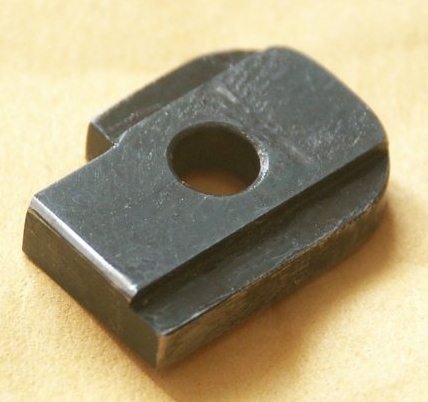
The frame that Danny experimented on is ruined. Repair of this frame would require welding up and recutting the feedramp. Alternatives include inletting the frame for a ramped barrel, or replacement of the frame altogether. Purchasing such a disaster at a gun show will guarantee that you own a semi-auto pistol that will not feed any type of ammunition attempted. The costs of repairing such a 1911 are so prohibitive that such a pistol must be avoided from the outset. This is why any used 1911 should have this area checked prior to purchase. Danny Dremel's first cousin once removed, Buffin' Bubba is known to do similar work when his blood alcohol content exceeds an RC cola with peanuts stuffed inside.

In the photo to the left, Danny's forays into metal removal is even more evident. Danny has effectively turned a 1911 into a time bomb. He has removed so much metal from the barrel's feed ramp that case head separation of the cartridge in the chamber is inevitable. Of course, Danny had to do this, so the barrel's feed ramp will blend nicely into the frame's feed ramp. What Danny and Bubba do not understand is that the barrel's feedramp is not a feedramp. It is a clearance. Polishing this area will not enhance feeding. Removal of metal will remove case head support. The result is case head separation on cartridge ignition. If the shooter is lucky, he will not be injured.

If you are ever offered a pistol with work ressembling this hack job, pass on it. Tell your friends to pass on it. There are just too many good used guns available not to.

What to look for instead......

Labels: ,

Thursday, April 10, 2008

The 1911 Extended Slide Stop

Click to enlarge
"Howdy. I read your blog on that Clark 1911, and noticed that it had the extended slide stop/release. I've searched THR a few times, and the general consensus is "don't get them." Now, I am well aware that a Clark Custom job would be hard (if not impossible) to match with "drop in" parts, but would you say that such a modification is handy to a 1911, or would you say that, lacking Clark's touch, the extension is more trouble than it is worth? I'm toying with picking up a Colt Series 70 repro this coming summer, and have toyed with putting in a similar part for various reasons, none the least of which is that I currently cannot easily reach the standard slide stop mechanism on a basic 1911."

Eightball

I despise extended slide stops on 1911s. The extra weight of an extended slide stop frequently counter balances the upward push of the magazine spring, especially a weak one, preventing the magazine follower from raising the slide stop into the notch on the slide to lock the slide open after the last shot is fired. As a result, the slide fails to lock back. I do not like that at all. It impairs quick reloads.

The only......only reason my Clark gun has an extended slide stop is because old man Clark put it there himself, fitting it with his own hands. I just feel it would be wrong of me to replace it on that pistol. Even J.E. Clark's extended slide stop can fail to lock the slide open on the last round, especially if the magazine is dirty, or the mag spring is weak.


The way I manage the standard 1911 slide stop is a pretty common technique. You never shift your right hand's grip during a reload. Use the right hand's thumb to drop the magazine while reaching for the spare mag with the left hand. The pistol is recovering from the recoil of the last shot. The empty magazine should fall free under it's own weight. The pistol's sights stay roughly on target, the pistol vertical.


Insert the spare magazine into the pistol with your index finger along the front to guide it.


Use your palm to smack it home, keeping your fingers outstretched to prevent them from getting pinched between the magazine and grip frame.


Now here's the trick. Watch closely.......Your left thumb depresses the slide stop and releases the slide as the left hand resumes it's grip on top of the right. The slide strips the first round off the full magazine, chambering it.


As the slide closes, the left hand curls around the right, the left thumb drops off the slide release, and the right thumb resumes it's position on top of the thumb safety. Notice that the pistol never changed position in the web of the strong right hand. The pistol's sights never left the general direction of the target.

I have yet to see an extended slide stop work as well as a standard version used correctly. Even on Jim Clark's gun. As far as I'm concerned, they are a crutch to compensate for a non-existent problem.

Best regards,
Xavier

Labels: , ,

Monday, March 03, 2008

The 1911 Gap

Because of the ready supply of aftermarket parts, many people teach themselves a bit of gunsmithing on the kitchen table after the purchase of their first 1911. This is not a bad thing really, it only becomes a problem when they do not understand concepts such as............If you are about to grind on the feedramp of a 1911 with a Dremel to make it feed better, you are about to turn a 1911 frame into a trotline weight. Unfortunately Danny Dremel will often try to pass off his mistake to an unsuspecting buyer lured by price.

When considering a used 1911 with a non-ramped barrel, expect there to be a small (about 2mm) gap between the frame's feedramp and the barrel's feedramp when the slide is locked back. This is normal. It's supposed to be there. If it is not there, the pistol will never feed correctly, and the only solution is to weld-up and recut the frame, cut out the frame and install a ramped barrel, or replace the frame. None of these options are fiscally attractive.

Always check for this gap. If it is not present, pass on the gun. You will save yourself a lot of anguish.

Here is what you want to avoid.

Labels: ,

Tuesday, February 26, 2008

The King's Bushing Wrench

It's not uncommon for even a skilled 1911 mechanic to have an embarrassing airborne moment when field stripping their version of Browning's masterpiece.........assuming, of course, the recoil control components are as John Moses intended.

One of the tools that can prevent you from looking all over your gun room for wayward projectiles is the King's bushing wrench. Made by King's Gun Works, this steel wrench is no ordinary bushing wrench. If you are tired searching for flying recoil plugs, or of plastic tools wearing down and slipping, this chunk of parkerized American steel is the tool for you. It used to be available from Brownell's, but alas, it has been discontinued. It has a protrusion on the side to keep the recoil plug under control. For what it's worth, genuine GI recoil plugs have a notch to catch the recoil spring on, preventing the search and rescue missions common with 1911 field stripping.

The King's bushing wrench is a superb tool for those with lesser recoil plugs though. I have yet to find a 1911 bushing to tight for it to turn. I have yet to have a recoil plug launch while using it. I have yet to have it mar a gun's finish. I do not know if King's still makes this tool, but if they don't, they should. Somebody should! If you see one for sale at a gun show or on ebay, grab it. It's a purchase you will not regret.

Update:
King's Gun Works does indeed still make this tool. It's right there in the King's catalog, page six. Bushing wrench item # 403A, King's Deluxe Gunsmith Bushing Wrench. $14.95. Order yourself some extra stuff while you are at it and save on shipping. King's is a top drawer outfit.
Kings Gun Works Inc.
1837 W. Glenoaks Blvd.,
Glendale, CA., 91201
Phone: 818-956-6010
Orders: 800-282-9449

Labels: ,

Saturday, February 02, 2008

1911 Primer

For those who want to taste the heady wine of american handgun perfection, Chris Byrne scores a bullseye with a basic primer for the 1911. Give it a read, and then take a look here too.

Labels:

Monday, November 12, 2007

Those Mil-Spec Springfield 1911s

My first 1911 was a Springfield Armory pistol. Click to enlargeBack then, I had not yet experienced the allure of the Colt product, but I wrote about the Springfield Mil-Spec as a review online somewhere. Fortunately, I still have that review in my files, as well as a subsequent review on the pistol that would become the Springfield GI45.

I still heartily recommend the Springfield 1911 to people who want to explore the 1911 and all it's potential. the Springfield has a forged frame and slide. Less expensive 1911s lack this quality. I believe forgings to be important on an old design that fires a substantial cartridge if the firearm is to remain durable in the long term.

I still own these Springfield pistols, and they still shoot beautifully. I would not hesitate to purchase another one at the right price. I paid $499 for my NIB Mil-Spec years ago, and $400 for my GI version. Not surprisingly, the prices have since gone up. Last week I saw a new Mil-Spec in a gun store priced at $663. They had a GI45 for $499. I present the rather dated reviews, with current photos, here for your enjoyment.


The Springfield Mil-Spec

Click to enlarge
I became interested in handguns during the height of the Wondernine Revolution. I was in the military when we transitioned from the venerable old 1911 to the M9 Beretta 92FS. Sidearms in particular are a personal thing to a man in the military. I heard all the arguments from the old salts who wanted to keep the 1911. Like most changes, the troops did not like the change to an unproven sidearm. When I got out of Uncle Sugar's Yacht Club in late 1991, the first major purchase I made was a Beretta 92FS. It took me years to see the wisdom of the old salts I had fought with.
A decade later, my son acquired a Colt 1991 Officer's Model, and I was amazed at it's accuracy. I was also intrigued by it's utilitarian business like design. Then one afternoon at my local gunstore, I noticed a Springfield Mil-Spec in the case. It was a rather uninspiring looking pistol, with black plastic grips and a dull black parkerized finish. I listened while the counter guy gave me the standard internet rumor that the NM serial number meant this pistol had a leftover National Match frame. I looked at the $499 price tag, and decided that perhaps it was the day to buy a 1911. The NM rumor ended up being horse hockey, the pistol ended up being a diamond in the rough. The pistol came with two magazines, a coupon for a bunch of goodies, but best of all, a lifetime warranty.

The Springfield Mil-Spec is a Series 70 type pistol, meaning it has no firing pin safety. Instead, Springfield uses a lighter titanium firing pin. This is the only proprietary part. All other parts can be replaced with Colt Series 70 parts. The Regular Mil-Spec (as opposed to the WWII model) has a lowered and flared ejection port. It has generous three dot sights that are quick to acquire. It also has a slightly extended tang on the grip safety that effectively eliminates hammerbite. At the time of this writing, the Springfield Mil-spec is available in Government length as well as Commander (Champion), and Ultra Compact (3.5 inch). There have been reliability problems reported with the Mil-Specs in Ultra Compact length, but nothing that the factory could not iron out. The Mil-Spec now comes in several finishes....parkerized, stainless steel, two toned (parkerized slide, stainless frame), olive drab Armor Kote, Springfield's teflon based coating.

The frames and slides of the Springfield Mil-Spec are forged. Click to enlargeThe barrel is a two piece barrel, a reservation for some, but a non-issue for others. Some have a Chamber Indicator Slot cut into the barrel hood to allow a shooter to see brass in the chamber. All have the Integral Locking System built into the mainspring housing. The ILS is a rather ingenious locking device that only takes a turn of a discrete keyway to lock the weapon's hammer in place, thus disabling it. What's ingenious about that you ask? Well you can get rid of it by changing out the mainspring housing, mainspring, and the mainspring cap. The housing is routinely swapped out by 1911 shooters anyway. The cap is a three dollar part. Thus you have a choice of whether you want the device. Springfield has preserved the original format of the 1911 while still incorporating a drop safety as well as an integral safety. Both Kimber Series II and Colt Series 80 pistols have extra mechanical mechanisms for a firing pin safety. Springfield's solution is simple, elegant and smart.

My Springfield Mil-Spec was a decently accurate gun out of the box. It would shoot average two inch groups with an occasional flyer at 25 feet. An experienced 1911 shooter could have done better, as I was new to the caliber and platform. One of the first things I did was change out the stainless steel bushing my Mil-Spec came with. I just did not like the silver bushing on a parkerized gun. I ordered a King's bushing and slowly went about fitting it. Over 3000 rounds later, it still requires a wrench to remove. The King's bushing had the Midas effect on this gun. It went from scattered groups to single holes. The change was so immediate that I have to credit the bushing and not my growing experience with the gun. To date I have well over 3000 rounds through this pistol with only one stovepipe in the first fifty rounds. That was likely my fault, from limpwristing. I use Wilson Combat magazines in the pistol, but it functioned fine with the stock Springfield magazines as well.

Out of the box trigger pull was a crisp 5-6 pounds.Click to enlarge To lighten the trigger pull, I installed a Colt trigger from my Commander, an 18 pound mainspring (along with a 20 LPI checkered mainspring housing to get rid of the ILS) and a bit of Brownell's Action Magic grease on the sear nose. I installed a King's wide spur hammer, simply because I like the looks of it. After a night of dry firing the pistol at liberals on the television, the action polished up to a crisp three pound trigger with a light take up and no creep. After I lightened the mainspring to 18 pounds, I received the occasional lightstrike. I rectified this by cutting two coils off the firing pin spring, thus lightening it as well. The lightstrikes were eliminated.

I really like the teardrop shaped thumb safety on a concealed carry 1911, but this 1911 was not to be a CCW gun. Thus I installed an Ed Brown extended ambi-safety. I went through several sets of grips before I finally settled on Kim Ahrends cocobolo checkered grips. They will stay on the pistol. I rarely change grips again once I find a set that I like for a given pistol. I also installed a Chip McCormick drop in rear sight.

I would recommend the Springfield Mil-Spec right alongside the NRM Colt as the perfect choice for the 1911 novice. It is affordable, reliable, durable, and incredibly addictive. Even if you never loosen a grip screw, you will find this pistol to be an incredible value. People have taken it straight from the counter to IDPA matches, with little more than a squirt of CLP on the rails, and found it to be 100% reliable. In the past, Springfields have taken a hit compared to Colts and Kimbers at the trade-in counter. I expect this to stabilize in the future. To take the hit, an owner must trade in the pistol. I don't ever expect to trade mine in, so it's a non-issue for me. For the person who wants to venture into the world of John Moses Browning's 1911 brainchild and see if they will enjoy a gun of infinite possibilities, undisputed effectiveness, and incredible value, the Springfield Mil-Spec is a $500 ticket to never seeing any handgun in the same way again. The 1911 raises the bar for all handguns. The Springfield Mil-Spec raises the bar for affordable 1911s. Get one. You will not regret it.


The Pistol That Became The Springfield GI45

Click to enlarge
In 2003, Springfield decided to release their own version of a military style 1911A1. Rumors of this had circulated the 1911 forums for a couple of months, and some buyers, like myself were chomping at the bit for this pistol. We all wanted a GI style 1911 as a shooter, and the Auto Ordnance version just did not measure up. The Colt reproduction was just to expensive, and many thought to pretty. Sistemas seemed to be a crapshoot and hard to find. Norincos were even tougher to find. Forget about Remington Rands and Switch & Signals and other real GI guns, they are just to valuable to be shooters. The market was ready for a durable, decently fitted and inexpensive GI styled 1911 that could shoot out of the box. I ordered mine the day after Springfield released them. I had no idea what to expect. The ads showed a gun with brown plastic grips and a stainless barrel. The initial MSRP was $489. My cost was $400, and it seems as if you can now find several Springfield WWII Mil-Specs at any gunshow for $399.

When my WWII Mil-Spec arrived, it had Springfield's ILS system, a teardrop thumb safety, standard trigger, and black plastic checkered grips. Click to enlargeIt also had a parkerized barrel with a loaded chamber indicator, and the older blocky Springfield front strap. I found it to be acceptable for $400 though.

I have listed the differences between the two Mil-specs below, as this often confuses people. My WWII Mil-Spec had "IMBEL BRAZIL" buzzpenned under the dustcover, indicating it was finished in Brazil. The good thing is that it had a GI style ejection port, straight slide serrations, and a parkerized barrel and bushing. The slide and frame are forged.

The first thing on mine to be changed were the grips. I went with walnut double diamonds. Basically what I wanted to do was not to reproduce a certain pistol, but to make my pistol have the feel of a military 1911. I located a GI trigger, a GI abbreviated thumb safety and installed them. Next, I installed a checkered magazine release and slide release. The ILS system had to go, so I bought a lanyard loop mainspring housing off ebay and installed it. I also picked up a couple of GI magazines. I like a wide spur hammer, so I installed one of those as well, and polished up the action.

This pistol is a surprisingly good shooter once you adapt to the military sights. It is as accurate as the regular Mil-Spec. Make no mistake though, military sights are not Novaks. This pistol looks even better with finish wear (imagine that!). After approximately 600 rounds, I began to have feeding difficulty on the last round of a magazine. I swapped magazines to no avail.Click to enlarge I finally resorted to putting an 18.5 pound recoil spring in the pistol, and it has been chugging along ever since. I'm not positive of my round count, but I know it is between 1500 and two thousand, mostly Winchester White Box with a smattering of reloads. This pistol does ding the brass a bit on ejection, but not badly according to a reloader friend. It will eject a live round. I had no stovepipes. It will shoot JHP, although I only ran one magazine of HydraShoks through it just to see if it would. Others report no problems with JHP as well.

The Springfield WWII Mil-Spec is a great buy if you want a military style 1911 that is a shooter and can be beat around. It won't fool a WWII buff, but if you swap in a checkered slide stop, checkered mag release, a GI thumb safety, put on brown plastic or walnut grips and get rid of the ILS mainspring housing it is pretty darned authentic. I would rate it as a best buy for a novice 1911 buyer. Many experienced 1911 shooters are buying this pistol and having a heck of a lot of fun with it. Most are trying to figure out how Springfield is turning a profit. This is certainly one 1911 that gives you more than you pay for.


A semi-accurate compilation of the differences between these two 1911s is listed below. Some changes have occured since, such as the improved rounding of the frontstrap and the dustcover to bring the pistols closer to the classic 1911 profile. I have not kept up with all the changes.

Springfield Mil-Spec
PB9108LP (parkerized 5 inch)
N or NM serial number
Around $650 now
Lowered and flared ejection port
Slanted slide serrations
Stainless barrel with chamber indicator
Three dot sights
Stainless bushing (some are parkerized)
Rounded front strap
Less machining marks under slide
Has crossed cannons logo on slide
No lanyard loop
Serrated slide stop and mag release
Civilian teardrop safety
Short serrated trigger
Sear and hammer pins are flat on right side
Black checkered plastic grips (later changed to crossed cannon logo wooden grips)
Comes in parkerized or stainless
Blue plastic box

Springfield WWII Mil-Spec (GI45)
PW9108LP (parkerized 5 inch)
WW serial number
Around $500 now
GI style high ejection port
Straight slide serrations
Parkerized barrel with chamber indicator (chamber indicator omitted on later models)
Military sights
Parkerized bushing
Blockier front strap (later models have the rounded frontstrap)
More machining marks under slide
No ".45 Cal" or crossed cannon logo on slide
Lanyard loop
Serrated slide stop and mag release
Sear and hammer pins are domed on right side
Civilian teardrop safety
Short serrated trigger
Black checkered plastic grips (later changed to US logo wooden grips)
Comes in parkerized, stainless olive drab, various sizes and even high capacity
Cardboard box (Later changed to green plastic)

Over the past few years, some of my preferences have changed, and Springfield's packaging and pricing of these pistols has changed, but I never felt the need to upgrade among Springfield Armory's products. Springfield makes some excellent high end pistols, and I understand their Custom Shop is second to no other manufacturers. I also understand their service is second to none. I have never had to use either.

I have purchased a used stainless GI45 at an excellent price. It, too, has been an excellent pistol. So, in the end, if you are a person wanting to try the 1911 platform, here's your meat. In my opinion, the Springfield 1911 is the best product available for the 1911 newbie who wants a durable, accurate and inexpensive entry gun into the 1911 arena.

How to remove the ILS.

Labels: , ,

Tuesday, April 03, 2007

How Does It Work?

I recently was shown two animations of how two popular handguns work. You can adjust the controls to make parts disappear or split so you can see the functions clearly. Pretty darned cool!

1911, courtesy of STI.

Glock, courtesy of Sniper World.

Enjoy!

Labels: ,

Thursday, March 08, 2007

What's Old Is New Again

Firehand has rediscovered a lost secret from John Moses Browning to reduce 1911 recoil.

It seems the Army thought the 1911 was too difficult to hand cycle the slide with the hammer down. As expected, manipulating the mechanics to acommodate user weakness resulted in functional weakness of the mechanism.

Chris Byrne gives his thoughts as well.
More on altering percieved 1911 recoil through firing pin stop manipulation can be found here.

Evolution Gun Works stocks the part. Fifteen bucks and a bit of file work, and Bob's your Uncle.

Labels: ,

Sunday, November 12, 2006

1911 Safeties


Occasionally, a photo is taken that succinctly shows exactly how a mechanism works. I try to save these for future reference. This is one such illustration, provided by John Holbrook.

Labels: ,

Thursday, August 03, 2006

Hammerbite!

Over the years, I have heard gunnies say some stupid things. One of the dumbest statements I have heard gunnies declare is that hammerbite with the 1911 is a myth. I hear this over and over again from people who adopt a low grip on the 1911. They often go on to talk about hitchhiking and opposable thumbs in an attempt to insinuate that a man who grips his pistol as high as possible is somehow wrong for doing so. Here is an example:
People who THINK they get hammer bite on a 1911, actually get cut by a sharp edge on a grip safety. The correct solution to that one would appear to be to break out a honing stone, not to put on a bigger aftermarket part that adds nothing but bulk to the weapon. Look at the mil spec 1911 with the hammer in the cocked position. Its impossible to get "hammer bite" from it, unlike say, the Hi Power, which actually extends out and down PAST the tang.
Others theorize on the cause of hammerbite with no empirical evidence to speak of.
Also, I'd bet the term "hammer bite" is a "catch-all" for cutting, bruising, etc the hand. Meaning, a lot of people will cut and bruise themselves because of the frame/beavertail edges impacting your hand on recoil and might call it hammer bite. It's not the hammer, but the effect is the same...basically.
Apparently these folks have held a pistol loosely and have felt the unrestrained recoil. It is impossible for a tightly held handgun to impact your hand, just as a properly shouldered shotgun will not bruise your shoulder. Saying that hammerbite is a myth because it never happened to you is like saying bones don't break because you never had a fracture. It's incredibly egocentric and ignorant. Here's another statement fresh off a forum:
I would probably pay cash money to see anybody get "hammer bite" with a stock 1911 when shooting it with their thumb DOWN in the proper position. If you stick your thumb in the air like you are hitchhiking when trying to shoot so you can imitate some idiotic gamesman who never survived a gunfight in his life, that's YOUR fault, not the guns.
Yep, there goes that hitchhiking accusation, and a little name calling tossed in for good measure. Is my thumb pointing at the clouds in any of these photos? Arrogance based on erroneous presumptions often makes the speaker appear more ignorant than he would like. This quote though, is my favorite.
I have loose fleshy hands that are on the large side, and the only gun I ever got hammer bite from was a Model 29 with stock factory target grips. But then again, I realize that I have an opposable thumb and what nature intended it for. Grasping, not hitching a ride...
How the hell does a person get hammerbite shooting a revolver? Oh, and there goes that opposable thumb thing again.

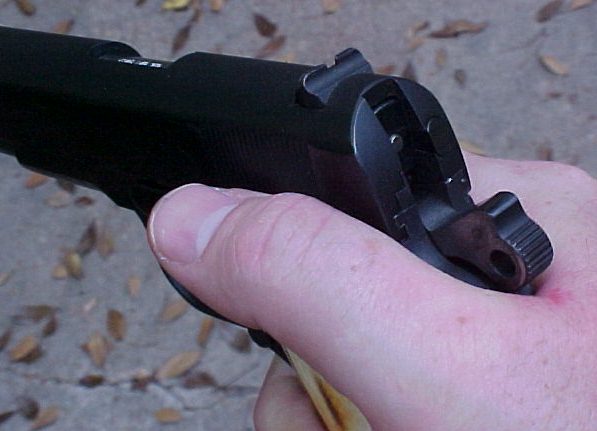
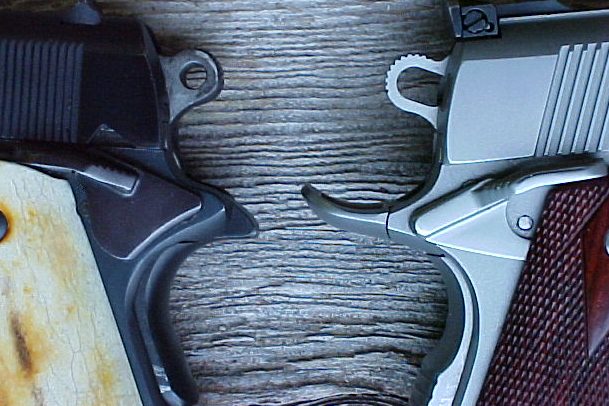
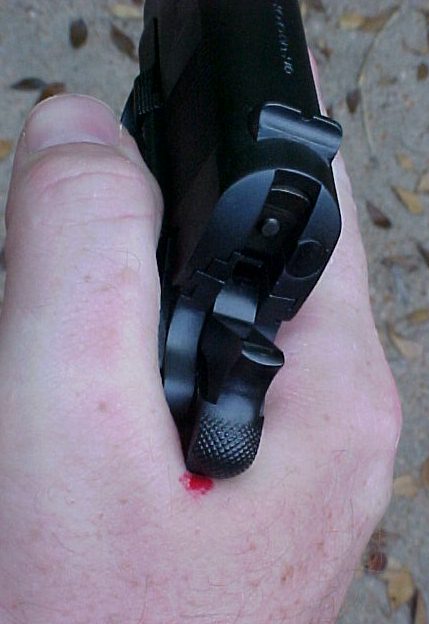
I have shot a Sistema in my usual high shooting grip and taken the photos above for one reason. Proof of hammerbite's existence and it's cause. In the first photo, the hammer can be seen pinching the flesh of my hand. In the second photo, with the pistol moved forward, the impression of the grip safety can be seen with no abrasions present. The pinched flesh wound can be seen immediately proximal to the grip safety impression.

These same people who deny the existence of hammerbite hate the beavertail grip safety. They declare that it is a trendy contrivance not needed by real men who know how to grip a handgun properly. Bullshit. The proper way to hold a handgun is to get the web of your hand as high as possible behind the bore axis. Doing so changes the recoil impulse from a lever action to a push straight back. The recoil of the properly held pistol is unable to act as a lever against the wrist. Follow-up shots come quicker, and they are more accurate. A beavertail grip safety effectively eliminates hammerbite, allowing the pistol to be held as high as possible, giving better control and enhancing accuracy. The beavertail grip safety is a simple, elegant, and permanent solution. It adds no bulk, and it allows the pistol to be shot without pain for a long period of time. The beavertail grip safety solves the hammerbite problem. It works. Period.

Failure to recognize this and calling the beavertail grip safety trend chasing is what psychologists call projection. That's right. The insistence on a GI style grip safety is as trendy and fashionable as the desire for a beavertail ever was. Those who refuse to accept the reality of hammerbite also lack the insight to see their advocacy of the GI grip safety for what it truly is. Reverse elitism. Snobbery. It is true that some pistols look better with a GI grip safety. I keep a GI grip safety and a Rowell hammer on my Series 70 Commander because I like the way it looks. Yes, the rounded Commander hammer occasionally nips my flesh. I like the looks of the GI grip safety on my Commander, so I keep it. That's fashion. If I were to install a beavertail grip safety, I would be responding to my needs to shoot this pistol more effectively. That is form following function, not fashion.

There are those who will say that all a person needs to do to eliminate hammerbite is trim the hammer. They would be right. I have done this on pistols. Still, there is a huge advantage for many people, as I stated above, to adopting a high grip on a 1911. The thumb sitting on top of the thumb safety provides leverage to prevent what little muzzle flip is left after raising the web of the hand behind the bore axis. The pistol pushes against the web of the hand rather than levering against the wrist. As a result, the sights stay closer to the target, and the target is reacquired quicker. That is not inconsequential. The improvement is measurable in split times. Some beavertail grip safeties get the hand higher on the pistol than others. I prefer the Ed Brown grip safety. It gets my hand a full quarter inch higher on the pistol than a stock grip safety. It also prevents hammerbite. That is not fashion. That is form following function. That is the evolution of design and an improvement worth keeping. All else is just fashion.

Labels: