A Nurse with a Gun

Friday, October 19, 2007

The S&W K-38 Combat Masterpiece

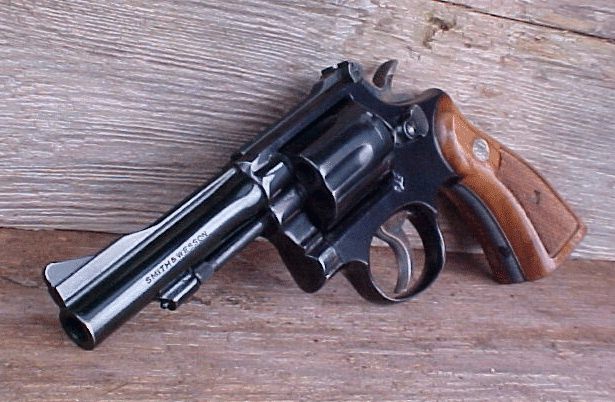
One of my favorite revolvers is a weathered .38 special handgun that I found on a pawn shop shelf years ago. Click to enlargeIt possessed incredible balance, and one of the smoothest double action triggers I had ever pulled. I suspect it received a professional trigger job at some point. The .400" wide serrated target trigger cranked back a matching 0.5" wide target hammer with ease, releasing it with no stacking or grittiness. I negotiated the price down to $179 from a tag reading $200. The old gun bears an exterior that has seen better days. If it were not for the cold blue painted on, it would likely have more metal than bluing glistening in the sunshine. Never the less, the appearance of the revolver belies it's performance.

The time worn revolver wore incorrect 1970's style magna grips when I purchased it. I took it to the range with a bucket of .38s, and I was amazed at it's inherent "handiness" and accuracy. When I finally found a Colt Python in my price range, the old Smith & Wesson was my standard of comparison in a range report. In my hands, wearing a Hogue Monogrip, the old Smith beat the snake. It is still the standard by which I judge other wheelguns.

The weathered old war horse I speak of is the venerable Smith & Wesson K-38 Combat Masterpiece. Click to enlargeNow, wearing proper diamond magna grips, my K-38 is still the sweetest wheelgun in my collection. The K-38 Combat Masterpiece was a beautifully blued revolver, with a four inch ribbed barrel and a Baughman Quick Draw front sight paired with an adjustable rear sight. It has serrations fore and aft on the metal portion of the grip frame. The package included the short fast action and an anti-backlash trigger. My revolver, serial number K2208XX, was produced in 1954, just in time to still be a five screw revolver. In 1957, the K-38 Combat Masterpiece evolved into the Model 15 with the introduction of model numbers.

My K-38 Combat Masterpiece had obviously spent a life in a holster when I purchased it. I suppose it was the sidearm of a peace officer at some time. I have to believe that this peace officer knew his stuff when he armed himself with this fine piece of sweet triggered ordnance.

Labels: , ,

Sunday, September 09, 2007

The Smith & Wesson Model 15

The Smith & Wesson Model 15 is one of my favorite all around revolvers. It's an exceptionally shootable revolver, precisely accurate with a rare trigger of exquisite smoothness. The Model 15 has a long and storied history, starting with the Model of 1899 and the Military and Police revolver. Target sights were an option on the Model of 1905, but were rarely ordered. Smith & Wesson Model 15-3 Combat Masterpiece, Smith & Wesson K-38 Combat Masterpiece, Smith & Wesson Model 15-9 HeritageOccasionally a man might have a gunsmith install adjustable sights.

After WWII, Smith & Wesson finally took notice of this trend, and eager to offer new products, they added a target sighted 38 Special K frame revolver to their line. It was a six inch model, made for target shooting. Smith & Wesson dubbed their new revolver the K-38 Target Masterpiece. The FBI and police departments around the country soon requested the same revolver with a four inch barrel and a Baughman Quick Draw front sight. Smith & Wesson was quick to honor this request, and the K-38 Combat Masterpiece was born. The K-38 Combat Masterpiece rocked the police shooting competitions. Many officers selected it as a duty gun. Whereas the old M&P had been a duty gun often pressed into target use, the K-38 Combat Masterpiece was a target gun suitable for duty use.

In 1957, all Smith & Wesson revolvers were given numerical model numbers. The K-38 Target Masterpiece became the Model 14, and the K-38 Combat Masterpiece became the Model 15. In 1999, the Model 14 was dropped. Subsequent six inch target sighted .38 caliber K framed revolvers were called Model 15's. Pictured at right are a Model 15-3 Combat Masterpiece from about 1974, a "two T" five screw Smith & Wesson K-38 Combat Masterpiece circa early 1950s, and a Smith & Wesson Model 15-9 from 2002.

Labels: ,

Sunday, May 28, 2006

Deciphering the Masterpiece

Long ago, Smith & Wesson began calling a select few revolvers Masterpiece. In fact, they had the audacity to name one of their revolver packages the Combat Masterpiece. That's a hell of a name. Combat Masterpiece. Presumptuous as hell, it sounds like it ought to be stepping into a professional wrestling ring wearing a lycra mask and a feather boa. What is this Combat Masterpiece?

After WWII, Smith & Wesson introduced an improved .38 Special revolver, designed for target shooting. It was designated the K-38 Target Masterpiece. Very quickly, law enforcement, and particularly the FBI asked Smith & Wesson to shorten the barrel to four inches and mount a Baughman Quick Draw front sight in place of the Patridge sight. $179 at a pawn shopThis new variation quickly took over the police shooting competitions of it's day, and became the favored carry gun of many officers. It was dubbed the Combat Masterpiece.

My old weathered K-38 Combat Masterpiece is pictured at left. This is an imminently shootable gun. I consider it to be my finest shooting wheelgun. The trigger is absolutely incredible. The K-38 designation is simply that of a pre-Model number K frame .38 Special Smith & Wesson. The K-38 Combat Masterpiece became the Model 15 in 1957. The stainless Model 67 was also known as a Combat Masterpiece. There was also a .22LR caliber Model 18, which was known as the K-22 Combat Masterpiece.

The features that make up a Combat Masterpiece include:
Four inch ribbed barrel
Micrometer adjustable rear sight
Baughman Quick Draw front sight
Serrated front and back strap
Short fast action
Anti-backlash trigger

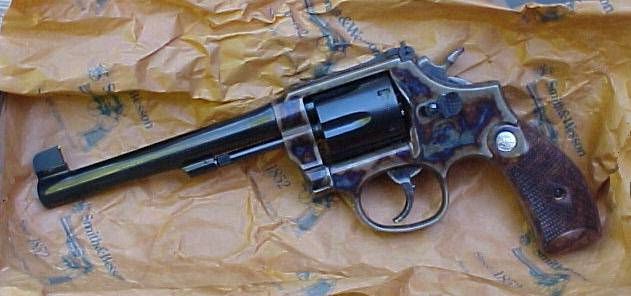
$199 at a pawn shopBy contrast, the Smith & Wesson Target Masterpiece had a six or eight and 3/8 inch ribbed barrel coupled with an adjustable rear sight. Over the years, the front sight varied on the Target Masterpiece, but it was usually a Patridge type sight. Serrated front and back straps were standard on the Target Masterpiece. It was available in .22LR as the K-22 Target Masterpiece and later Model 17, and .38 Special to make up the K-38 Target Masterpiece and later Model 14. To make matters worse, there are also heavy lugged barrels on some Target Masterpieces, as well as a K-32 Target Masterpiece/Model 16. Pictured above is my Model 17-3 Target Masterpiece.

The Masterpieces of Smith & Wesson are not fancy. They do not have light rails nor mounts for red dot scopes. They are not trendy. They are classic. Many say that the Model 27 in all it's variations and lucious liquid blue finish is the pinnacle, the Mona Lisa, of Smith & Wesson revolvers. The checkered sight rail and jewel like blue of the Model 27 is indeed beautiful, baroque. There is, however an undeniable beauty in the simplicity of design, in the work of Mies van der Rohe and his contemporaries. Less is more. The Mona Lisa is not the only artistic masterpiece ever painted, and the Masterpieces of Smith & Wesson are indeed masterful renditions of purpose driven revolvers. They well deserve the title of Masterpiece.

Labels: , , ,

Saturday, April 29, 2006

Pawn Shop Circuit: A Combat Masterpiece

It was a dreary rainy day today, and I spent the first half of it not doing much at all. I had planned on getting in touch with Cussin' Bob and taking him his gun, but he wasn't answering his phone. Finally, cabin fever set in, so I set out into the rain to hit a few pawn shops.

Dave's shop was first, and he had added a couple of pistols to his display. One was a Glock the other a Ruger MKII stainless with a tapered barrel for $199. I did not need another MKII, but that pistol will be a sweet deal for somebody.

As I entered Neil's place, I spied a new black revolver in the case beside the reblued and bobbed .455 Hand Ejector. I asked Neil pull out the new arrival. It was a pristine S&W Model 15-3 wearing the original magnas. This revolver had apparently fired less than 50 rounds. The trigger was smooth and sweet as a fudge sundae. The cylinder locked up tight and the chambers aligned perfectly. The barrel was pinned. I flipped the tag over to reveal a $199 price. That was to much to bear. I asked for a 4473 form.

Neil laughed, he said he had placed the revolver in the case this morning, that it had only been out of hock for three hours. He went on to say that if it had been a .357 magnum, it would have been his.

The Model 15 is the descendent of the K-38. Like the K-38, the Model 15 was one of the sweetest shooting wheelguns Smith & Wesson ever produced. At $199, it is a steal.

Labels: ,

Tuesday, February 21, 2006

Smith & Wesson Model 15-9 Range Report

In the Spring of 2001, right at the height of the S&W boycott by many gun owners, the Smith & Wesson Performance Center and Lew Horton collaborated to produce a series of revolvers that would elicit memories of days gone by. The revolvers were even shipped in period style boxes, wrapped in wax paper. These guns may have been the right revolver released at the wrong time. They were scorned by the revolver buying public. Their case colors were laughed at. The tiny round butts became the butt of jokes. Eventhough one gun rag named the case color Heritage Model 25 in .45 Colt "Handgun of the Year" other gun magazines gave the series no ink at all. The special run of Heritage wheelguns was virtually ignored by collectors. With Performance Center prices and retro looks, they were destined to become poor sellers. Many Heritage guns were eventually consigned to firearm liquidators at greatly reduced prices. That is how I came upon my Smith & Wesson Model 15-9 from CDNN. In 2004, I paid $599 for it, roughly half the MSRP for a NIB Performance Center .38 special revolver.

It was easy to see why this revolver was either scorned or praised. There were things that I, myself, loved about it, and other things that were a curse. The fact that S&W put in a overtravel screw on a smooth trigger was a huge plus. The upper sideplate screw was a nice retro touch, as was the period tapered barrel. The rear sight had a rounded front, which was very nicely fitted to the topstrap. The teardrop hammer was slick. Thank God this revolver had no zit lock on the side. It was, however, difficult to overlook the nickel plated billboard heralding Ed McGivern's world records that was riveted to the sideplate. Alternatives are not available for that folly. The case colors were done by Doug Turnbull. While beautiful, and fiery, they are alien to the history of the Model 15, and indeed any S&W Hand Ejector. The front sight is a huge affair, derided as a gut hook by many shooters. It has a brass Call bead mounted on it. There is no period pin to secure the barrel in place. The firing pin is frame mounted. Then there were the itty bitty round butt grips. Sure, they are nice figured walnut, but they are not sufficient for this revolver.

It felt odd, I had purchased a new Smith & Wesson, and a PC gun at that.
That was a strange move for a fellow who eschews the new stuff S&W produces. One of the first things I did after initially shooting the Model 15-9 was acquire a Hogue Monogrip for it. I considered a cocobolo Monogrip, but settled on a gun show special rubber Monogrip instead. I was pleased and surprised to discover the Model 15-9 actually looked better in the rubber grip! I suppose with the case colors, the eye needed a rest which the matte rubber provides. Sadly, the rubber does not totally obscure the nickel billboard on the right side. The Monogrip does feel 100% better though.

From day one, this revolver has been a shooter. It is fitted better or at least as well as any revolver I own. I took it to the range today and ran the targets out to ten yards. The revolver showed that it was capable of hitting only the ten ring, if I was up to the challenge. I was not, but I did manage to stay in the black. I shot Winchester White Box ammo from Wal-Mart.

There are a lot of things to like about this revolver, not the least of which is it's inherent accuracy. The "gut hook" sight is a pleasure to use, so much so that I plan to get a Call bead on other guns. It is exceptionally quick to acquire. It actually looks pretty sporty in it's case colors and rubber grip. If I could find one that would totally cover that silly nickel plate on the side, I would be a very satisfied shooter. Until then I will just enjoy this revolver for what it is, a damned accurate six gun.

Labels: ,

Tuesday, September 27, 2005

Range Report: Pristine Python vs K38 Combat Masterpiece

The Standard


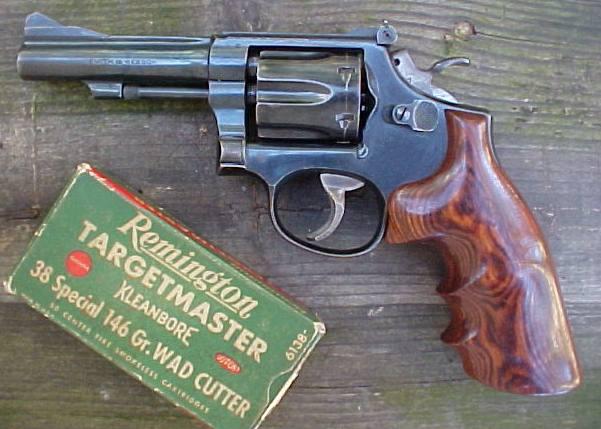
K38 Combat Masterpiece $179For several years my favorite six gun has been a work hardened K38 Combat masterpiece that I bought from a pawnbroker for $179. This old revolver had obviously been carried. It has quite a bit of holster wear touched up with cold bluing. The trigger is the best I have on a wheelgun though. It is smooth and light all the way to sear release with no stacking and no catches. Either this gun had a good trigger job at some time, or the parts have been polished to perfection through use or both. At any rate it is the standard I use to judge a revolver. It is an inherently accurate gun, and although it is a weathered old warhorse, it still ranks as the best handling and most accurate six gun in my safe. The only known alteration it has from stock is a Hogue Monogrip.

The Challenger


Colt Python $599The Colt Python is a legendary sixgun. Many say it is the finest six gun ever made in America. It is a handfitted gun of impeccable finish. The old-style Colt "Bank Vault" lockup, Colt's superior quality barrels, with their faster rifling twist are often cited as the Python's advantage. Colt went even farther with the Python, designing an expensive tapered-bore barrel, which is finished with Colt's mysterious "Silver Ball" treatment. In short, The Python is very much like ordering a true custom 1911 from a maker like Wilson, Brown, or one of the other top custom builders. What you're getting is a revolver on which expensive hand labor is lavished, and on which everything possible is done to insure it's the finest quality and most accurate production revolver possible. The Python never has been a moderately priced handgun. I found this pristine four inch example at a pawn shop for $599, and bought it immediately.

The Tussle


Before I talk results, let me state the purpose of this head to head test, plain and simple. The Python cost $599. The K38 cost $179. Is the Python worth 420 more dollars to ME? I chose these two because I shoot my K38 better than any other DA revolver. The Python is often heralded as an accuracy legend. Apples and oranges? A 1950s .38 special up aganst a 1990's .357 magnum? To help level the playing field both guns will be shooting .38 special. To further level the field, no wadcutters or such. I went to Wal-Mart and bought some value packs of Winchester White Box. That is what I usually use, and that is reason enough for the ammo choice. Then I headed to the range.
ResultsI shot 100 rounds through each revolver, and came up with these representative groups. A few things must be acknowledged.
The K38 is my favorite revolver. I prefer it's wide trigger, and the Hogue Monogrip fits like it was made just for me. I shoot this gun double action frequently to demonstrate that DA shooting can rival SA shooting. In my hands, this is a hard gun to beat. It fits, and I usually shoot my best with it. The Python did not fit me nearly so well. To be fair, if I installed a Monogrip, I'm sure it would. The Python's trigger pull is smooth, but not as smooth as the old K38's, and it seems to be a bit stiffer. This may or may not be attributable to the wider S&W trigger. The polish on the Python's trigger made the more narrow trigger a little better. The Accro sights on the Python gave a better sight picture than the stock K38 sights.

In function, the old K38 accepted rounds, swung the cylinder into place and ejected casings with aplomb. Nary a hitch, and smooth as silk. Again, I attribute this to the K38 being a "mature" gun with a lot of bullets down the pipe. By contrast, the tightly fitted Colt would sometimes take two tries to have the cylinder lock into place. The chambers seemed to be a bit snug, and the .38spl ammo did not want to seat as easily. Likewise, the casings required a firmer push for extraction. The old K38 did not lock up as tightly as the Colt. The Colt exhibits the famous bank vault lock-up. The S&W has gotten a bit lackidasical in it's lock-up over the years. Neither gun spit lead, neither gun had any failures.

If my familiarity with my K38 and how well it fits me is factored in, as well as the newness of the Python, accuracy in my hands was essentialy the same. I had quite a few better groups of five or four shots than what is pictured with the Python. Often it would cloverleaf groups of three and four. Then I would shoot a flyer, which I could instantly call as such. I have a feeling if I placed a Monogrip on the Colt, and shot it as much as the K38, it would hold the edge in accuracy in my hands. As it is, the K38 out shot the Python.

There is no denying the Python is a fabulous gun. If these were watches, the S&W would be a Seiko, and the Python a Rolex. The Python is beautiful. It's bluing is lucious and swimming pool deep. There is not a flaw on the gun. It's beautiful.
If I am going to pull a wheelgun out of my safe to take shooting, and show a young whippersnapper what a six gun is capable of, I'm pulling out my beat up Smith & Wesson K38. If I am going to pull out a gun to show a young whippersnapper how a handfitted gun looks and feels, I'm pulling out the Python. So, back to the original question........is the Python worth $599 to me? Well, I have not taken it back (and I can under the pawn shop's return policy). I suppose it is worth $599 to me. I feel certain I will be able to get that back out of the gun if I care for it properly.

What many will want to know is which gun "won"? In my opinion, there is a clear winner. The old beat-up S&W K38 cleaned the Python's clock. In another shooter's hand though, it might have been a different story.

Labels: , ,