A Nurse with a Gun

Thursday, July 23, 2009

Shooting the Clark Commander

It was a gorgeous day to be at the range. The skies were blue with puffy cotton clouds, and a cool breeze whisked the sweat away. Frieda had not been back to the range since we last shot, although she had been doing a lot of dry fire practice. Click to enlargeTruthfully, I had not made it to the range as much as I should have. The heat and humidity just kept me away. Today was a new day though, and I wanted to put some copper jacketed lead through my new pistol. I brought along my Ruger MKII fishing gun, and my Clark Meltdown Colt Commander, fresh from Jim Clark's hands. Frieda had her Ruger MKII, and Little Darling was along for the ride.

First off, the Clark Commander shot well. As usual, it was more accurate than myself, and it was totally reliable. Over the course of the afternoon, I put 200 rounds through it with no failures. I ran drills of one, then two shots using a flash sight picture. The pistol pointed naturally, and came to sights without error. I rotated between the Commander and my MKII to prevent myself from getting too comfortable.

Frieda was excited to get back to the range. She had brought along a box of Blazer ammunition. I grimaced at the sight. Click to enlargeCall me a nut, but I just prefer the copper washed Federal bulk pack stuff. Frieda did not need my assistance though. She was able to load her own magazines, and when a cold range was called, she set her target out at ten yards.

Her first couple of magazines were shot low, and I had to talk to her again about the human sympathetic grip. As we coil our index finger, the remaining three fingers of the hand tend to tighten. When holding a pistol, this can make the muzzle drop. I reminded Frieda to take a firm grip on the gun with her right hand. If our fingers are already tightly grasping an object, the sympathetic grip is minimized when we use our index finger. Frieda listened, and applied my suggestion. She found herself shooting in the red again immediately.

After Frieda got a couple hundred rounds downrange, she began to have occasional stovepipe jams. I would have to clear her pistol for her, and I attributed the problem to the Blazer ammunition. Frieda with her target, Click to enlargeI was still shooting just fine with Federal. Its my belief that Blazer may have a reduced charge in some rounds, and less consistency from round to round. A pistol depends on the recoil impulse to eject the spent brass from the gun. When the recoil impulse is reduced because the ammunition is loaded lighter, the bolt doesn't move as quickly and ejection problems can occur. I have not performed my Ruger magazine modification on Frieda's mags. That could have played a role as well. Frieda persevered though, and resolved to buy Federal ammunition next time.
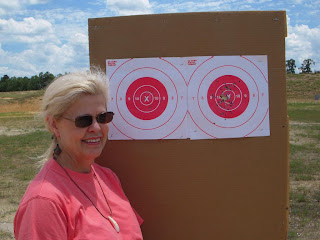
Frieda and Little Darling kept looking at my target and comparing their shooting with mine. This is a natural thing for anyone to do, and it is one of the reasons I do not shoot when I am teaching a novice. It is also a reason why I will work on drills that impair my accuracy when shooting with someone who has established competence and needs to push themselves a bit more. Frieda and Little Darling with my target, Click to enlargeFrieda noticed that I was working on flash sighting. She remembered me talking about it with her, and asked me why I was shooting that way.

"The person most likely to survive a gunfight unscathed is not necessarily the person who is the most accurate," I told her. "Almost invariably the person who is shot first will be the person who comes out on the short end of the stick. Shooting accurately is important. Shooting accurately enough, fast enough is more important. You can train for target shooting, or you can train to survive a lethal encounter. Proficiency at target shooting teaches you to use a gun in a certain manner. Under the stress of unexpected violence, we will revert back to the way we trained ourselves to shoot. I want to be the guy who gets shots on target first, not the guy who does it most accurately. I just need to be accurate enough."

Labels: , , ,

Thursday, March 05, 2009

The Smith & Wesson M&P

Plastic pistols are no longer my thing. I'm an unapologetic aficionado of guns from an earlier era. My first few automobiles had chrome plated or painted steel bumpers. By many people's standards, that means I'm on the downhill slope, I guess. I recognize that plastic pistols (and now revolvers.....) are the wave of the future, and a lot of people find them to be the tactical Tom's meow. I enjoyed shooting a few of them for a while, but the more I shot them, the more they all started to look and shoot alike.....
Bottom line, since I don't shoot 'em, you are not likely to find much written about 'em on my blog. Brigid, however does pack plastic, and she wrote an informative review on the 9mm Smith & Wesson M&P compact. If you are interested in S&W's new polymer vundergun, go give it a read. Todd G at Pistol Training.com conducted a long endurance test of the S&W M&P, eventually firing 62,333 rounds with a little help from his friends before the slide cracked. The gun kept running, S&W examined it and pronounced it safe to shoot, but then the lawyers intervened, spoiling the fun. Todd has posted updates over the course of thirty three weeks, plus a few more. Good reading as well if you are interested in this particular pistol.

Labels:

Thursday, February 26, 2009

Colt M1991A1 and Springfield GI45 Comparison

"Xavier, What is the real difference between the parked Colt 1911 and the Springfield GI 45?"
Well, not much really. The Colt has the Series 80 firing pin safety, but the Springfield comes from the factory with an integrated locking system. The Springfield's lock can be easily removed by replacing the mainspring housing. A shim can be obtained from Brownells to remove the Series 80 firing pin mechanism.Click to enlarge However, a gunsmith I highly respect advises against using the shim long term.

Little things like lanyard loops and such make up the bulk of the difference. The Colt does have more visible sights. The Springfield has a two piece barrel in contrast to the Colt tube. A used Colt M1991A1 with the old style rollmark and parkerized finish is generally priced a bit less than a comparable new Springfield GI45 with a parkerized finish. The Colt will hold resale value better, but the real difference is in the shooting. Or is it?

I took my Springfield GI45 and my Colt M1991A1 to the range for a comparison. Each pistol has some bits and pieces that were added by myself, but each one retains the original sights, barrel and bushing. Neither pistol has been tightened. Both have trigger jobs.

I shot at ten yards, alternating between the two pistols. The Colt target is on the left, the Springfield target is on the right. The accuracy of the groupings is about equal. The Colt was pretty much on target for me. The Springfield shot a bit high. I attribute that to the Springfield's arched mainspring housing. I learned long ago that I shoot better with a flat mainspring housing and a long trigger. Click to enlargeMy Springfield GI45 is set up to resemble a military pistol, while the Colt is set up to my preferences. I suspect a swap in parts on the Springfield would put me in the ten ring.

I have owned and regularly shot my Springfield GI45 since 2003. The two piece barrel (which I think may be a Storm Lake barrel) has been a non-issue. The pistol has been durable, reliable and accurate. The Colt is new to me, but frankly, I don't envision it being any different. The fact that many top notch 1911 'smiths keep a Colt barrel in a custom 1911 instead of routinely replacing it with a Barsto speaks volumes for Colt's barrel quality.

It was difficult impossible for me to determine whether one pistol actually shot better than the other. The groups were remarkably similar, except the pistol with the arched mainspring housing and short trigger shot higher for me. If you want a Colt, and are concerned about resale value, a used Colt M1991A1 is a perfectly adequate pistol. If you want a new gun and the Colt name is meaningless to you, the Springfield is a very fine substitution.

Labels: ,

Saturday, December 27, 2008

The New Agent versus The Defender

Two of the finest carry pistols yet designed, in my opinion are the Colt Defender and the Colt New Agent. That's a pretty bold statement. Before I receive hate mail, let me explain that I am ruling out revolvers, which are not pistols. Let me also say that I believe the 1911 pistol is the finest fighting pistol ever designed. Quick, accurate, powerful. In a world of competing designs, almost a hundred years later, it remains the gold standard for the disciplined shooter, not the good enough gun for the lowest denominator.

When Colt finally decided to produce a true concealed carry 1911, they went whole hog with the Defender. Colt's new product was so different from their previous 1911s that they bestowed a new series designation on it, the Series 90.

The Colt Series 90 pistol is a three inch bushingless 1911 style pistol with a lightweight aluminum frame. They are designed for carry and self defense, not target practice. The Series 90 pistols have the Series 80 firing pin safety, but that is the only similarity.

The Colt Defender is not a particularly flashy pistol. It bears a stainless steel slide and a big rubber Hogue wrap around grip. The sights evolved from upright three dots to low profile swept back units. It has a three hole trigger, and a beavertail grip safety that morphed over time along with the sights. The Defender uses the Officer's ACP magazine, allowing for seven plus one capacity.

Where other three inch 1911 style pistols failed, the Colt Defender quickly gained a reputation for being a pistol reliable straight out of the box. Many shooters who had shied away from the smallest 1911 pistols, indeed shooters who had stated that any 1911 beneath Commander length would likely need professional gunsmithing to run reliably, were shown that reliability could come in small packages from Hartford.

The basic Defender formula was a good one, and the little pistol that could became the best kept secret of the 1911osphere. Typical of Colt's modern advertisement campaign, the pistol received little fanfare, and next to no mention in the gun rags. Across the internet though, buyers were raving about Colt's new product. They were buying it in droves and trading out the Good Year grips for slim slabs of wood.

Thus when Colt decided to produce a similar Series 90 pistol, one even more dedicated to concealed carry and self defense, they had their ear to the ground. The Colt New Agent debuted at the 2008 Shot Show and suddenly shooters were debating point shooting versus sighted fire for self defense again. The New Agent was similar to the venerable Defender, but with a significant twist. Conventional sights were absent. The top of the slide was as slick as Charlie Brown's head. Rather than dovetailed sights, the New Agent received a sighting trench, often termed a "gutter sight" along the top of the slide. The slide of the New Agent was blued, and the aluminum frame was black anodized. Other small differences abounded. The slim wooden grips that shooters were screwing on their Defenders came from the factory on the New Agent. The front strap had serrations. The slide was lightened in the front with a profile similar to the Browning Hi Power. The New Agent thumb safety was a GI style unit with a nubbin of a tab. The grip safety was reminiscent of the upturned grip safety found on some Commanders.

The reception for the New Agent, while initially enthusiastic, became more sedate as shooters contemplated the sighting system. Some preferred the black pistol to the stainless, and wished Colt had simply produced a blued Defender. Others decided to put sights on their New Agent. Over the course of a year, I purchased both pistols.

My New Agent stayed basically the same as it came from the factory. Click to enlargeMy Defender underwent some changes. Most notable was the addition of slim wooden grips, and the modification of the grip safety to achieve the spartan profile of an early Commander grip safety. I installed a Nowlin Speed Demon hammer on the Defender to complement the austere grip safety. Both pistols received trigger jobs and solid triggers.

Both pistols retained the polymer mainspring housings. While I routinely swap out the Colt polymer mainspring housing for steel, adding a heavier part just did not make sense on a pistol designed to be lightweight. The polymer housings are durable, and light. I kept them.

At the range, each pistol was stone cold reliable, and sufficiently accurate for self defense. Each pistol carried so easily in an OWB holster on a good gun belt that I forgot it was there. The real difference was in the sighting system.

Today, I decided to take both my Colt Defender and my Colt New Agent to the range and shoot them side by side. They have become remarkably similar pistols with the exception of the sights. I alternated between the pistols with each magazine, to prevent fatigue from creating the illusion one pistol was outperforming the other. At ten yards, I shot fifty rounds through each pistol into two targets, side by side, on the same frame.

Point shooting would have given similar results, so I used the sighting systems on each pistol. Click to enlargeI shot by raising the pistol from low ready to the sights, squeezing off two or three shots of sighted fire, and back to low ready. After a magazine in one pistol, I moved to the other. I did not "warm up" with another pistol, and I made certain I shot when I was hungry and full of coffee, allowing hypoglycemia and caffeine to simulate an adrenaline dump.

The results were interesting. The New Agent target is on the left. It has rounds concentrated in the lower left, usually indicative of anticipating recoil. The Defender target on the right had considerably more rounds in the ten ring, but the flyers indicate I was breaking my wrist either up or down. While it wasn't my best day at the range, it is undeniable that every shot would have been center of mass. Either pistol would be a worthy sidearm in an armed confrontation. At the end of the day, when the pistols are put to their intended use, I think whether the buyer wants a blued or stainless pistol may be more important than what is on top of the slide.

Labels: , , , ,

Tuesday, February 19, 2008

Helwan Brigadeer

In November of 2003 I purchased a Helwan Brigadeer from Southern Ohio Guns. I wrote a review on my experiences with this pistol, and I've dredged it up from the old files on my hard drive. For those who may be interested in this 9mm Beretta copy, here it is.
For many years I have been interested in Berettas. One derivative in particular has fascinated me, the single action Egyptian Helwan Brigader. The Helwan is a 8 shot 9mm copy of the Beretta 1951, much the same as a Sistema is a copy of a Colt 1911. Beretta set up the factory and trained the workers to produce the pistol in Egypt. Of course, that was a long time ago.

Helwans have often been derided in the US as a cheap pistol with no real value. Click to enlargeRecently Helwans have once again become available for $159 at SOG. I placed an order. I figured for that kind of money, I could take a chance.

When the pistol arrived, it was NIB, and a pretty flimsy box at that. It came with a manual, two single stack magazines, and a brush. The fit and finish was OK, but not up to Beretta standards by any stretch of the imagination; not even close. The serial number and importer's marks were the typical CAI buzzpen job. The slide is obviously cast. The sights are pure itty bitty military. The magazine release is on the bottom of the grip, Euro style. The barrel locks up with a falling block, like the 92FS. The safety is a button that runs though the frame at the top of the grip. Left to fire, right to safe. Cocked and locked is an option. The safety blocks both the sear and the hammer.

I began to clean the pistol, and lube it in preparation to go to the range. I found that the grips do not like Gun Scrubber. "Ah well, it's a cheapo pistol, and a bit of spray paint will take care of it" I thought. The trigger was heavy, and the underside of the slide was corrugated with machining marks, but it slid easily along the frame rails. The barrel locked up tightly. It is about as narrow as a 1911, with the length a bit longer than a Commander.

The next day, after the grips had hardened up again, I took the pistol to the range. I also carried 300 rounds of Winchester White Box, 100 rounds of Wolff, and a gallon bucket of 9mm reloads. I did my usual load one shoot one, load two shoot two, load three etc routine and had no unintended double taps. I ran a target out to 25 feet and loaded up a full magazine. I began to shoot 4 inch groups, and as I settled into the heavy trigger, they began to shrink down, finally averaging around two inches.

I stopped counting rounds at 500 (and still had a half bucket of ammo). I had no failures of any kind. No failures to extract, no failures to eject, no failures to fire. Nothing. The recoil was heavier than I was expecting in a pistol this size. I'd equate it along the lines of my HK USP in .40S&W. The pistol will empty a magazine as fast as you can pull the trigger.

The slide release was a bit pointy and could use some smoothing out, and the trigger never did lighten up. All in all though, I have to say that I am happy with the pistol. It is a low buck service pistol. You have to figure that into the analysis. It has the design of a Beretta, the finish of a KelTec, and the price of a High Point. I found this pistol to be reasonably accurate at combat ranges. Helwan Brigadeer Click to enlargeIt is certainly no target pistol, nor was it meant to be. I found it to be easy to aim and shoot despite the small sights.

I will definitely strip this one down and see if I can lighten up that trigger some. Oh, and I think it deserves some new grips. It's a keeper.

Helwan Update:
Today, I tested my trigger job. I had replaced the hammer spring with a 1911 18 pound mainspring. I had also polished up the sear and hammer hooks and applied a bit of Action Magic. The trigger was sweet now, and at the range, I saw some benefit in my accuracy.
After approximately round 1200 though (total round count), the Helwan choked. It failed to extract a shell, and the pistol jammed hard. I was unable to field strip it at the range, so I pulled the magazine, put it in my bag and went to another pistol.

Tonight, it took a bit of work to tear the pistol down, but I was able to do it using my hands and leverage. The front of the frame rails had peened where the slide impacts them, making movement of the barrel very difficult. I could find no cracks. I took a file and removed the burrs from the front of the frame rails. I stoned the rails everywhere the barrel contacts them. After a bit of work, I had the barrel sliding nicely again. I reassembled the pistol and the action worked smoothly. I'm hoping that the original rough machining in the frame rails and slide rails contributed to the burr development that brought shooting to a halt. If so, then beveling these corners should prevent it from reoccuring.

I am thinking about adapting a B92 Shok Buff if I cannot find one specific for this pistol. It's possible the steel may be a bit soft. I tried to fit a heavier B92 recoil spring, but it would not fit.

On another note, the blueing seems to be a bit thin, and is already starting to wear off the barrel. By contrast, my Beretta 92FS that I purchased in 1992 has about the same amount of wear with many more rounds through it.

As of right now, I cannot recommend this pistol to anyone who is not a tinkerer. For the money, it certainly is not a pistol to take to a gunsmith to fix. Because of this failure, I cannot recommend the Helwan as a defensive pistol either. It is not a failure that can be cleared without taking tools to the pistol. On the flip side, If you can find a jammed one used, you might be able to pick it up for under $50 and put it back into range use with a minimum of effort. I am not calling the Helwan a POS yet, as the problem may have been erased for good with a little filework and stoning. Time will tell.
I never did get around to shooting the Helwan very much after that. There were other pistols to keep me interested. I did see a Helwan in a pawn shop for $119. I passed. Today, my Helwan still resides in my gun room, as a lesson learned and a possible bartering bit should I ever need one.

Labels:

Friday, February 15, 2008

The KelTec P32

It's better to have a mousegun in your pocket than a cannon back home. No truer words were ever spoken. Several years back when the KelTec P32 had staked it's claim, and KelTec had just introduced the first generation P3AT, I wrote this review on my KelTec P32. Now Ruger has introduced a similar pistol, the Ruger LCP. I still carry my P32 from time to time. It is still reliable. Here's a look back to a review from the time KelTec opened a new avenue in the world of concealed carry.

When I first saw the KelTec P32, I thought it was a cheapo .22 pistol. I asked to see it, thinking some kid might mistake it for a water pistol. Indeed it was about the size and weight of a water pistol (at least the ones I had as a kid). Was I ever surprised to learn that it was a .32ACP. I was also surprised to see it was a locked breech pistol. The feed ramp is integral with the barrel, and the barrel has a hood that both locks into the slide and directs the bullet nose to enhance feed reliabilty. The barrel bushing is integrated into the slide similar to the compact 1911 design. KelTec P32 and Beretta M21AThe barrel is enlarged at the muzzle to lock into battery, but is hourglassed directly behind the muzzle to allow itself to pivot and unlock. The barrel lug is a solid block, with no linkage.

The more I studied it, the more I realized that the P32 was not a miniaturized rehash of another pistol, but a pistol that was designed from the drawing board to be concealed when nothing else could be. All corners are rounded. No sights protrude above the slide. It is snag proof, and if the slide were hard chromed, it would be sweat proof. The P32 is DAO with a trigger pull around 5 pounds. There is no manual safety. The outer grip frame is polymer with an inner frame CNC machined from solid 7075-T6 aluminum. The barrel and slide are 4140 ordnance steel. Frankly, it was more compact than my Beretta M21. My extended index finger reached the muzzle while I gripped the pistol. The P32 came with one Meggar magazine and a pouch. The price was $230.

I was still skeptical, so I went home to research the pistol on the internet. I learned the P32 had a loyal following as well as rabid detractors. Much of my research was done on the KelTec Owner's Group website. It was there that I learned about the fantastic KelTec customer service. Service so good that it should be the industry standard. I thought it was unique that KelTec provided a link to the independent KTOG forum from their own website. Now that is faith in your product and service! KelTec representatives frequently answered questions and addressed problems on the forum. At KTOG I also learned about the fluff and buff. I continued to research the pistol, and the more I read, the more I liked what I saw. I made up my mind. I went back and bought it.

I took my new KelTec P32 home and did a fluff and buff. I lubricated the little shooter and headed to the range where I bought 100 rounds of PMC 71 grain FMJ.

The sights on the KelTec P32 are rudimentary at best, with no projections above the slide. Aiming is accomplished by aligning a white dot on the front of the slide with a white dot on the rear. At 15 feet I was able to group seven shots within three inches. At 20 feet I stayed on a 3X5 index card. For those who would sneer at such accuracy, I would submit that coming from a pistol with next to no sights and a sight radius under four inches, it is pretty good. I had no failures. The plastic checkering on the P32 was pretty abrasive to my hands though.

I took the pistol home, cleaned it, and took some sandpaper to the grips to smooth the checkering a bit. I placed a belt clip, a metal guide rod, and a spare magazine on order from KelTec. Next, I set about trying to find a black pencil eraser to make into a trigger stop. I "installed" the rubber eraser trigger stop with superglue and when the parts arrived from Keltec a couple of days later, I put in the metal guide rod. Supposedly you can drift out the frame pin to install the belt clip. I had to carefully drill it out. I installed the belt clip with the supplied hardware and went back to the range.

Once there, I bought 100 more rounds of PMC 71 grain FMJ ammo. Again the pistol performed flawlessly. The grips were less abrasive, but now the head of the belt clip attaching bolt was eating into my thumb knuckle. I struck some making tape on the knuckle and continued shooting. I later touched up the bolt head with a file and a bit of cold blue. The trigger stop allowed me to stage the trigger, and then add just a bit more pressure to squeeze off the shot. This improved my follow up shot time and accuracy substantially. Again, I had no failures. Later, I also painted the front "sight" red to assist in aiming, although this pistol is a natural point and shooter.

The KelTec P32, and more recently the KelTec P3AT (.380ACP and about the same size, but one less round) are all about function. KelTec P32 Click to enlargeThey are really in a class by themselves. The only mousegun that is even close is the NAA Gaurdian, but it is twice the weight, as well as twice the price. The .32ACP is not a known manstopper by any means, but consider that seven rounds of .32ACP is roughly equivalent to a round of 00 buckshot. This is a deep cover back up gun. It was never designed to be a primary weapon, although a lot of people use it as one, or as a means to get to the larger gun if needed.

The KelTec P32 is the only pistol that I can carry concealed in my scivies. A brave man could probably conceal it at a nudist colony. Many people make wallet holsters for it, and carry it in a front pants pocket. I use the clip to carry mine inside my pants or inside a pocket.

I only have two reservations when recommending the KelTec P32.

#1 The new buyer must understand that the pistol will need to be finished by himself. Consider it a starter kit if you will. A fluff and buff really helps make it reliable out of the box. The price is low, and the design money went into research and development. Be prepared to learn a bit of gunsmithing.

#2 The new buyer must understand the limitations of the .32ACP. I will not carry JHP due to the risk of rim lock. Rim lock can shut down an otherwise reliable .32 pistol. The FMJ round will have better penetration anyway. The new buyer must also understand that this is a last ditch pistol. It is not one to try to intimidate your way out of a confrontation with. The person on the recieving end is very likely to believe it is a toy until they start to leak blood. If you pull it, plan to use it. Of course, that goes for any gun, but especially this one. It has no intimidation factor.

I believe that the KelTec P32 and P3AT are on the cutting edge of handgun design. As such, there have been people who were unhappy with the pistol. Thus far, however, I have yet to see a used one for sale. Even with the new P3AT, it seems as if people are keeping the P32. If I were buying today, I might very well buy the P3AT to get the .380ACP cartridge. I have not felt the need to upgrade from the P32 though. I presently have a bit more than 1000 rounds downrange from this pistol with no failures. It still fills it's BUG role admirably.

Despite the usual criticisms, I am including "Marshall & Sanow's Street Effectiveness Figures for the .32 ACP Cartridge" for comparison.

CorBon is conspicuously absent from the data, as are Gold Dot and other "custom" or +P loads. Kel-Tec states the P-32 will manage +P ammo, but recommends not shooting it excessively. Note too, "one shot drop" statistics for this caliber vary.

Winchester Silvertip JHP 60 gr. rates 970 fps, 125 fpe, 63% drops

Winchester FMJ 71 gr. rates 905 fps, 129 fpe, 50% drops

Magsafe Defender JPF 50 gr. rates 1250 fps, 174 fpe, 57%.

Glaser Safety Slug JPF 50 gr. rates 1065 fps, 126 fpe, and 46%

KelTec P32 Specifications:
Caliber: .32ACP
Weight unloaded 6.6 oz.
Loaded magazine 2.8 oz.
Length 5.1 inches
Height 3.5 inches
Width .75 inches
Barrel 2.7 inches
Sight radius 3.8 inches
Muzzle energy max 200ftlbs
Capacity 7+1 rounds
Trigger pull 5 lbs
MSRP $300
GRP (Get Real Price) $230

P3AT Specifications:
Caliber: .380ACP
Weight unloaded: 7.2 oz
Loaded magazine: 2.8 oz
Length: 5.2 inches
Height: 3.5 inches
Width: .77 inches
Sight radius: 3.8 inches
Muzzle energy max: 250ftlbs
Capacity: 6+1 rounds
Trigger pull: 5 lbs
MSRP $305
GRP $250

Mouseguns.com

Oleg Volk's review of the KelTec P32

Labels: , ,

Sunday, January 27, 2008

Colt New Agent: Range Report

In the Summer of 2007, Colt released a pistol to little fanfare. It was a pistol designed to take Kimber's Ultra RCP and smack it down to the CCW mat. For a while, I had secretly lusted over Kimber's dedicated concealed carry pistol, but I never could get past the Series II thing. Now, I didn't have to.

It took me several days to decide to purchase Colt's dedicated carry gun, even after I had found a nicely priced example at a gun show. Click to enlargeWhen I finally realized the price was the same as a used Lightweight Commander, I broke down and purchased my first new gun in several years.

The Colt New Agent is an Officer's ACP sized pistol with an aluminum alloy frame. The barrel length is three inches, and it carries 7+1 rounds of 45ACP. The pistol has a blued slide atop an anodized frame. The black color is all business. The grips are slim grips, with a double diamond pattern that is pressed rather than sharply cut. The thumb safety is the same little nub as was present on the M1911. The mainspring housing is plastic and the frontstrap is serrated. The New Agent is a Series 90 pistol, incorporating Colt's patented firing pin safety. It comes with two magazines.

What makes the pistol unique in Colt's line-up is the sights. The New Agent lacks conventional sights, relying on a 2mm channel cut along the top of the slide. The idea behind the "gutter sight" is a snag free, quick to acquire sighting system. The trough is not meant for accuracy so much as it is meant for speed.
Click to enlarge
Once I had my New Agent home, I cleaned and properly lubricated it. Then I spent some time dry firing and trying to get used to the sighting system. The trigger was crisp and about four pounds. There was no creep, and no overtravel screw to adjust. For a defensive weapon, the lack of that trigger overtravel screw is a blessing.

I gathered up some ammunition, stuffed my Colt Compact in my holster, and took the New Agent to the range. I planned to shoot a variety of hardball, along with some Gold Dots and HydraShoks. I brought my Colt Compact along for comparison.

I started off with my usual drill, making certain the light weight Colt, even though new, was safe to fire. After a few single shots, I progressed up to a full magazine. then I tried to make the pistol jam. I limp wristed it. I fired it sideways, upside down. I let my thumb ride the slide. The New Agent was boringly reliable. The modified Colt Compact had a definite edge on shooting comfort though. The Ed Brown grip safety, the polished frame, and the additional weight all combined to make the Colt Compact a relative pleasure to shoot and the New Agent a handful by comparison.

In addition, the Teflon coated Colt Compact was quicker out of the holster. I was using a hand made IWB holster similar to a Summer Special. Click to enlargeI swapped over to a Don Hume JIT, and I experienced the same results. Perhaps as the New Agent is used a while, it will rival the Compact in ease of presentation. Time will tell.

The Colt Compact also ate the New Agent's lunch on accuracy, not surprising since it has sights. The New Agent did not come to sights for me quicker than the Compact. If anything, the sighted pistol had the edge in speed. Perhaps that was due to my unfamiliarity with the gutter sight, but those were my results. On the Colt Compact I have a Ted Yost retro rear sight paired with the stock Colt front sight. I had a dentist friend press some gold filling stuff in the recess of the Compact's front sight. The result is an accurate pistol with quick sights. Plus, I'm used to it. The lack of contrast in the gutter sight was detrimental. Perhaps I will paint the channel red white.

I continued to blast lead down range with the New Colt. The pistol seemed to be grouping low and to the left for me. I wondered what could be causing that, and then I noticed my finger placement on the trigger. I was over reaching the trigger, and shoving the muzzle over with the trigger stroke. Once I corrected my finger placement, the gun got in the black. I wondered, though, why that had happened. Then I realized.....Click to enlargeThe slim grips had changed the profile of the gun, as well as my grip on it. The screws and bushings were too short to try alternatives. I adjusted my grip, and the problem evaporated.

The New Agent had shot 300 rounds without a failure, so I loaded the magazine with HydraShoks, charged the chamber, locked the hammer, and put the pistol in my holster. My jacket draped over it, concealing it completely. I loaded my gear back in my range bag and went on about my day. I thought about going back to the gun show, but I had shopping and chores to do. I went to Wal-Mart and the hardware store, and then I continued about my business at home. I forgot the New Agent was on my hip. In the Don Hume JIT, on a good gun belt at 4:00, it carried that well. No, the unprotected thumb safety did not disengage. It is my hope that the pistol will slick up some coming out of the holster. I also hope that highlighting the gutter sight with paint will have a positive effect. If so, the Colt New Agent will be a welcome addition to my choices for carry.

Update
Click to enlargeThe New Agent passed my carry gun qualification test......500 rounds with no failures, 100 of which are carry ammunition, and it has earned a place on my hip. It carries like a dream. In a OWB holster supported by a gun belt from The Belt Man, I forget the pistol is even there. It is still chilly out, and I frequently use a sweatshirt as a cover garment. The pistol carries just as well underneath a sportscoat. These are my two preferred modes of carry.

When it warms up, I may swap back to my old Model 38 slid inside a Uncle Mikes #3 and stuffed into the front pocket of my khakis. For now though, having 6+1 rounds of 45ACP on tap if needed gives me an extra pocket, and I can't tell the difference in the effort it takes to pack it.

More on the Colt New Agent

New Agent recoil springs from Wolff

Labels: , , , ,

Friday, January 04, 2008

Kimber Pro Carry: Range Report

Every person that owns a recently manufactured 1911 style pistol owes Kimber a debt of gratitude. That may seem a strange statement coming from a fellow who eschews Yonkers for Hartford, but it is true. Kimber almost singlehandedly revitalized old slabsides during the wondernine revolution of the 1990s. With the introduction of the Kimber Custom in 1996, 1911 aficionados could finally purchase the pistol they had previously paid their gunsmiths to build for them. Nice triggers, match grade accuracy, decent sights, and a beavertail grip safety was standard as was the extended thumb safety. Kimber quickly rose to the forefront of the 1911 scene, and they held that position firmly until they decided in 2001 to place a firing pin safety and an external extractor on their re-vamped pistols. Until that time, Colt, and other 1911 manufacturers were put on notice. If they did not supply what shooters wanted, the shooters could go elsewhere for less money and effort. As a result, Springfield, and even Colt began to listen to their customer's wishes.

When I found a Series One Kimber that was designed for carry, in a pawn shop at a good price, I found it irresistible. There were things about the pistol that I did not like, but the addition of night sights coupled with very little apparent use made it a deal to me. I purchased the pistol and took it home for a going through. Click to enlargeI was not surprised to find the pistol devoid of lubricant. Many people barely lubricate their firearms. There were metal injection molded (MIM) parts in the pistol. Some folks are concerned about MIM parts, but today, they are a fact of life in a production gun. I cleaned and lubricated the Kimber Pro Carry, and I tuned up the trigger. Even though the plastic mainspring housing is a functional non-issue, I swapped it out for an aluminum one from Smith & Wesson. I reinstalled the original slide stop, as the previous owner had stuck an extended one on the gun. I screwed on some cocobolo grips, smacked in a Wilson 47D magazine, and I was off to the range.

45 caliber slugs exit the Pro Carry's four inch bushingless barrel. A captured recoil assembly controls the forged steel slide. The Kimber Pro Carry has a steel slide and an aluminum frame. Lightweight Kimber frames are machined from solid blocks of 7075-T7 aluminum, supposedly the hardest and strongest available. Click to enlargeLightweight Kimbers have been factory tested for up to 20,000 rounds without showing any appreciable wear. After shooting and toting my scandium framed SW1911, I was ready for another lightweight carry gun.

I loaded two rounds in a magazine to start off with. Then I ran a full magazine through the pistol. I shot a magazine sideways, upside down, I let the pistol flip around. I blasted off two magazines as fast as I could. It never failed to feed and function. Recoil would best be described as snappy. The lightweight frame of the SW1911PD made it a breeze to shoot. The lightweight frame of the Commander sized Pro Carry made it a bit tougher to manage. The pistol was not uncontrollable, but you knew the pistol you were shooting was not a Government Model. The trigger was crisp with no creep, and very little take-up. Pull was about four pounds.

I put some index cards out at 10 and 15 yards, and swapped the grips back to rubber. With aimed fire, I found the Pro carry shot a little low for me, although it was consistent. It grouped well. By compensating for elevation, I could nail what I wanted.Click to enlarge I have to wonder if the Tru Glo sights atop its slide were meant for the longer Government Model.

As I continued to pound lead out of the handgun, the BreakFree and Tetra grease I had lubricated it with began to seep out of the pin holes and slide rails. That is good. I just wipe it off and keep shooting. All in all, at this range trip, I shot 270 rounds of Winchester White Box, Fiocchi, Federal HydraShoks, and a trusted friend's reloads. The pistol consumed it all with methodical glee, never failing to go bang. The trigger never changed. It stayed sweet and consistent from the first shot to the last.

It was easy for me, a Colt kind of guy, to see why so many people like Kimber firearms. The Pro Carry was accurate, and reliable. It was a fine pistol that came in the box ready to do its job as a carry gun. After another 250 trouble free rounds, it will have earned its place in my carry gun rotation.

Syd's Thoughts on the Kimber Pro Carry

Labels: , , ,

Thursday, December 06, 2007

Springfield V-16 Long Slide Review

The Springfield V-16 Long Slide. It's an awesome concept in pistols. When I first saw a photo of one, I wanted one for myself. With a six inch ported barrel and a corresponding slide, it is a unique target pistol. Unported Long SlideThe combination of weight forward of the hand, porting, and a longer sight radius supposedly combine to make a production pistol like few others. Thus, when I saw a used Long Slide on a dealer's shelf, I had to take a look.

It was an older example, stainless steel with plain checkered grips. It had a single sided extended thumb safety. As far as I was concerned, those were positive aspects. It also had a full length guide rod, and I'm guessing it was a two piece. The guide rod had a slot in the front, not a hex. There was no internal locking system on the gun. I was rather tired from shooting my own 1911s, and the dealer informed me Long Slide pistol shot low. I decided to purchase a bit of Fiocchi ammunition and take it for a ride. Unfortunately, I only had a cell phone camera.

I first endeavored to dial in the rear sight of the pistol. I quickly had the Long slide hitting just a little left of where I wanted. The trigger was a bit gritty with a hint of creep, but nothing that would not clean up nicely. Poor quality cell phone photoThe whole idea behind the V-16 Long Slide was to create a pistol with no muzzle flip, able to tweak the last bit of velocity out of a .45 ACP round or shoot .45 Super. The concept would have been great for a bowling pin gun.

I did not find the V-16 Long Slide to be any more or less controllable than my Government Model 1911s with an Ed Brown grip safety. I like the Ed Brown grip safety because it gets the web of my hand up higher behind the bore axis. The Springfield gun, with a lower cut beavertail, accomplishes the same task with a longer slide and porting.

The pistol was accurate. I fired five round strings in rapid succession into index cards. The pistol performed flawlessly, with no malfunctions. I ran 100 rounds through the behemothic pistol. I would have preferred a dovetailed fiber optic front sight. I'm not certain, but I think Springfield offered that on later Long Slide guns. The V-16 Long Slide was an interesting firearm, and I might have taken it home, except the dealer wanted $799 for this older pre-owned example. That was a bit much for me.

Labels:

Monday, December 03, 2007

TOZ-35 Range Report

There is an old saying.......an inaccurate gun is a boring gun. There are handguns that have "combat accuracy," better known as acceptable accuracy. This is often a compromise between durability, portability, marketability, and of course, cost. Then there are handguns with "target accuracy".........two inch groups at 50 yards with the right ammo. Click to enlarge True, these pistols, usually semi automatics, are well above the average pistol in the ability to put holes in the black, but they are compromised by a reciprocating action that must return the barrel and sights to the same position over and over.

Finally, there are "free pistols".......The free pistol is a handgun built for extreme accuracy. A free pistol is easily identified by its grip, which may completely envelope and stabilises the shooter's hand, although it cannot reinforce the wrist. Regulations require only that a free pistol fires .22 calibre long rifle cartridges and has open sights. These pistols posses a longer barrel, and sight radius. Most are single shot pistols, or they use a modified magazine that can only contain one round.

Free pistol, a precision shooting event, has been part of the Olympics since 1896. Competitors shoot .22 caliber pistols from 50 meters at precision targets with a 5cm 10 ring. Competitors fire 60 shots in two hours. 600 is a perfect score, and 565 is considered world class. The top eight competitors advance to a 10-shot final round, with 75 seconds allotted for each shot. The final is scored in tenths of a point and added to the match score to determine winners. A perfect final score is 109. A perfect aggregate (Match + Final) score is 709 points. The free pistol is a no excuse precision hole puncher. The shooter of these handguns only has himself to blame is a shot flies wide of the bullseye.

I purchased my TOZ-35 from CDNN for $499 with the wooden case. Click to enlargeWith overnight shipping, the price came to $512. The outside of the case was pretty badly scuffed up and the top of the case was loose, but nothing a bit of wood glue can not repair. The felt lining was intact throughout. the wooden case had persevered and protected the treasure inside. Included with the TOZ-35 was an English version of the manual, and an odd bottle for lubricant. The rest of the package.......Tools and assorted sight leaves were missing. The absent items didn't really bother me that much, it was still a deal in my opinion. I immediately went online to research the pistol.

Designed in 1959, the Vostok TOZ-35 is still a worthy competitor against such names as Hammerli and Pardini. Click to enlargeAt the 2000 Milan World Cup, Bill Demarest won and set a new world record in Free Pistol of 676.2 points with a TOZ-35. The TOZ-35 won Gold, Silver, Bronze, and 4th place at the 1996 Olympic Games. Yes, it's still a competitive pistol without all the lightweight unobtainium high speed space age gyroscopic whiz bangs. Heck, I kind of like it's antique-ish flavor. I guess I'm just a walnut and blue kind of guy.

The grips of the TOZ-35 are adjustable walnut. The left grip fully encircles the thumb. The upper wing supports the firearm on the hand, while the adjustable lower wing supports it underneath. The lower wing would not adjust far enough down for my big ham of a hand, so I removed it for this range report. In the future, I will fabricate a bracket so the lower wing can be attached when I shoot the pistol.Click to enlarge

The action of the Toz-35 is not unlike that of the old Martini-Henry rifle. The breech is locked by means of a bolt rocking on its pin, which is actuated by a release lever extending beneath the grip. A single round is fed in, and the breech is locked. The firing mechanism housed in the bolt is simultaneously actuated by an accelerator mounted on a separate base plate. The accelerator is armed by deppressing the trigger cock lever on the left side of the pistol. Until the trigger is cocked, the trigger is unable to fire the pistol. The sight radius of the TOZ-35 is 375mm. The sights are about as far apart as possible. The crown is recessed into the muzzle.

The fittment of the pistol is quite nice. Although manufactured in the Soviet Union, the Russkies placed some craftsmanship into this firearm. The trigger mechanism itself is quite amazing. Click to enlargeIt appears complex with an array of very finely threaded screws to adjust it. The trigger is fully adjustable, for pull length, pull angle, angle of alignment, degrees of rotation towards the finger, and of course, pressure and creep. I do not know what this trigger is set at. The directions say it will adjust up to one pound. It is light........So light a butterfly fart could trip it. I'll be careful of butterflies, and not cock the trigger until I am prepared to fire. So, after a careful inspection and lube job, I packed up the TOZ and headed for the range. I took along a 550 round bulk pack of Federal .22 ammo. I also took my Ruger MKII to compare the TOZ with.

It was a cold, clear day when I arrived. Cold at least for Louisiana.Click to enlarge It was about 55 degrees. I removed my jacket to go to work. The sky was crisp and blue, a Bluebird kind of day. I read over the instructions again to familiarize myself with my new hole punch, and I removed the lower wing from the grip. I placed some targets out, my usual index cards with a spot in the center. I loaded a round into the TOZ chamber and raised the pistol, being mindful to keep my trigger finger extended. I reached up and cocked the trigger. I moved my trigger finger to the trigger. POP! SaZaaaam! WOW! I moved the release lever forward, extracting and ejecting the spent shell casing. Damnnnnnn, that was a light trigger!

I set the TOZ down to think about this a bit. I picked up the Ruger. The Ruger I had brought for comparison is a modified Target Government MKII. It wears a Nill grip, and cranks out .22 bullets using Volquartsen internals and compensator. Click to enlargeIt seemed heavy compared to the TOZ. It was heavy by comparison. I loaded up a magazine and warmed up with the Ruger. I blew through several magazines, controlling my breathing and trying to reach that tranquil and calculating place of zen shooting. Once I had reached that transcendental plane I returned to the Russkie gun.

I picked up the TOZ-35 and slipped it on my hand. That's right, I slipped it on. Like a glove. It immediately became apparent that you don't hold this pistol as I had the Ruger. You wear it. Like a well fitted prosthesis, it becomes a part of yourself. I loaded it again, raised it, cocked the trigger and aimed it. I touched the trigger and it placed a hole an inch low. I ran a few more rounds though it to make certain. The TOZ grouped them tightly. I removed the pistol from my hand and tried to turn the rear sight knobs to adjust. They were stiff with dried grease.

With a little dexterous persuasion and a squirt of Break-Free, I was moving the hits where I wanted them. I had the windage adjustment knob all the way to the left, so I compensated for that by loosening the sight leaf and moving it to the left. Click to enlargeThen I returned the windage knob back to place the rear sight centerline again.

I transitioned between the two pistols every fifty rounds or so, shooting offhand, and the difference was startling. I had thought the Ruger was the cat's knees before I shot the TOZ-35. The Ruger was a good, accurate pistol, but the TOZ out-classed it handily. In fact the TOZ plucked and fried that Ruger eagle and fed it to the MKII on Bolshevik china.

The TOZ-35 was a dream to shoot. I didn't have to think about shooting the pistol. I only had to aim it. It was as though I willed the hole to appear where ever I aimed. The TOZ-35 is a perfectly balanced pistol. It aims as though it were the finger at the end of your arm. The hole appears where you aim. What more could a target shooter want?

Notes:

To prevent damage to the action, the TOZ-35 must be stored properly. If dry firing is desired, steps must be taken to prevent damage as well.

Placing the TOZ-35 into storage:
1. Check that the chamber is empty, then carry out the following procedure.
2. Cock the trigger set.
3. Using the action lever protruding beneath the grip, slightly open the action.
4. Fire the set trigger. This will release mainspring pressure.

If the action lever moves to the rear, it shows that the main spring is released. Check by slightly opening the action. Residual spring tension indicates that the mainspring has been released. The pistol may now be stored.

If the action lever is moveable without tension, the mainspring is still compressed. Repeat the procedure to release the tension on the main spring.


To Dry Fire the TOZ-35:
1. Open the action enough to check that the chamber is empty.
2. Make certain the mainspring is not under tension.
3. With the mainspring pressure released and the action lever locked in the rear position, the set trigger may now be cocked and dry fired without damaging the mechanism.

Parts are available at Larry's Guns in Maine.

TOZ-35 Manual

Labels: , ,

Tuesday, May 29, 2007

Bulgarian Makarov Review (2003)

A decade ago I made an error in judgment. In 1993 Makarovs were plentiful at any gunshow. Ammo was not all that plentiful back then, and a lot of people were claiming that .380ACP could also be shot through the Makarov. Back then, such a handgun did not sound like a deal to me, even though you could buy Russian and East German Makarovs for $100 apiece. I passed. I kicked myself for several years later.

Then, in 2003, the Makarov again began appearing on our shores, this time from Bulgaria. These ranged in price from excellent examples costing $124 to unissued, still in cosmoline pistols for between $150 and $180. The Bulgarian Makarov can be recognized by the "Circle 10" military proofmark beside the slide release on the left side of the pistol. In general, the Bulgarian pistol is considered to be high on the Soviet Bloc fit and finish scale. I found an unissued Bulgarian Makarov at a gunshow for $150. It came with two magazines, a holster and a cleaning rod. I did not make a mistake this time, I bought the gun.

The Makarov is a blowback operated, double action pistol of all-steel construction. A manual safety is located on the left side of the slide, and, when engaged, safely brings hammer down from cocked position, and then locks the hammer, sear and slide. The hammer can be cocked manually for the accurate first shot in single action, or it can be cocked automatically by the longer and heavier trigger pull in double action. Field stripping is accomplished by pulling down the trigger guard and pulling the slide to the rear, like a Walther PPK. The Makarov magazine holds 8 rounds. The magazine release is in the heel of the pistol's grip. The Bulgarian Mak is fitted with small military style sights. Unloaded weight is 1 pound 8 ounces. The Bulgarian barrel appears to be chrome lined. While other pistols may have more panache, the Mak has a well earned reputation for rock solid reliability.

My Makarov came with the red commie grips. These are my prefered grips. There are several grips available for the pistol. My Mak has the CAI buzzpen import marks on the right of the slide. The date code indicates my pistol was made in 1984. I detailed the gun, removing plenty of cosmoline, and revealing an unblemished pistol. I lubed it and took it to the range.

9X18 Makarov ammo is now plentiful. The Mak was designed for steel cased ammo, so Wolff ammo will not harm the pistol. I shot Wolff and Blazer ammo. I shot 300 rounds with no failures. The DA trigger was heavy with noticeable stacking. The SA trigger pull was creepy. Still, the gun fit my big hands well, and I achieved fair accuracy. I shot at 25 feet, and grouped shots between 2 & 3 inches. I was constantly pulling my shots due to the pistol's trigger. With less stacking in DA and less creep all around, I feel the pistol could have been more accurate in my hands. Recoil was controllable, but noticeable. Muzzle flash? Yes.

If a person needs a CCW pistol, and has less than $200 to spend, then the Makarov may be the best deal going. The caliber is the only potential drawback, as it is sandwiched between the 9mm Parabellum and the .380ACP. If the pistol still makes the cut after caliber considerations, the shooter will find it to be easily concealed, easy to use, and almost boringly reliable. Obviously a steel pistol's weight will be more than that of a polymer pistol, but with a good holster (and they are available for the Mak) the weight difference is easier to deal with. Novak type sights are available. Eventhough I do not carry my Makarov, I'm glad I did not pass it up again.

Makarov.com

Labels: ,

Wednesday, April 18, 2007

SW1911PD Range Report

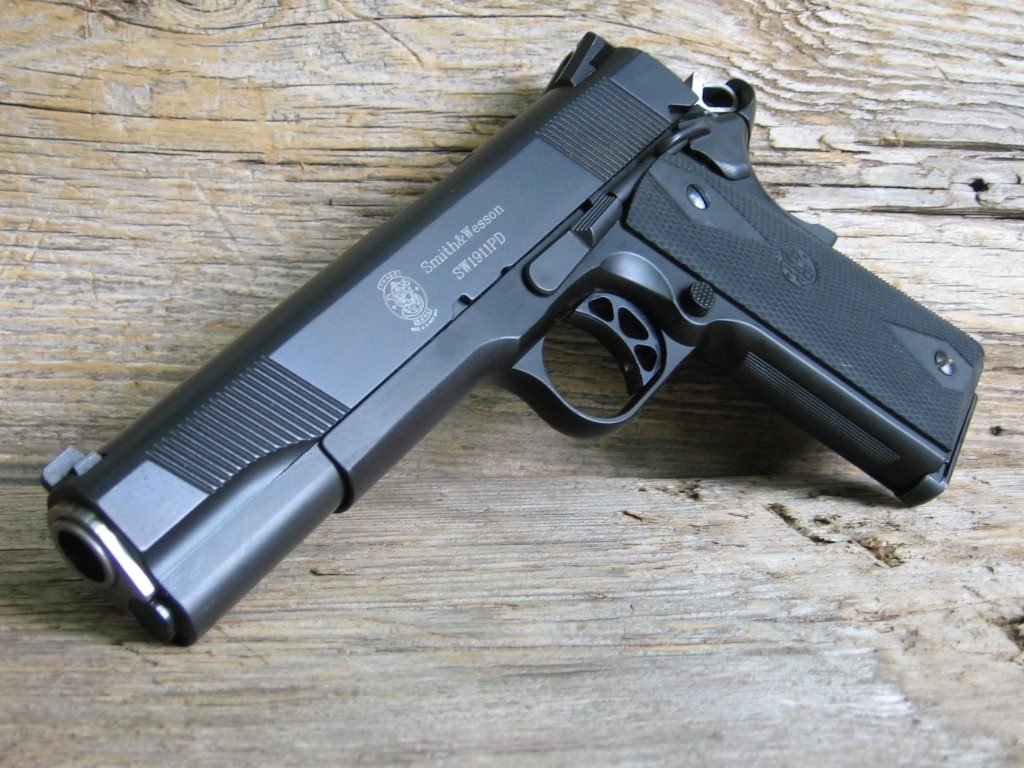
A new lightweight 1911 was inevitable when Smith & Wesson began making their version of "old slabsides". In 2004, S&W first introduced the scandium alloy framed SW1911Sc. It weighed an overall 28-ounces, as opposed to the near 40-ounce weight of a standard Government Model. The pistol was an instant hit for a carry gun, and has proven to be durable and reliable. In 2006, Smith & Wesson showed they listened well to their customer base when they released the SW1911PD. The SW1911PD was essentially the same pistol, blacked out, with more discreet markings on the slide. Click to enlargeWhen I found a used SW1911PD for sale at a good price, I quickly snapped it up.

Like the SW1911s before it, The SW1911PD has a serrated frontstrap, Novak sights, and a grip safety activated firing pin safety. The small parts are made of MIM, and the mainspring housing is checkered aluminum. From the factory, the pistol has a solid full length guide rod, and forward slide serrations, both of which I can live without. The external extractor on the SW1911 is not what John Moses Browning designed, (or rather, what the US Army requested), but Smith & Wesson had a lot of experience with external extractors on their double action auto loaders. Where external extractors fail on other 1911s, the S&W unit has a reputation for keeping on ticking.

To bring the pistol closer to my idea of a carry gun, I installed rubber S&W grips, a GI recoil set-up, and did a trigger job on it. Astute readers may notice a marking gone. With a Wilson magazine stuffed inside, I was ready to take the pistol to the range for reliability testing. Click to enlargeI brought along 250 rounds of Winchester White Box 230 grain target ammo, as well as 50 rounds of Federal 230 grain HydraShoks. I also took a standard SW1911 to compare the scandium framed pistol to.

I had read how the scandium 1911s were more difficult to shoot, due to their lighter weight. I prepared myself for that, but I refuse to wear shooting gloves. Over the past three years, I had not read a single complaint regarding the frame being weak. That is a good thing, because I like to train with what I carry. If a pistol cannot stand up to the pounding I will give it in training, I really don't want to stake my life on it.

I started shooting with the SW1911PD, first, just making certain it was safe after my gunsmithing efforts, and then trying to make it jam. I limp wristed it. I shot it sideways. I rode my thumb on the slide. I shot it upside down. Not once did it fail to feed and shoot. The safeties functioned positively as advertised.

I shot all 300 rounds through the SW1911PD. It was a blast to shoot. It had a quick, certain return to sights, allowing for rapid recovery and follow-up shots. Click to enlargeI found absolutely no difference in muzzle flip than what I am used to in a Government Model. Perhaps this is because I use a very strong isometric grip in a Chapman stance for my shooting. With my grip, the weight of the frame is simply not a factor in recoil.

I was, frankly, having a blast. Two shooters with Glocks were off to my right, and I was eating them up at 30 feet. I was punching holes in an index card taped to the chest of a silhouette target. There was a single ragged hole in that card. I was flying high. The SW1911PD was accurate. If I slowed down, it was a precision shooter. Then, I had a problem........I was out of ammo.

Damn. I went to the counter, and I bought another 100 rounds of 230 grain MagTech ammo. I decided I had better switch to the standard framed SW1911 immediately. I noted that the perceived recoil and muzzle flip was the same in my hands. Click to enlargeI shot about 25 rounds through the standard SW1911 and I realized something else. The SW1911PD was actually easier for me to shoot! I could hold it up, with less effort, for a longer period of time. No wonder I had unknowingly blazed through my ammunition. My arms simply were not getting tired from holding the extra weight extended at arms length!

I only have 375 rounds through this pistol thus far, but it is showing great potential as a carry gun. I have little doubt that the reduced weight on my belt will result in less fatigue at the end of the day. I would have absolutely no hesitation about recommending this pistol to a woman as a carry gun, assuming she is familiar with the 1911 platform, and uses an isometric grip. I look forward to passing the 1000 round mark and putting the pistol into service as a carry piece.


Then, I wondered how it would compare to my Colt Compact.

Update: The first internet report on a SW1911PD frame cracking that I have come upon is here.

Labels: , , ,

Saturday, February 17, 2007

Remington Rand First Shots

Click to enlarge
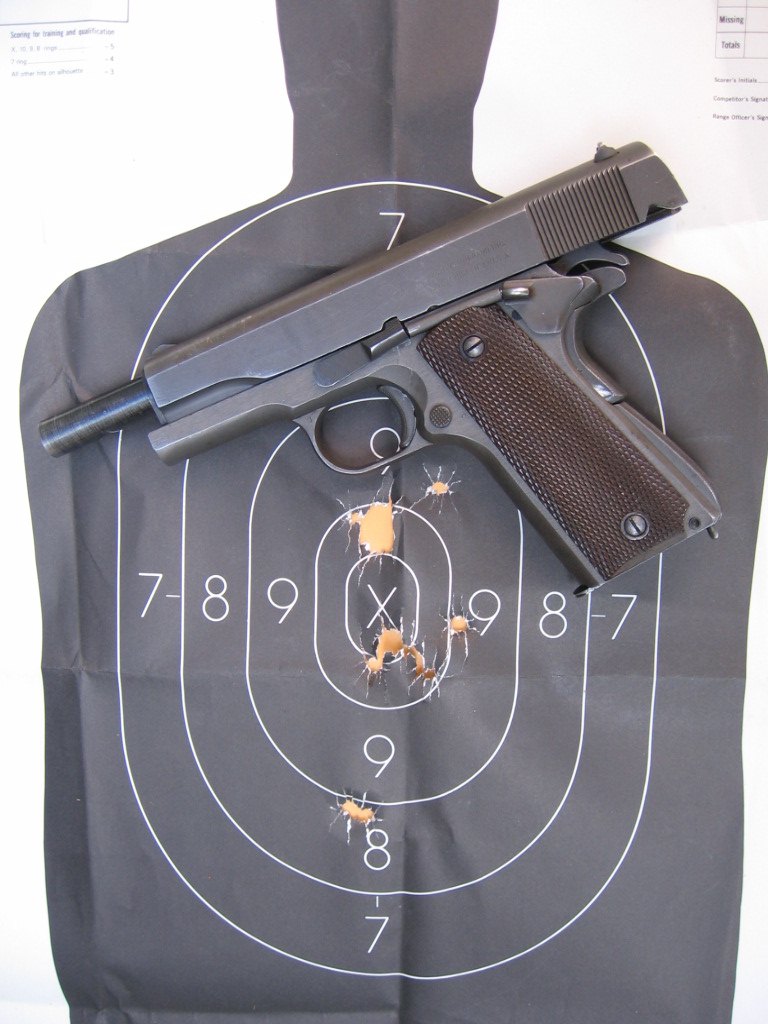
I took the Remington Rand M1911A1 out to the range today, with the original HS barrel installed. I shot it at 7, 15, and 21 feet, using 230 grain Winchester hardball. It performed flawlessly through two hundred rounds of ammo.

Two stations down from me, a young man was teaching his girlfriend to shoot a Glock. It made me wonder........They were all over the page, but it was likely not the pistol's fault. I started to rent a Glock pistol to compare the Remington to, but I will save that challenge for another day.

Labels: , , ,

Monday, January 01, 2007

Serious Business: The Highway Patrolman

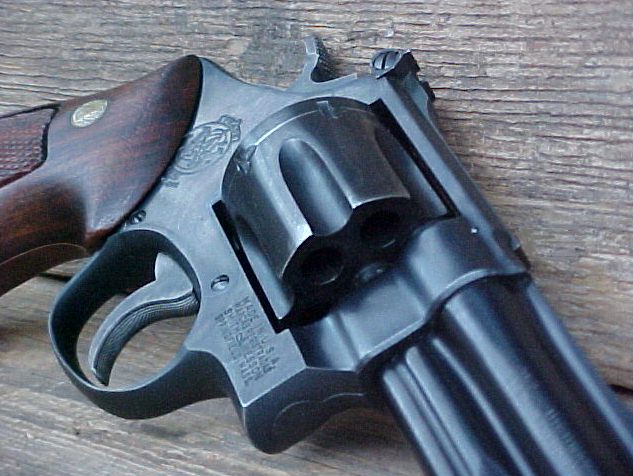
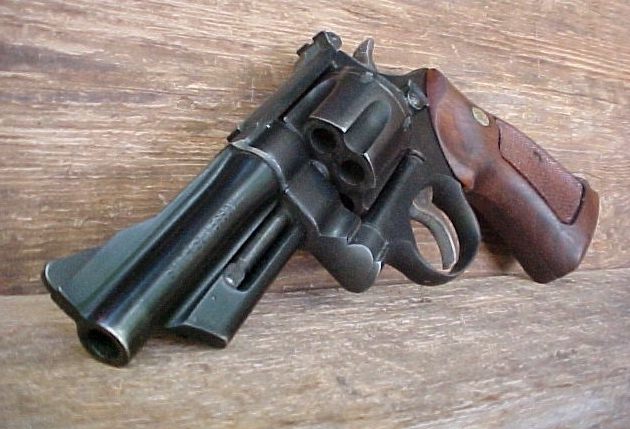
The Model 28-2 is a rather unusual Smith & Wesson. It is a revolver that had features deleted rather than added, with the sole purpose of building a more pragmatic gun, not of cutting costs. As such, it became the epitome of minimalism in handgun design. The Model 28, also known as the Highway Patrolman can trace it's heritage directly back to the venerable Registered Magnum. The Registered Magnum later morphed into the Model 27. Law enforcement agencies favored the Model 27, but the high polish and sumptuous topstrap checkering was not practical in a carry gun. To accommodate them, Smith & Wesson followed the path of Staatliches Bauhaus. The minimalistic approach was never to create something that was less, but rather to remove ornamentation from art in an attempt to reveal it's most fundamental form, the essential substance of the work if you will. As as result The Model 28 becomes the N frame imperative.

Pinned and recessed N frame Smith & Wessons are rapidly becoming scarce on the used handgun market. As a firearm created specifically to fire the .357 magnum round, the N frame is a requisite gun for the Smith & Wesson collector.

Representing the essential N frame, the Highway Patrolman is blued, but it is not polished. The topstrap and frame rounds are beadblasted to achieve a stippled appearance. The overall effect is a gun that exudes serious business. It is not a flashy gun. It needs no ballyhoo. It speaks the hardcore indisputable language of the .357 magnum. It speaks that lingo again and again, and that is enough.

I took the Highway Patrolman to the range yesterday, among many other guns to shoot. I was shooting with an old friend who was a shotgunner, but not a handgunner. We shot clays for about an hour, and then we set out targets. I started to work with him on handgunning skills. We were, of course, shooting .22 revolvers, but I had brought along a couple of 1911s and the Highway Patrolman as well. Todd is a man with an interest in history, so he shot my GI 1911 copy and liked it. He then picked up the big N frame Smith, fondled it a bit, felt it's heft, and put it back down. I asked him if he wanted to shoot a cylinder or two through it. Todd declined. "That's a damned serious gun," he said. He was right. It's a unique revolver in a long line of resplendent Smith & Wessons, a gun stripped to it's elemental form, designed for nothing more than deadly social callings, and keeping officers of the law alive. It doesn't get much more serious than that.

Labels: , , ,

Sunday, October 01, 2006

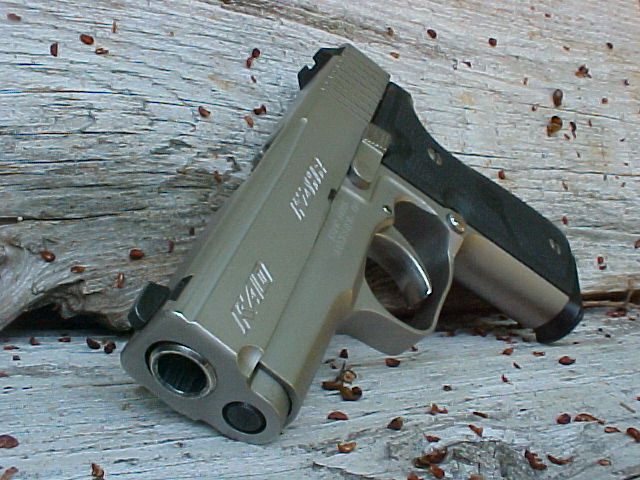
The Kahr K40 Revisited

Back in 1999 I purchased this Kahr K40 as a carry gun. I found it at a used gun counter, and forked over $489 for it. Unlike many of it's brethren, this pistol is plated in electroless nickel, making for a durable and beautiful finish.

I carried the pistol for a while, until my wife shot it. It then became her carry gun. The Kahr is one of the first pistols that was designed on computers through CAD/CAM and 3D modeling and then produced on CNC equipment. The result is a mass produced pistol that has the fit and feel of surgical precision. It is not a flyweight pistol like some of the polymer Kahrs that followed it. The K40 has heft. You know it is on your belt.

The K40 utilizes polygonal rifling, and a 6 round single stack magazine. Until the pistol is grasped in a firing grip, it feels top heavy. Insert a full magazine and grip the pistol properly, and all that changes. It becomes an imminently pointable pistol, an extension of one's hand. The Kahr pistol incorporates six different design patents that make it unique in the world of firearms. It sits lower in one's hand, and the single stack magazine provides an almost straight path for chambering ammunition. The feed ramp is offset, allowing the trigger to be next to it, rather than below it. The barrel hood is relieved to facilitate ejection from tight quarters. The result is a pistol that carries the maximum amount of ammunition in the smallest space, while maintaining the lowest possible bore axis, without compromising reliability.

The Kahr K40 is not a match quality pistol, but it is accurate. I can keep all shots on a 5X9 index card at 10 yards. Other people had better accuracy, but then, gun magazines usually have better results. The Kahr K40 does exhibit some snappy torque on recoil. It's not unmanageable, but it is stouter than a Government Model in .45ACP. I no longer care for the trigger on the Kahr. It is silky smooth, but it progressively stacks until sear release. For a man grown accustomed to 1911s and Smith & Wesson revolvers, the Kahr trigger is disconcerting. For other shooters, it may be ideal. When I bought the pistol in 1999, I liked the trigger. In fact, I bought the pistol because of the superior fit and finish, and that trigger. It's strange how perceptions change over time.

My wife now carries a J frame, and I prefer a 1911. I don't have any .40S&W practice ammo in my cabinet any more, and the Kahr rests in it's plastic box in my safe. I don't shoot it any more. I suppose the time is coming that it will be traded off. It is a good pistol though, just not my taste anymore.

Labels:

Wednesday, August 30, 2006

Clark Combat Colt 1911

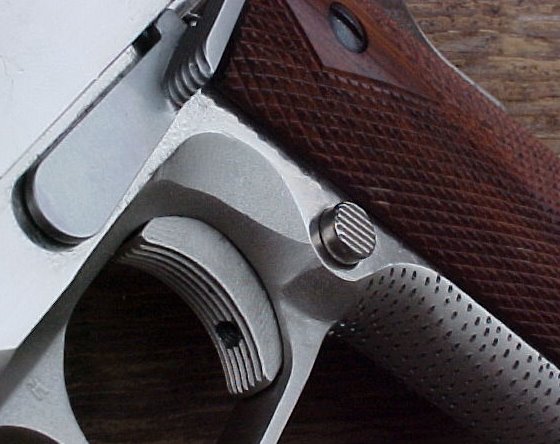
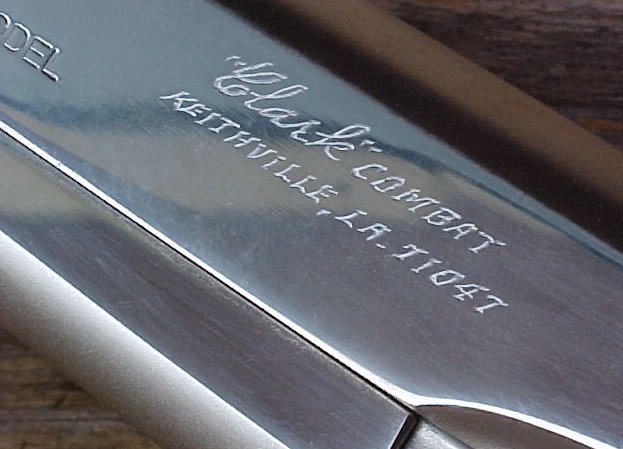
Long before Bill Wilson ever checkered a front strap, James E. Clark had found a way to glue a pistol into a competitor's sweaty hand. Jim Clark had been customizing pistols for eighteen years when Ed Brown decided to become a part time gunsmith. Jim Clark was a founding member and the first President of the American Pistolsmiths Guild. As a competitor, perhaps he was proudest of being the only civilian trained national bullseye champion. In 1950, Jim Clark founded Clark Custom, and began a career of producing no bullshit innovative and competitive pistols based on the 1911. One must remember that surplus GI pistols were the raw materials of building a race gun then. There were few parts on the market to augment a gunsmith's ability. If a man could not weld, fabricate and create, he could forget being a gunsmith. In this environment, Jim Clark flourished, laying the groundwork and ideas for the many permutations of the 1911 pistol that were to follow. His son, Jim Clark Jr. continues his father's legacy at Clark Custom, but as a North Louisiana resident, I always hoped to find a gun made by Jim Clark the Elder. Even in the piney woods of North Louisiana they are precious heirlooms, as rare as turtle teeth, or priced like golden boudin when they appear.

Finally, after years of perseverance, fortune would shine on me, and I found a Jim Clark the Elder gun that I could afford. This pistol was ordered from Jim Clark by an anesthesiologist in 1981. It is built on a Colt Mark IV Series 70 base gun. He shot a "box or two" of ammunition through it and put it away. Even though this pistol does have a Safari Arms extended safety and slide stop, they were impeccably fitted by the old man himself. The lockwork on this pistol snicks back and forth with a precision and an ease that belies it's close tolerances.

In this gun Jim Clark was not attempting to build a beautiful gun. It is almost ironic that he inadvertently did. Nickel was laid across this pistol not to provide additional glitz, but to effectively prevent rust in the sweltering Louisiana heat. When Jim Clark Sr. needed a competition trigger, he simply took the original Colt trigger, drilled and tapped it for a set screw, and then adjusted the length of the stirrup by welding a polished shim at the back to achieve a zero take up, minimal over travel trigger. The pull was adjusted through polishing the trigger stirrup, adjusting the sear angle, hammer hooks and sear spring. This pistol has a trigger that breaks consistently at three pounds with no wiggling around in the trigger guard.

To cement the gun in the shooter's hand, Clark applied his trademark "Tiger Tooth" stippling to the front strap and mainspring housing. Clark's technique is not as pretty as Ted Yost's perfect checkering, nor as fashionable as Ed Brown's reptilian scales. Clark's stippling is incredibly effective however. Grasping it is like holding a rasp in your fist. When the little metal teeth created by Clark's chisel bite into one's calloused hand, this pistol is not going to shift under recoil.

In 1981, Clark Custom offered low mounted Bomar adjustable sights, or Smith & Wesson K frame adjustable sights. Like many early shooters, my anesthesiologist friend opted for the S&W sights. They were a known quantity with an available parts supply, and when mounted correctly, they compliment the lines of the 1911. Indeed, they almost look like the Gold Cup's Eliason sight. It is indicative of Jim Clark's craftsmanship that not a hint of the original rear sight dovetail remains to be seen through the nickel finish. Unless the hammer was placed beside an original, the bobbed hammer is just as stealthy. Clark paired the Smith & Wesson rear sight with a ramped hardball front sight, into which he grafted an orange plastic insert. The orange portion of the front sight precisely fills the rear notch. There is no more nor less than necessary.

Today, when Clark 1911s are mentioned, many people visualize the incomparable Clark Meltdown. Clark Custom is not founded on the Meltdown, but rather on guns that work. Jim Clark was not known for building beautiful guns. Indeed, Armand Swenson was the man to go to for a beautiful custom Colt in those days. Jim Clark was known for building effective guns. When I purchased this pistol, the seller also supplied me with the original paperwork. This pistol received Clark's "Combat Conversion", consisting of an accuracy job, trigger job, the S&W rear sight, front strap stippling, ramp work, lowered ejection port, and mag well bevel. The seller had also requested the extended safety and slide release, stippled mainspring housing, orange sight insert, and white outlined rear sight. The 1981 base price for the pistol was $352. The Combat Conversion and extras cost $393.50, for a total of $745.50 in 1981 money.

Even today, Clark guns are commonly the homeliest gun on the line at any competition. Their effectiveness, however depends solely on the shooter. They allow no excuses. Jim Clark guaranteed a three inch ten shot group including "first shot flyers" at fifty yards. Today, other manufacturers, most notably Les Baer, make the same guarantee. They, however, manufacture their own frames and slides on CNC equipment. Jim Clark honored his guarantee on a Colt 1911 that he peened the rails on, and welded up and refitted the factory barrel on himself.

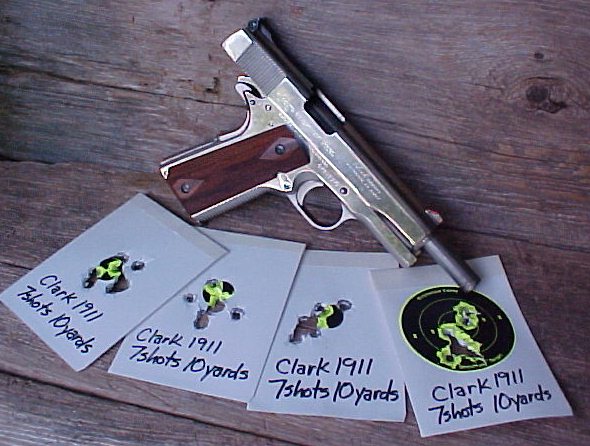
When I took this pistol to the range with a couple of boxes of 230 grain hard ball, Jim Clark's work spoke for itself. This pistol shot like a hellcat. It had no stoppages and tossed the empties neatly to my right. The pistol shot every bit as well as I was able. It came to sights quickly and accurately. It placed every shot exactly where I aimed it. In 1981, Jim Clark created a pistol that continues to impress twenty five years later. That is nothing short of amazing.

More

Labels: , , , ,