A Nurse with a Gun

Wednesday, March 04, 2009

Old Guns

There is something gratifying about a gun that has honest wear. It does not create concern over the first patch of silver peeking past the finish. It asks for no special treatment, just a bit of lubricant and a steady diet of ammunition.

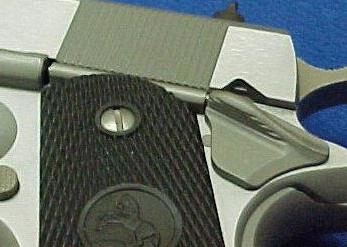
Click to enlargeI find myself more and more attracted to basic 1911s. To make their pistols stand out from the competition, many manufacturers have produced 1911s that border on the pretentious. Weird two tone frames. Strange slide serrations. Flamboyant curves and blended edges. Browning's masterpiece is not a pretentious pistol though. It's a basic tool designed to save a soldier in a last ditch effort when his rifle is empty.

The more I shoot my Colt M1991A1, the more I like it. I have had a couple of failures of the slide to lock back on a Chip McCormick magazine, but a magazine change remedied that quickly and effectively. The pistol has been otherwise reliable, and surprisingly accurate. I had considered changing out the rear sight for a Yost Retro sight, but at this juncture, I don't see the point. I like the pistol as is. A set of walnut double diamonds and a plain black aluminum trigger put this gun exactly where I wanted it to be. Simple. Durable. Reliable. Accurate. Less is more.

Labels: ,

Thursday, February 05, 2009

Pawn Shop Circuit: Two Models of 1905

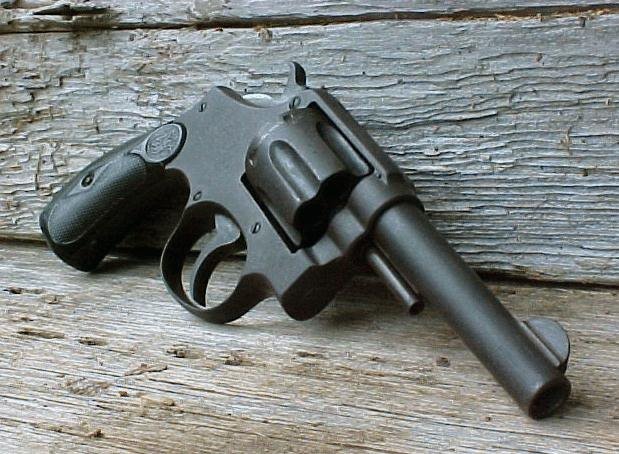
I finally went by Neil's pawn shop and paid off the Model 10-8 that I had placed on lay away back in October. Click to enlargeThe sale price on the nickel service revolver was $239, and I only had $37 more dollars to pay.

At one time not long ago, I would have passed on a Model 10 that was over two hundred bucks, but times have changed. You just don't see them what I used pay any more. I suppose that goes for a lot of things. Earlier in the week I looked over a blued Model 37 with a three inch barrel, but the $425 price tag switched me off cold. I'm willing to recognize the prices have gone up a bit, but I'm not willing to pay 2015 prices yet.

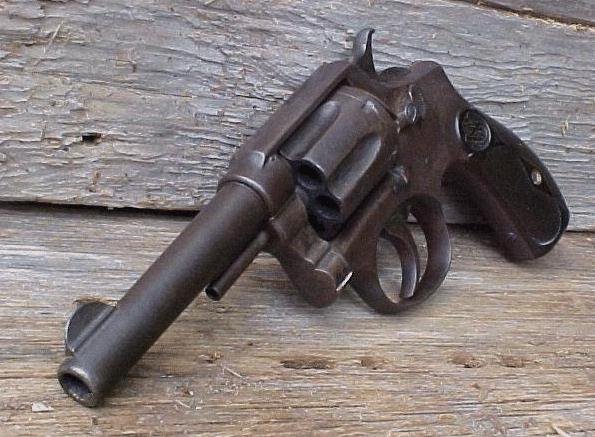
I took the modern day Model of 1905 home and cleaned it up, and then found some period appropriate magna grips in my spares box. It's my first heavy barrel Model 10. I've just always preferred the taper barreled M&P, but I have to admit the heavy barrel handles nicely. Click to enlargeWhen compared with my eighty-eight dollar Model of 1905 (no change) that I picked up at the last gun show, the Model 10-8 looks like a jewel.

The Model of 1905 was the first five screw Smith & Wesson revolver. It was manufactured for one year before the first change occurred. There is something about those old brown revolvers that I enjoy. They are invariably inexpensive, they are about as tactical as a pair of Hush Puppies, and the patina reeks of a past unknown. Yeah, I appreciate the old beater guns nobody else wants too.

Labels: ,

Monday, January 26, 2009

The Colt "Black Army" M1911

In May of 1918, to meet the demands of the US Army in the war to end all wars, Colt changed the way it finished the Model of 1911 pistol. The Army wanted production increased, and requested that Colt eliminate the final polishing process prior to bluing the M1911. As a result, the surface of the pistols would be left with a rougher appearance, unlike previous Colts. In addition, Colt began using a gas fired oven blued process. Between these two factors, the appearance of the M1911 changed from a lustrous blue to almost black. Collectors have since coined the term "Black Army" to denote the last of the M1911 pistols, with the finish phased in after serial number 312000.

To be sure, Hartford was cutting corners to produce as many pistols as possible. Many of the small parts such as the slide stops and thumb safeties were outsourced or previously manufactured, and were still polished and blued in the previous manner. Over time, the weaker "Black Army" finish wore off many of the slides and frames while the small parts remained blued. After ninety years, the uneven appearance from different rates of wear often gives the impression that all original pistols were put together from scavenged parts. Click to enlargeBecause of the mix master appearance when weathered and a greater chance of wear on these wartime pistols, many collectors are still seeking the elusive Colt "Black Army" pistols with a high amount of finish. When such a pistol appears on the market, it can command high prices.


All "Black Army" pistols will have the rampant Colt in the center of the slide. The prancing pony moved there sometime between serial number 275000 and 290000. They will also have the typical characteristics of a M1911, a smooth flat mainspring housing with a lanyard loop, an early M1911 slide stop, and a wide spur hammer with an itty bitty spur on the grip safety. Walnut double diamond grips are de rigueur.

I was fortunate to find my Colt "Black Army" walking into a gun show at a fair price. Although the wartime expedient finish is mostly absent on the exterior of my pistol, it has seen very little actual use. Click to enlargeThe interior parts are still as new, and the bore is bright. Prior to being accepted by the US Army, this M1911 was given the nod by Springfield Armory inspectors. The eagle proofmark is visible above the magazine release. I am happy to have an all original M1911 that can be handled without hesitation.

While the "Black Army" pistol is often viewed as a World War One pistol, it must be remembered that the Great War ended with the armistice signed on 11 November, 1918, a scant seven months after the "Black Army" variation began. Thousands of Colt "Black Army" M1911s languished in the armories of the US military, where they sat ready until war was again declared in 1941. The "Black Army" Colts were a common sidearm in the combat theaters of WWII until 1943, when production of the M1911A1 reached it's zenith. It's ironic that many pistols often associated with WWI finally saw combat after Pearl Harbor, and were brought home by the GIs of WWII.

Labels: , ,

Monday, January 12, 2009

Finish Wear

After work this afternoon, I took two of my beater 22s to the range for some informal plinking. Every shooter should have a 22 handgun that is weathered and scarred. Click to enlargeThe shiny silver peeking from beneath the blue just means they get used, and a 22 handgun should get used, a lot.

The Ruger MKII pictured here is what I call my "fishin' gun." It wears a Clark Custom palmswell grip that changes the MKII grip angle to that of a 1911. I wish Clark still marketed that grip. I have a Volquartsen sear and trigger in the pistol as well. The muzzle is silver now, and the grip metal finish is worn away to a lovely brown tone. Gun oil and continued use keeps the rust demons away.

The Model 17-3 was purchased from Dave's pawn shop a few years back. I had searched gun shows and pawn shops a long time for a Model 17 priced under $200. Dave sold me this one for a buck less than that. The finish wear made it affordable, but the old gun is no less accurate than it ever was. If a person is a revolver shooter, they should not wait as I did. I was extremely lucky to find a Model 17 in that price range.

Finish wear is actually a good thing in a lot of ways. I don't have to worry terribly about that first bit of silver appearing on the muzzle. I take care of the old handguns, but they can be stuffed into a holster and spend the day bouncing around on the bench seat of a pick-up truck, or riding on my hip. And that's what a handgun should do.

Labels: ,

Wednesday, September 17, 2008

The Police Positive Pocket Pistol

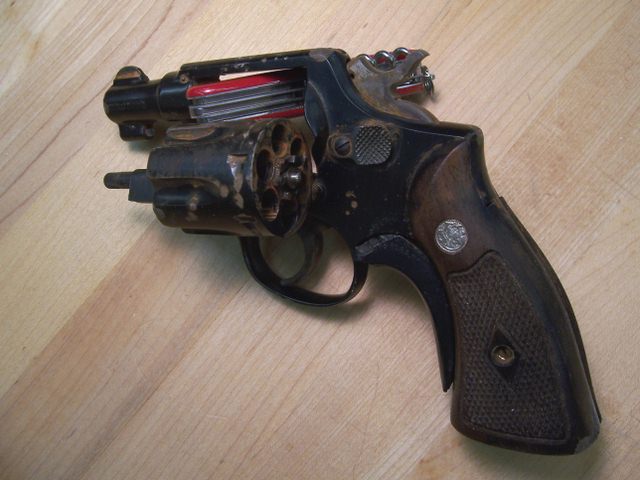
I enjoy guns with a history. One day, while in a hole in the wall pawn shop near Arcadia Louisiana, I spied what I thought was an early Detective Special. It looked rather lonely in it's fake stag Franzanite grips, so I asked to see it. What was handed to me was even more interesting.

I was handed a First Generation Colt Police Positive. As serial number 1529XX, it came out of the Colt factory late in 1923. Click to enlargeAll the numbers matched, and it locked up with the famed Colt tightness. It was chambered in .38 S&W. What was interesting was the barrel. It had been cut down to two inches and had the original sight silver soldered back on. As I held the gun, I felt the history flow out of it. I felt more history in this gun than any sock drawer special collector gun I have held. The gun was altered and as such, it had no real collector's value. I'm more interested in the history of concealed carry than the history of firearms manufacture though. The pawnbroker and I dickered a bit and finally agreed on a price.

To me, this gun had value.

Because of the quality of the work, and the use of the original sight, I made the leap of faith that the attenuation of the barrel occurred early in this Colt's life. At one time somebody needed effective concealed protection, or perhaps an officer of the law made detective and transitioned to plain clothes. Either way, the gun needed wasn't available from the factory or in the township, or perhaps money was scarce. The owner of this revolver decided to take matters into his own hands and delivered the gun to a skilled gunsmith. The revolver was delivered back to the owner as an effective carry weapon. I am drawing this conclusion based on the availability of weapons and the economic reality of the time, but I believe the barrel was cut down either before or during the Great Depression. Because of the remaining blue finish, I believe this gun was stored for several decades before it came into my possession. An interesting aside is that it fits perfectly into my J frame pocket holsters.

I was at first confused that on a weapon such as this, the hammer had not been bobbed. I later learned from one of my patients that in the 1920's there were many people who had learned to shoot with the Colt SAA. Cocking a hammer on a draw was commonplace. On this gun, the carrier's thumb would likely have rested on the hammer while the gun was still pocketed, effectively shrouding it on the draw stroke, and cocking the weapon while it was drawn. The unbobbed hammer supported my conclusion of when the barrel was cut down.
I've shot the revolver a few times, but the cost of .38 S&W is rather prohibitive. I'd rather buy .45 ACP. Still, the old cut down Police Positive is one of my favorite beater guns from days gone by, a real concealed carry belly gun that must have an interesting story behind it.

Labels: ,

Saturday, July 19, 2008

How Much Is It Worth?


"I was browsing the local gun store today and looked at an old S&W Victory model .38 special. The gun locks up tight, however, it is very beat up from the outside, the blue is almost entirely gone, the grips are bad, and some dufus engraved his name into it. (poorly)

What would you say a gun like that is worth? They were asking $299 but I think that's too much, I might go back and make an offer. I've been looking for a gun in exactly this kind of shape to fix up...but I'm thinking it should be under $200. Am I wrong?"

First, make certain it is originally a .38 Special and not one of the converted British Victories.

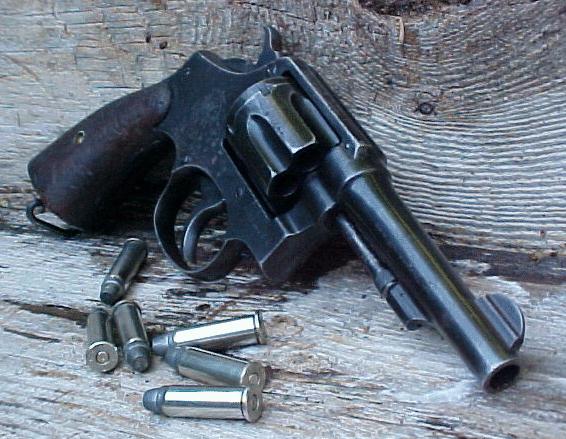
Assuming it is originally .38 Special, and assuming it has no function issues, a beater Victory Model is worthwhile as a functional firearm. If it still has the original grips and lanyard loop, it can be an interesting addition to a revolver collection. Not all guns have to be pristine. Sometimes it's nice to just hold a scarred up old gun and wonder about the stories it could tell.

Several years back I purchased a battle scarred and reblued Victory Model that had a bent trigger guard binding the trigger. It had diamond magnas on it, and the lanyard loop was long gone. I fixed the trigger guard, put on some appropriately scarred Victory grips and a lanyard loop. I enjoy shooting it, it's reasonably accurate, and I don't have to worry about devaluing the gun if it gets knocked around a bit. To me, that has value.

I paid $150 for it. I've had a lot of fun with it, it shoots decently, and is reliable. It's also historical. To me, that is worth $150, perhaps a bit more now. Later on, I found a nicer Victory Model for $300. I bought that one too. I still have them both, but the one I brought back from the brink is the one I prefer.

At this time, in my opinion, $300 is too much to pay for the Victory Model you describe. $150 is more like it, maybe $200 if you are in a S&W deficient area. In time, it will be worth $300, but it's going to be quite a while. If you want the gun, try to talk the seller down to a more reasonable price. Wait him out if you have to. If you have $300 and want a Victory Model in better condition, you can likely find one fairly easily. Whether the revolver in question is worth $299 is entirely up to you though. On a gun like this, the gun has no absolute value. It is only worth the price the seller and buyer agree on. You, or another buyer, will be instrumental in making that determination.

Labels: , ,

Sunday, June 08, 2008

On Getting Beaten

I am often asked how I find the deals I do in firearms. I have a simple answer, I show up with cash and I look for them. I look at estate sales, garage sales, gun shows and pawn shops. I put the word out of what I am interested in. Often, putting the word out among women can be more fruitful than putting it out among gun nuts. Sometimes though, I am a day late or a dollar short, just like anyone else.

At a gun show last year, I was only ten minutes late. I had entered the auditorium on the West side, but one of my good friends entered on the East. Click to enlargeWhen we met in the middle and shook hands, Lester opened his jacket to show me the Smith & Wesson revolver he had just purchased stuck in his belt.

It wasn't a collector's piece by any means. This was no revolver that had been purchased and then stuck on a shelf in the original box having never been fired. It was more interesting than that. This was a Smith & Wesson Model 27-2 with a three and a half inch barrel that had been carried. Whether it started as a blue gun or not was anyone's guess, but now the remnants of it's finish resembled parkerizing. It was honest wear, and a lot of it. The big N frame had spent it's life in someone's holster, not someone's drawer. To me, that was beautiful. To Lester and his daughter, it was beautiful too. He bought it for her, and then she left to go look at jewelry.

I was dumbstruck as I handled the weathered .357 magnum revolver. Here was one of the most desirable Smith & Wesson revolvers today, in a condition that invited carry rather than investment. The revolver locked up like a new Model 27. Click to enlargeThen Lester told me the price he paid, and I almost fell over. $265. From a dealer. The dealer had tried to tell Lester it was a Model 28, and then had talked down to Lester when Lester tried to inform him otherwise. Lester's daughter had been the wise one. "Just buy the gun Daddy, I want it," she had said. Over the past year, Lester did do a couple of things to the old revolver. He swapped out the beat up original grips for stag, and he replaced the damaged rear sight blade.

Often times I feel like I have found a mini oasis in the gun collecting accumulating world. I enjoy the guns that show time spent in a holster. I enjoy the firearms that have been modified to make them more suitable to the job at hand. This gives me an opening and a chance to find many different firearms that I enjoy. Even so, I occasionally still get beat to the table.

Labels: , , , ,

Thursday, November 29, 2007

The Smith & Wesson M-13 Aircrewman

Experts say there are more fakes of this revolver on the market than real ones. The value is so high that fakers are willing to risk felony time just to alter a serial number to get a fake gun lettered as authentic. Click to enlargeThe Smith & Wesson M-13 Aircrewman was produced from 1953 to 1954 with an aluminum six shot cylinder. In 1954, the cylinder was changed to steel. There were approximately 40,000 produced, with nine known variations, and almost all were destroyed by the U.S. government. The cylinder had an objectionable habit of turning into a grenade when the cartridge inside it ignited. Production ceased in 1957.

M-13 Aircrewman revolvers were given serial numbers within the range of other production K frame revolvers such as the Model 12 Airweight. Some of these commercial models, with serial numbers in the correct range, where given fake markings to make them appear similar to an Aircrewman. Unscrupulously reproducing the stampings on the aluminum frame is pretty easy. The barrel markings are more difficult to forge. M-13 Aircrewman barrels were marked on the right side with "AIRCREWMAN" over the ".38 Special CTG". The caliber marking is in smaller type than commercial models. Click to enlargeSerial numbers range from C247,000 to C405,363, but serial numbers of genuine demilled examples are best kept secret lest a felonious faker usurp the numerals for his "representative example" and then seek to have result lettered by Roy Jinks. Suffice to say, Aircrewmen with an AF prefix change hands in the $5000 range.

The M-13 Aircrewman and holster pictured here are genuine, the real deal. Alas, they are not mine. Most of us will never be so lucky as to find this revolver gathering dust on a pawnbroker's shelf. Marilyn Monroe is more likely to knock on our door and lavish us with a lifetime supply of ammunition and free gun cleaning services.

I was, however, fortunate enough to receive a M-13 Aircrewman. Click to enlargeMine, is regrettably the result of John Kennedy's administration trying to protect our fly boys. It was crushed to insure it would never be fired. Then it was sold off as scrap.

The "Property of U.S. Air Force" markings on the backstrap and the "Revolver, Lightweight-M13" markings on the top strap are still intact, as is the inspector's mark. The C prefixed serial number falls within the correct range. Because it is a crushed example, it is almost certainly the real article. It is inconceivable that a faker would fake a crushed frame. I will guard the serial number to prevent it from being used fraudulently. Click to enlargeI was offered this chunk of aluminum by a friend who spotted it at a gun show. I happily accepted it, and placed it into my collection of revolvers, right beside a crushed Victory Model.

If you believe you have an Aircrewman in your possession, one of your best recourses is to post photos of the revolver on the S&W Forum for evaluation. Then consult the Standard Catalog of Smith & Wesson for more information. Finally, get the revolver lettered. If you are buying even then confirm and consult as much as possible.

As I was photographing my M-13 along with an ejection handle I had brought home from my military service as a souvenir, I noticed the "Smith & Wesson Lifetime Service Policy" emblazoned on the blue counter mat. I wonder.........

Labels: , , ,

Friday, October 19, 2007

The S&W K-38 Combat Masterpiece

One of my favorite revolvers is a weathered .38 special handgun that I found on a pawn shop shelf years ago. Click to enlargeIt possessed incredible balance, and one of the smoothest double action triggers I had ever pulled. I suspect it received a professional trigger job at some point. The .400" wide serrated target trigger cranked back a matching 0.5" wide target hammer with ease, releasing it with no stacking or grittiness. I negotiated the price down to $179 from a tag reading $200. The old gun bears an exterior that has seen better days. If it were not for the cold blue painted on, it would likely have more metal than bluing glistening in the sunshine. Never the less, the appearance of the revolver belies it's performance.

The time worn revolver wore incorrect 1970's style magna grips when I purchased it. I took it to the range with a bucket of .38s, and I was amazed at it's inherent "handiness" and accuracy. When I finally found a Colt Python in my price range, the old Smith & Wesson was my standard of comparison in a range report. In my hands, wearing a Hogue Monogrip, the old Smith beat the snake. It is still the standard by which I judge other wheelguns.

The weathered old war horse I speak of is the venerable Smith & Wesson K-38 Combat Masterpiece. Click to enlargeNow, wearing proper diamond magna grips, my K-38 is still the sweetest wheelgun in my collection. The K-38 Combat Masterpiece was a beautifully blued revolver, with a four inch ribbed barrel and a Baughman Quick Draw front sight paired with an adjustable rear sight. It has serrations fore and aft on the metal portion of the grip frame. The package included the short fast action and an anti-backlash trigger. My revolver, serial number K2208XX, was produced in 1954, just in time to still be a five screw revolver. In 1957, the K-38 Combat Masterpiece evolved into the Model 15 with the introduction of model numbers.

My K-38 Combat Masterpiece had obviously spent a life in a holster when I purchased it. I suppose it was the sidearm of a peace officer at some time. I have to believe that this peace officer knew his stuff when he armed himself with this fine piece of sweet triggered ordnance.

Labels: , ,

Tuesday, January 16, 2007

Rescue Revolvers

The S&W Forum is one of the absolute best places to get information concerning Smith & Wesson revolvers. Posting there can sometimes be intimidating for the neophyte though, because of the level of expertise, as well as the gorgeous photos of rare revolvers owned by the members. Recently some members ave begun posting threads with pictures of neglected revolvers they rescued and renovated for little or nothing. For the pawn shop scrounger, these threads are very heartening and interesting. Here are two.
Rescue Revolver's and Another "rescued" revolver!

Labels: , , ,

Saturday, June 10, 2006

Pawn Shop Circuit: Tent Sale Remington

Neil was having a tent sale this morning, and I had promised to go by. He had beaucoup tools and electronics outside under the tent, but inside he had discounted a slew of shotguns as well. It seems Louisiana's shotgun migration has once again hit homeostasis, and they are clogging up the pawn shop shelves.

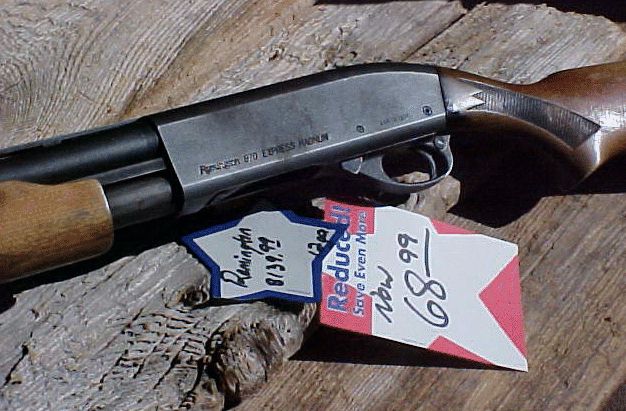
I asked Neil to show me his cheapest shotgun, and he handed over a Remington 870 Express Magnum, marked down from $139 to $69. That was to much to bear. It was in good shape with the usual wear patterns one would expect from more storage than shooting. I have always eschewed Remingtons for the Mossberg or Winchester pumps. I just like the location of the safety and slide release better. For seventy bucks though, it's the perfect shotgun to have on hand as a beater or trade fodder. For seventy simolians you cannot lose. I asked for a 4473.........

Labels: , ,

Thursday, May 25, 2006

Miss Myra's Gun

Miss Myra had never been afraid of what the future held. When she was a child of eleven years, her father had handed her a revolver and instructed her to take care of her little brother and sister while he went to look for work. He never returned. For her, the future was always uncertain, but she knew it would come regardless, so she had no fear. When she reached her 89th year, she knew she could no longer live on her own, and she would have to go into a nursing home. She called me to come get the one thing she had held dear all of those years, her talisman against the dark and unknown future. Miss Myra gave me the gun her father had given his young daughter. She said she could not keep it, and she would not need it where she was going. She refused to let me pay her for it. I accepted her kind gift with reverence. I felt so undeserving, but Miss Myra told me she only wanted me to have it.

Miss Myra's gun is a Smith & Wesson M&P 4th Change in 32WCF. It still held five cartridges, which I removed that afternoon. Miss Myra had never fired the gun, but it made her feel safe all of her life. It was the one connection to the man who made her feel safe and had disappeared into the Great Depression.

Miss Myra's gun may be a rust flecked anachronism in an obsolete caliber to some, but to me it is very special. As I hold it, I am reminded of a brave little girl, who left school and got a job in the fields to support her two siblings. I am reminded of a young woman who saw her true love go to war and never return. I am reminded of a woman who went to the big city to make a life for herself from nothing, who eventually fell in love again, married, and who ran a greater distance with her life than most people can contemplate. Miss Myra never did give up. To give up was to die.

It worried me that day, when she gave me her revolver. It had meant so much to her, and to face the unknown in a nursing home without it must have been frightening. I went to see her the next day, to make sure she was OK. She was adjusting well, smiling and playing dominos. A week later, Miss Myra was gone. She was right, she did not need her Daddy's revolver where she was going. Sleep well Miss Myra, sleep well.

Labels: , ,

Sunday, April 09, 2006

The Case of the Missing Knob

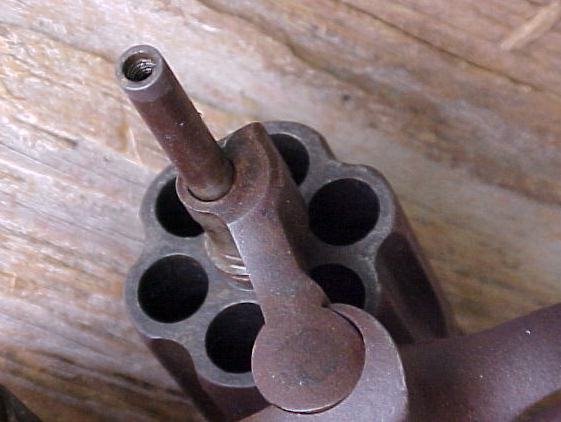
A few days ago I lucked into a Model of 1899 M&P that was well weathered, but in working order with unbroken grips. The revolver was complete except for the knurled nut that screws into the end of the extractor rod. I bought the revolver anyway, it was only $69, and I hoped to find the part online or at the upcoming gun show. Well, that little bugger was made of unobtainium.

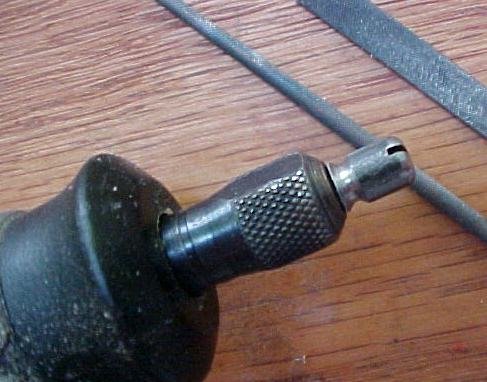
I was trying out different ideas for filling the hole, when I came upon a screw that holds a Colt SAA ejector rod housing to the barrel. Hmmmmmm the threads worked, and the diameter was the same.
I chucked the screw in my rotary tool, and spun it as though it were on a lathe while I used a needle file to carve a groove and a flat file to round off the edges. Finally, I used red LocTite to permanently fix the screw in place. The hard part was the finish. Matching the 100 year old patina would be next to impossible. I blued the screw, then spun it in some 400 grit sandpaper to bare some metal. Lastly, I took a small piece of cloth dipped in 20% saline and wrapped the little knob. That got the process started. Hopefully over time, the finish on the new part will match that of the old gun.

Labels: ,

Thursday, April 06, 2006

Pawn Shop Circuit: An Early M&P

I swung into Neil's place today and I could see from the doorway the handgun volume had increased since my last visit. Several guns had come out of hock, including a stainless Colt ORM Series 80 1911. The Colt was in great shape, but unfortunately, unlike the SW1911s Neil saw dollar signs on that Colt. He had it priced at $699. I explained that a new stainless Colt NRM 1911 could be had for that, but Neil was unfazed. He believed the gun would sell at that price. It was used, but it was in good shape. Perhaps it will.

I moved on to Neil's next gun, the one I was interested in anyway. I had Neil pull out a Smith & Wesson 1899 M&P from the case. This old Military & Police had such an even patina that I thought it was parkerized at first. It wore the original grips and they were uncracked. The action was buttery smooth, although the cylinder lock-up was a bit lose. The ejector rod was missing the knurled button that fits on the end. The bore was smokey but it still had rifling. The 1899 M&P was a four screw gun, with a smooth trigger. It was chambered in .38 Long Colt and .38 Special. I could barely make out the .38 S&W Special inscription on the barrel. The Smith & Wesson trademark on the right side was very faint as well. The good thing was that this revolver had an even brown patina, and Neil had not been impressed with it. The tag read $69.

I suppose Neil thought because I had bought the two SW1911s, and I had eschewed his .455 Hand Ejector, that he should overprice the Colt 1911, and underprice the Smith & Wesson 1899. That was fortuitous. I asked for a 4473 and began to fill it out. Neil asked "You're not going to layaway?" Suddenly I realized he thought I was buying the Colt. He was crest fallen when I told him it was the little Smith I was interested in. When we were done with the transaction, Neil asked me how much I had beaten him on the Smith & Wesson. I told him I honestly did not know if I had at all. I just liked the gun. I will have to find a knurled knob for the ejector rod, and that might be a tough order to fill. Still, I am very happy with my $69 gun!

Labels: ,

Friday, March 10, 2006

Reclaiming a Victory Model

I first saw my Smith & Wesson Victory M&P on the Pawn Shop Circuit. It was far from perfect. It had a sticking action, a missing lanyard loop, and the wrong grips. I was able to purchase the old revolver for $150, so I took it home to troubleshoot it. The gun had been dip blued. The sticking action was caused by a bent triggerguard. At some point, this gun had been used to adjust someone's attitude. I removed the trigger and filed it's underside until it cleared the triggerguard and no longer stuck in place.
I had some old faux stag grips in my parts bin, so the diamond magnas were removed in favor of stag. I shot the old war horse this way for a while, but it just did not seem right. I began a search for the proper wood and a lanyard ring.
Today, my old Victory M&P looks like it has lived a rough but full life. The refinish is worn, the walnut is dented and chipped, and there is freckling appearing in places. Like an old armoir that has collected some scars through the years, this revolver has character. It's reliable, and a gun that can stand some rough handling. For $150, that ain't bad. I'm pleased to own it.

Labels: ,

Sunday, October 09, 2005

Smith & Wesson 67-1 Resurrection

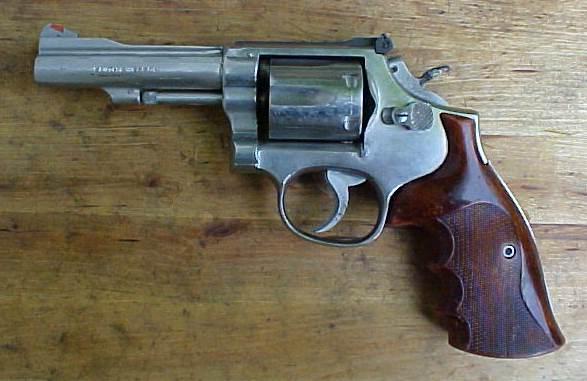
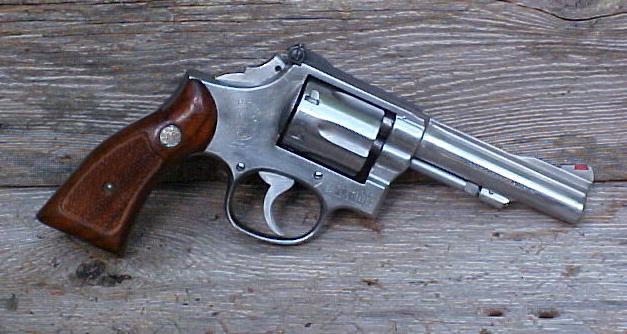
First bought A couple of weeks ago, I found this S&W specimen on a pawn shop shelf for $179. It had some corrosion on the hammer and trigger, and was pretty dirty overall. My favorite revolver is a K38 Combat Masterpiece though, so for $179 it seemed worth picking up. This wheelgun was found to be reliable and accurate, but a rough example from the Bangor Punta era. The aftermarket grips on the gun felt good, but were ugly as sin.

S&W Model 67-1 I was unsuccessful at removing the black corrosion from the hammer, so I bobbed it. The original hammer and trigger are flash chromed, so I had to consider refinishing my work afterwards. Other work at this point includes a reshaping of the triggerguard, radiusing the front of the cylinder, cleaning up the lines of the gun, and overall polishing. A set of Magna grips was fitted.


Finished Finally, rather than sending the hammer and trigger to an outfit like Fords for a hardchroming, I came across a NOS case hardened target trigger and hammer. I prefer the wider trigger anyway, so the set was purchased and fitted to the 67-1. The case hardening is not exactly correct, but it is evocative of the nickel guns of days gone by. The new grip is a nylon Hogue Monogrip. Future plans include serrating the topstrap beside the rear sight, and slicking up the action with another thousand dry fires.

With the next hard chrome job I farm out, I'll send my bobbed hammer. Then if I ever find a snubby Model 10, I'll have the hammer ready.

Labels: , ,