The 1911 is handgun design that endures as the standard by which combat handguns are judged today, almost 100 years after it's inception. Only the uninitiated would argue that point. Yet, personal protection for a private citizen is grossly different from personal protection in a combat zone. The very thing that makes the 1911 the epitome of combat handguns, the cocked & locked single action deployment, can become a enough of a liability in civilian use to give even the most hardheaded defense attorney a headache. While, to my knowlege, there has not been a criminal conviction on the grounds of cocked & locked carry, some cases have come perilously close, in stating that the cocking of a DA revolver not only implied malice of forethought, but made the gun a more "efficient killing machine". Whether one agrees or disagrees, these are the legal seas a person must navigate after a lethal encounter, whether justified or not.
Through the years the basic 1911 platform has not been altered much. Sure, more effective sights were installed, more resistant finishes were applied, more comfortable controls were fashioned, but the pistol itself functioned the same as always. Paraordnance has been a consistent provider of 1911s that possess an inovative approach to needs for the 1911 shooter. Paraordnance appeared with a 13 round 1911 frame and magazine in 1988, and in 1990, became a major player in the 1911 arena by making the entire high capacity 1911 pistol itself. Suddenly, the 1911 was a competitor in the wondernine era again.
Then in 2001, Paraordnance overturned the 1911 applecart. Seeing that CCW was a sweeping trend across the United States, Paraordnance decided to tap into that market. The 1911 platform has always been an excellent one for concealed carry. No handgun carries flatter on the hip, and gets into a fight quicker. The problem of the potential legal entanglements afterwards always remained, however, not to mention many potential pistol packers simply get the willies thinking about cocked & locked carry. Rather than deny these limitations, Paraordnance resolved to attack them head on.
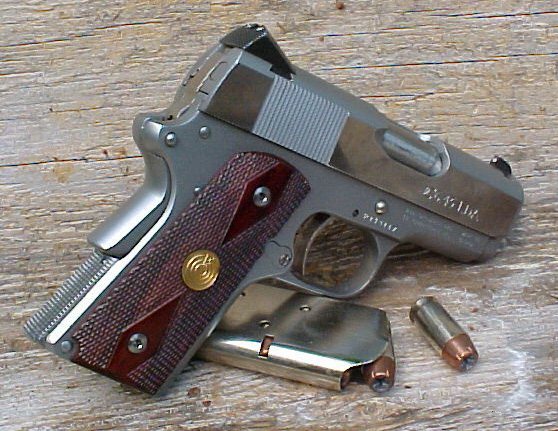
What resulted is possibly the best concealed carry gun yet designed. The C6.45 LDA (Para Carry) has what Paraordnance calls their Light Double Action Trigger.

It is a DAO action, but with a trigger unlike any other. The LDA system uses two hammers. When the slide is racked, the outer hammer carries the inner hammer with it, and cocks it. The outer hammer then follows the slide forward and rests just off the firing pin. The pivoting trigger works by way of a drawbar to then pull the outer hammer back under very light resistance. Once the outer hammer is again fully to the rear, increased resistance (approximately 6.5 pounds) is felt without creep just before the sear releases the inner hammer, firing the weapon. This allows the same trigger pull for each shot, as well as giving the ability to stage the hammer in use. The trigger really has to be used to be appreciated. The only drawback to the action would be in the event of a misfire. If a misfire were to occur, a tap, rack bang response would get the pistol back into action.
The Para C6.45LDA has three safeties. The firing pin safety uses an inertia firing pin and a spring loaded plunger, which keeps the firing pin from going forward until activated by the trigger's drawbar. The thumb safety can only be activated when the internal cocking cam, and the slide, are fully forward. When the thumb safety is pushed up and engages the slide lock notch, the slide is prevented from moving rearward and the drawbar is disengaged, preventing the hammer from moving rearward even if the trigger is squeezed. In use, it functions exactly like a standard 1911 thumb safety. The grip safety prevents the rearward travel of the trigger and the slide unless the pistol is gripped firmly with the shooting hand depressing the grip safety. While the function of the LDA grip safety is similar to that on a standard 1911, it accomplishes the same task by blocking the hammer with the grip safety lever instead of by the trigger bow as in a standard 1911.
The C6.45LDA was designed from the ground up as a concealed carry weapon. Because the external hammer does not allow for manual cocking, it is shaved off to little more than a sliver. Since the shaved external hammer cannot bite the shooter's hand, the pistol does not require a beavertail.
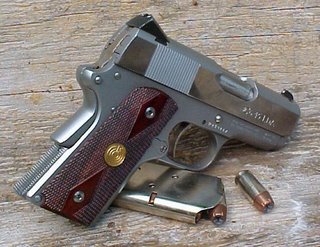
What results is a rear profile on the weapon that eliminates any snagging on the draw. While a spur hammer and beavertail may not present a problem with a holster on the hip, limitations are discovered when one tries to draw such a weapon from deep cover. The pistol comes with low profile three dot sights that are serrated and ramped on the rear, again preventing snagging on the draw. The gun is small. It is a similar size to any other micro 1911 on the market. The grips are very nice cocobolo, and are about as thin as could be cut and still maintain structural integrity. Unfortunately, the screw placement is unique to the pistol, making replacement grips a difficult proposition. The C6.45LDA uses a proprietory recoil system of two captured springs on a full length guide rod. The C6.45LDA does not use a barrel bushing. Lock-up is accomplished by two locking lugs on the top of the barrel, and a standard bull barrel arrangement. The barrel is fully ramped with a concave crown. The trigger is rounded and polished smooth.
I obtained my Para C6.45LDA as a prize in a Pistol League competition. I likely would not have bought it myself. Afterall, 1911s that are shorter than Commander length have a reputation for problems. I wasn't sure I would like the LDA trigger, and how accurate could a four inch sight radius be? Still, it was a pretty interesting 1911, and as a freebie, I gladly accepted it.
After a good cleaning, lubing and familiarity check, I took it to the range with a bucket of 230 grain hardball. My first shots amazed me. At 15 feet, this pistol was a one hole shooter. I ran the targets out to 25 feet. My slow fired groups stayed under two inches. I noted that the recoil was greater than a Government model, but not uncontrollable. Quick follow up shots would be possible with a strong controlled grip of the weapon. My pinkie finger rested below the magazine, lessening my grip. I borrowed some skateboard tape and applied a strip to the plastic mainspring housing. Viola! I could maintain weapon control. After 400 rounds of hardball, I had no failures, but my hands were needing a rest.
Later that week, I showed up at the range again with the Para to try out some hollow point ammo. I shot Federal HydraShoks, PMC Starfire, and Winchester SXT, all in 230 grains. All fed without problems. All were accurate, shooting consistent groups under two inches. This pistol was looking like a definite keeper to me by this time. Once home, I went to the Smith & Alexander website looking for a checkered MSH for the pistol. I found none, but on calling S&A, I was told that a P12 MSH should fit, and if it did not I could return it for a full refund. I placed my order. There is something about a plastic MSH that bothers me. A plastic MSH with skateboard tape on it is even more unappealing. A few days later, the stainless steel MSH arrived from S&A. It fit the pistol, but extended past the rear corner of the frame more than I liked. It also had some very sharp checkering. I broke out the files and went to work. A short time later, my pistol had a metal MSH that would stay locked to my palm.
I continued to train with the pistol using 230 grain hardball, and after 1000 rounds I noted that the thumb safety barely contacted the slide on recoil, and had peened it under the serations.

I filed down the upper corner of the thumb safety to keep it clear. Also around round 1200 I began to have some issues with the pistol jamming. The extractor and ejector looked fine. On examination of the barrel/frame fit, I saw that the sharp edges of the barrel ramp were cutting into the frame, raising a small burr on the frame and slowing the barrel on recoil. I took out my jeweler's files and Dremel and gently radiused the edges of the barrel ramp and smoothed up the inside of the frame. The problems disappeared. It was around this time that I replaced the recoil assembly. Paraordnance recommends replacement of the entire recoil assembly every 1500 rounds or so. They sent me my first replacement pro gratis. I remain convinced, however, that the jamming problems were caused by the barrel ramp edges biting into the frame of the pistol.
After putting over 2000 rounds downrange with this pistol, it became my primary CCW pistol for a year nor so. I learned that a full capacity Wilson Combat magazine will lock into the pistol and feed without any problems. Thus, eventhough the C6.45LDA came with a spare magazine, I carried it with a 6 round magazine and Wilson magazines as spares. I figured if I had to pop in a second magazine, I will probably need the extra ammo in the Wilson. I carried the pistol in a couple of ways. If I had the luxury of a covering garment, I liked a Don Hume JIT. The Colt Commander sized holster fits this pistol like it was made for it. If I did not have the luxury of a covering garment, I prefered a SmartCarry holster. The C6.45LDA carried very nicely, with no gouging or painful reminders a gun is there.
There are only a few things I would have liked to see different. I believe the pistol should have come with night sights. I would also have liked to see it come with standard grip screw spacing and a standard recoil system. Paraordnance has resolved these issues already, with the C7.45LDA, Companion Carry pistol. These improvments come at the cost of a slightly larger pistol though. As a result, we take our choices. This Paraordnance mini-cannon met my needs as a carry gun. It was small and comfortable enough to stay concealed all day long in hot weather. It had the takedown power and accuracy to remove a threat with a minimum of shots fired. After a bit of work it became solidly reliable. It effectively adressed the issues many have about carrying a 1911 in the civilian world. It did all this while remaining a stock pistol. Because of the jamming problems I had, I cannot whole heartedly recommend the C6.45LDA, but I was confident enough in my particular example to stake my life and freedom on it.

The astute reader will note that the last paragraphs are written in past tense. I quit carrying this pistol. Why would a man stop carrying what he felt was the best CCW pistol designed? I began to hear rumors then see photos of Paraordnance mini-pistol's slides cracking. Whether the cracking occured because the recoil assembly was not being changed regularly, because of hot ammo, or other abuse did not matter to me. I train with the gun I carry. I train hard with the gun I carry. If the pistol cannot stand up to the pressure and round counts of my training, it's not up to the job of riding on my hip. Regrettably, I retired the Para C6.45LDA after I saw several cracked slide pictures. My own pistol has not shown any signs of cracking, but I know it will be worthless if it does. Perhaps, at some point, I will trade it off. Time will tell. The ParaCarry C6.45LDA was a fantastic idea, brilliantly designed, but apparently poorly manufactured. That is a shame.
Labels: Carry Guns, Paraordnance, Range Reports