A Nurse with a Gun

Sunday, March 21, 2010

The Ruger 10/22 M1 Conversion

I like the Ruger 10/22 rifle. It's cheap, reliable, and reasonably accurate. With the right barrel and scope, it can be a tack driver. I've built a few, and they are a fun gun to shoot. The problem is, the wilder the modifications become, the less handy the rifle becomes.

One of the handiest rifles ever designed was the M1 carbine. Often, in the real world, handy beats the pants off gnat's ass accuracy. Now, the vesatile 10/22 can be modified to ressemble the M1 carbine. No longer do you have to search out a used Marlin 99M1 and roll the dice. Take a look at E. Arthur Brown's Ruger 10/22 to M1 carbine package.

Get one. Build it. Learn about Appleseed. Become a Rifleman.

Labels: ,

Thursday, July 30, 2009

The Colt .22 Tactical M4 Rifle


One of the loudly heralded rifles from the 2009 SHOT Show was the Umarex/Walther/Colt M-forgery. I had heard that the big box store had a couple of Colt rimfire M4s in stock, so I drove over to take a gander for the first time today. Overall I was impressed at Walther's ability to make a rimfire replica of America's favorite black rifle. The fact that the carry handle was detachable on the M4 version was a big plus for me. The barrel contour seemed pretty close to correct. I'm not certain if the hand grip or the adjustable buttstock will swap out with conventional AR aftermarket equipment though. If it does not, then shame on Walther. A major component of the AR's allure is the modularity that makes the rifle user friendly towards customization.

The magazine was not in the rifle that I examined, so I asked to take a look at it. The salesman assured me it was "exactly like a M-sixteen clip." All I had to do was fill out this yellow sheet....... I asked again to see the magazine. When the salesman's assistant brought the 30 round magazine from the rear of the big box store, I was not surprised. It was heavy plastic with a cut out on either side to show the remaining ammunition inside. A follower button was present on each side to aid in loading. That was a shame, to make a replica so close and then let the magazine destroy the illusion. There are many who would purchase the Colt/Walther M-forgery as a 22 rifle simply because it mimics the real deal so well. With the magazine in place, only Paul Helmke would have a problem seeing the difference.

The blue hang tag on the forward sling swivel attested to the rimfire rifle's all metal construction. Indeed, it felt to be about the same weight as it's more powerful cousin. I began to wonder if the receiver was good aluminum, or if it was pot metal. I remembered the problems Walther had a couple of years ago with the P22 slides. I envisioned this rifle after a year of use, with silver showing through the black paint on the receiver. It would certainly take on a patina common to a well used and well loved rifle through legitimate high volume use.

The asking price at the big box store was $589 before tax. I had ascertained that this was about a hundred bucks above dealer cost. That was fair enough, and for a man who shoots a lot of .223, it could mean the rifle would pay for itself quickly. My appetite for black rifle goodness is not that voracious, however. Perhaps it should be. If I owned one of these carbines, I would likely shoot it a lot. It would not be a substitute for a rifle i presently shoot a lot however.

I decided I would wait. I would wait until I saw some real world durability reports and real world reliability complaints. I would wait until the aftermarket caught up and accessories became available to fit the rifle. I would wait until I could purchase it used at the next gun show. Before I saw the magazine I almost had my checkbook out. I had always said if Colt made a 22 rimfire M4 replica, I would buy it. I probably still will, in time. I just want to know a little more at the price they are asking.

Labels: ,

Saturday, September 20, 2008

The Savage 87A

Every once in a while, even a savvy pawnshopper gets beat, or at least falls to the siren song of a firearm that is going to be a bum deal. Such was the case when I drove fifty miles to visit a dusty Mom & Pop pawn shop I heard was closing down. Click to enlarge Pop had a couple of overpriced Smith & Wesson revolvers for sale. No doubt he was planning on keeping them, but he wanted Ma to think he was trying his best, so he had them underneath the glass. Along the long gun rack were a few shotguns and a tube magazine fed 22 rifle. I asked to have a look at the rifle.

It was a Savage 87A, and the cooling vents surrounding the bolt intrigued me. "Damned fine rifle, that is...." ventured Pop. I turned the heavy rimfire rifle over in my hands, noting the knurled bolt screw at the rear, the bolt knob with concentric circles cut into it, the dovetailed front sight with a brass bead. The serrated trigger was light. The walnut stock was in decent shape, well oiled and polished, although the usual nicks from a life afield were present. The barrel still had the brownish tinge of bluing long gone, with a few blood spots near the muzzle. Testimony of a rifle used to put wounded game down once they were located. I asked Pop how much he wanted. Click to enlarge"Sixty-seven dollars, plus tax," he grinned.

Now I don't know about most folks, but it's difficult for me to walk away from a sub-hundred dollar gun. This rifle had the option of shooting .22 longs, .22 shorts, and the option of locking the bolt to use it as a bolt action type rifle. I paid the money and thanked the man. That night the Savage received the first cleaning it had experienced in years.

The next day I took my old rifle to the range. It was decently accurate, but failed to feed often enough to frustrate me. When the 75 year old Savage did cycle, it was a strange experience compared to newer 22 rifles. The old girl chambered the next round in a slow motion ker-chunk that you could chronograph with a stopwatch. One of the old gray range hands informed me "That's an old one. It's supposed to cycle like that boy." I diagnosed the feeding problem as the shell lifter, and ordered another one from Numrich.

I fitted and installed the new part, and the feed problem improved but never totally disappeared. I still keep the rifle. I'm reluctant to trade off an unreliable rifle without informing the recipient. I also enjoy shooting it occasionally. For $75, I figure that's enough reason to keep it around.

Labels: ,

Friday, September 19, 2008

The Marlin Papoose

A 22 caliber rifle is often on the short list of firearms to "bug out" with for most gunnies. Lightweight, cheap to shoot, and inexpensive to obtain, the rimfire rifle is one of the most versatile tools for survival. Survival rifles are often designed to break down into a compact package, and therein lies the rub. Maintaining accuracy and reliability while making the firearm breakdown into a compact package can be difficult.

One 22 rifle that has been around for quite some time is the Marlin 70P, also known as the Papoose. When this rifle was first introduced, it came with a birch wood stock, a black receiver and a blued barrel. The entire package can be carried in the cordura travel case supplied with the package. Today, the same rifle is offered in stainless steel with a polycarbonate stock as the Marlin 70PSS.

The barrel has a knurled fitting that quickly screws it onto the receiver. Screw on the barrel, pop in a full seven round magazine, and chamber a round. You are ready to shoot. The rifle owes it's reliability to the same semi-automatic action that is found in the Marlin 795. As long as the shooter holds the bolt back a bit while screwing on the barrel, to make certain it is properly seated, the rifle will shoot all day without failure. Disassembled and zipped into it's carrying case, the entire package measures 23 X 8 inches. There is ample room in the case for ammunition and extra magazines if desired. The barrel fits in a pocket along the spine of the case, while the stock is secured with velcro straps.

While the receiver has an integral scope rail, I prefer to stick with the barrel mounted iron sights. They consist of a simple spring leaf/ramp rear sight and a Patridge front sight. I dabbed some day-glo orange paint on my front sight to improve visibility.

I found this little rifle in a pawn shop for under $100. I purchased it immediately. When I head to the range I usually take another rifle, but this one is tested, proven reliable and decently accurate. It stands ready, packed up at home with a couple of boxes of ammunition in case it is needed.

Labels:

Wednesday, September 10, 2008

The Browning 22 Auto

One of the last masterpieces designed by John Moses Browning was a humble sporting rifle. Unique among rimfire rifles, the The Browning 22 Auto was first produced by Fabrique Nationale in 1914. The proportions of the rifle are golden. Slender and light, it is easily handled by both young shooters and adults. A tubular magazine in the stock holds eleven long rifle rounds. A gold bead graces the muzzle with a simple flip up rear sight. The rifle quickly breaks down into two pieces for easy storage and transport.

Today, the Browning 22 Auto is manufactured in Japan. It is available in several grades, with different levels of finish and wood quality. Click to enlargeEven so, the Grade 1 version, with a relatively non-descript polished walnut stock bearing cut checkering and an engraved blue receiver stands out above other 22 rifles. Even in the least expensive version the craftsmanship is pure quality. The prices range from $500 for a new Grade 1 rifle, to the stratosphere for custom Belgium antiques.

Because of the price, the Browning rifle is not a common gun in the woods during squirrel season. That is a shame. The rifle is accurate and quick to sights, a perfect small game hunting companion. Modern versions have the barrel drilled and tapped for a scope mount. There have been copies of the take-down 22 available, most notably by Norinco, but they never had the fit and finish necessary for the design to function with long term reliability.

The Browning 22 Auto ejects straight down. It chambers the next round as if by magic. For the unwary, hot brass down a long sleeve can cause the once famous Browning 22 dance. In a lot of ways, the Browning 22 Auto is an aficionado's gun. There are less expensive 22 rifles available that are just as accurate, namely the Marlin Model 60, and others that are more versatile, namely the Ruger 10/22. For the small game hunter who wants a 22 that will last forever and hold it's value well, one that will break down for easy packing while maintaining accuracy after assembly, the Browning masterpiece can not be beat. I was fortunate to find one in good condition bearing a price of $129 on an unknowledgeable pawnbroker's rack. I have found it to be worth much more than I handed across the counter.

Browning 22 Auto Owner's Manual (pdf)

Labels:

Tuesday, September 09, 2008

Cleaning the Browning 22

I set about cleaning the Browning 22 Auto this afternoon. The action still functioned, but it was caked with hardened residue from long use. Apparently it had never been disassembled for cleaning.

As I went through the mechanism getting rid of the cordite coatings in chunks and black smudges soaking through oily cotton rags, I was amazed at the unique genius of John Moses Browning. He had again designed a firearm that could be field stripped with no tools at all. To make such a utilitarian rifle, and to have it so easy to disassemble and clean, yet crafted in such a beautiful manner was art.

Labels:

Saturday, February 02, 2008

The Ruger Charger

I know a lot of people are going all googly over Ruger's new 10/22 pistol, but I don't see the point. If you see something out there that needs a little hole in it, then why not punctuate it with a 10/22 rifle? If you want a good 22 caliber pistol, there is the Ruger MKII, or the Browning Buckmark, and neither requires a bipod. If you want a firearm on a bipod, why not chose a rifle? This attenuated rifle is neither a decent rifle, nor a decent pistol.

Or am I missing something here?

Labels: , , ,

Monday, December 17, 2007

The Ruger 10/22

I'm a big fan of the Ruger 10/22. I'm an even bigger fan of getting a sub-hundred dollar gun at a pawn shop, and turning it into a tackdriver. The Ruger 10/22 has been around for over four decades. It is a staple of a child's progression to becoming a rifleman, and it is only surpassed by the 1911 as the most customized firearm of all time. The Ruger 10/22 rifle has a near cult-like following of people who invest more in accessories than the rifle retails for, all in pursuit of one hole groups at fifty yards.

At last count, I had nine 10/22s in my home. These range from an all out tackdriving fantasy rifle to an ancient "super stock" 10/22 with an aluminum buttplate, a "no warning" blue tapered barrel and a walnut carbine stock. The only modifications to the "super stock" is a set back match chamber, a bedded action, trigger work, and a recessed target crown on the floated original barrel. Among those nine rimfire rifles residing in my home are a purple metalflake carbine with a youth stock for my daughter, an adjustable stock target rifle for my wife, Turtle guna "Wally World Special", and the first rifle my son ever built, a Hogue overmolded stocked 10/22 he used to take squirrels.

My "Turtle Gun" was so named after an afternoon of executing turtles in a pond about 75 yards from the back porch. Modifications include a Barracuda stock, Magnum Research carbon fiber barrel and Volquartsen hammer, sear, and magazine release. The rest of the action was polished, an auto bolt release was installed along with a bolt buffer, and the firing pin was pinned. The trigger group is bedded. The Turtle Gun's glass is a Nikon Monarch 6.5-20X44 scope mounted on Weaver 4X4 rings. This rifle was bought as a $100 pawn shop stainless carbine. All that remains of the original firearm is the bolt and the receiver.

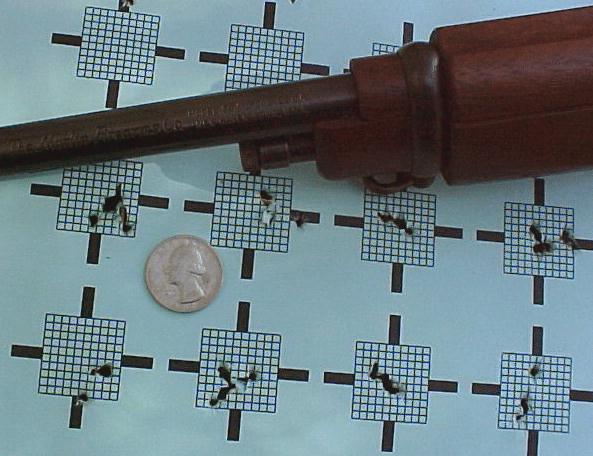
The genius in the Ruger 10/22 is it's modularity. The barrel is held in place by a wedge block retained by two Allen screws. The trigger group is secured to the receiver by two cross pins. The stock is attached with a single screw. As an out of the box .22 rifle, the Ruger 10/22 is admittedly not as accurate as others in it's class, such as the Marlin 60 and the CZ bolt action target rifles, but it has a distinct advantage. It is reliable, durable, and incredibly "handy". It is accurate enough. When the owner becomes bored with the firearm, or when cabin fever drives him to madness, he can open a Midway catalog and order enough goodies to totally transform the little plinker into a precision rifle that will keep ten rounds on a Xeroxed quarter at 75 yards.

This 10/22 rifle started life as a $109 Deluxe 10/22 I found in a pawn shop. Silhouette RugerThe stock is a Fajen Silhouette in orange, green and teal. The barrel is a 20" Whistle Pig matte aluminum, free floated in the stock. The trigger group is bedded. The action has been polished with an auto bolt release, Volquartsen magazine release, and bolt buffer. The bolt has been chamfered and the firing pin pinned. The rifle is scoped with a Nikon 4X32 Prostaff secured by Weaver 4X4 rings.

Many adult shooters grew up with the Ruger 10/22. Those who have shot them compulsively invariably begin to modify them. I thought I had done all there was to do with a Ruger 10/22. Then, I read that Ruger may have finally produced what many 10/22 shooters had always dreamed of.......A 10/22 pistol. I just might have to wander back into a gun store.......

If the gunnie in your life still needs something for Christmas, buy them a Ruger 10/22. Then order a Midway and Brownells catalog to find Christmas presents in the years to come. It's guaranteed to put a smile on their face.

More info:
Ruger 10/22: From Factory To Fantasy
Rimfire Central
Joe's Trigger Group Modifications
Ruger's Serial Number Database

Labels: , ,

Sunday, January 08, 2006

Marlin 99M1 Range Report

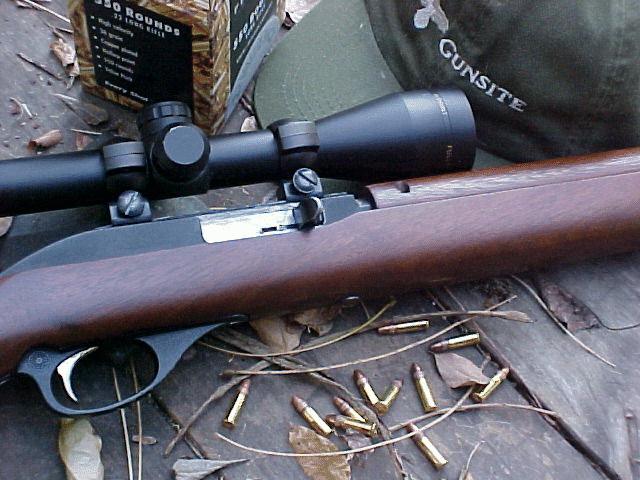
The Marlin Model 99M1 is a short carbine with the same tubular magazine and action as the Marlin 99 and 99U. The main difference is the 99M1 has a wooden hand guard and an 18-inch barrel to make it look more like a US military M1 Carbine. Marlin introduced the 99M1 in 1964, in hopes that the resemblance to the US M1 carbine would appeal to the thousands of WW II veterans who had trained with and carried into combat the larger caliber US M1. The 99M1 was a success and over 160,000 were sold before production was discontinued in 1978.

I acquired my Marlin 99M1 from a pawnshop. It had a $79 price tag, but I traded another .22 rifle for it. I spent an hour or so that night disassembling it, and cleaning years of grey gloop out of the action. The only redeeming value of that gloop is it may have helped hone the action. That night, I noted that Simpson Ltd. was selling a Marlin 99M1 for $250. If mine shot, I got a deal.

When disassembling a Marlin 60 or 99 action, the trigger group itself should never be taken apart unless it contains a broken part. Probably due to it's era of manufacture, my 99M1 had screws holding the trigger group in place instead of plastic pins. I cleaned everything with Gumout carburetor cleaner (I had it handy and it works) lubricated it with Breakfree a bit, inspected it, and reassembled everything.

I took my Marlin 99M1 to the range for a first shoot today. It came from the pawnshop with a Simmons 3-9X40 scope. The furniture of the upper handguard had to be massaged a little to accept this objective, but the job was very well done, almost imperceptible. The scope mounted on a rail molded into the Marlin reciever. If I like the rifle, I might smooth things out to accept a Weaver style rail.

The first nice surprise about the 99M1 was the trigger. I was expecing the mushy creepy trigger of a Model 60, but this one was better. It had some creep, but not nearly as much mush. I have to wonder if the plastic pins holding the Model 60 trigger group versus the metal screws holding this 99M1's trigger group makes the difference in feel.

The Marlin is accurate. I expected that. At 25 yards on sandbags, it shot half inch to 3/4 inch groups consistently, with cheap Federal bulk pack ammo. My 99M1 lost it's iron sights sometime in it's past. Numrich has the front sight for $17. I understand the rear peep sight assembly is next to impossible to find. I suppose my rifle will always have a scope.

I did have several failures to eject, one every 50 or so rounds. As I continued to shoot, the problem exacerbated. That is unacceptable in my opinion. I will tear the rifle down again to see if I can diagnose the cause. The inner magazine tube wanted to stick while sliding it back into the outer tube after loading. I will address that issue as well.

Overall, I am very happy with this little shooter. It is very accurate for a .22 rifle with a stock chamber. Once the ejection issues are cleared up, I am certain it will become one of my favorite shooters. Maybe I can find a proper WWII era sling at the upcoming gunshow.

Labels: ,