A Nurse with a Gun

Sunday, March 21, 2010

The Ruger 10/22 M1 Conversion

I like the Ruger 10/22 rifle. It's cheap, reliable, and reasonably accurate. With the right barrel and scope, it can be a tack driver. I've built a few, and they are a fun gun to shoot. The problem is, the wilder the modifications become, the less handy the rifle becomes.

One of the handiest rifles ever designed was the M1 carbine. Often, in the real world, handy beats the pants off gnat's ass accuracy. Now, the vesatile 10/22 can be modified to ressemble the M1 carbine. No longer do you have to search out a used Marlin 99M1 and roll the dice. Take a look at E. Arthur Brown's Ruger 10/22 to M1 carbine package.

Get one. Build it. Learn about Appleseed. Become a Rifleman.

Labels: ,

Thursday, February 19, 2009

Ruger MKII Cleaning

The Ruger MKII "beginner gun" had started getting a sticky sear return, so I disassembled it for cleaning tonight. While I will totally detail strip the gun if necessary, this is as far as I need to strip it for a thorough cleaning.

A blast of aerosol brake cleaner into the lock work, work the mechanism to allow it to seep in, and wipe away. Then a bit of powdered graphite and a touch of grease on the hammer notch and the pistol was ready for reassembly. The blast shield was working well. It had an eigth of an inch thick layer of black soot caked on it. There was no gritty trigger. Underneath the blast shield, the trigger was as clean as a whistle. However, around the hammer and sear, so much crud was built up that the trigger reset was sometimes delayed. My usual Ruger MKII post shooting clean-up consists of a poke around the chamber with a bronze brush and patch, a bore snake and a wipe down. It takes many, many rounds to build up the residue of shooting in the rear of a MKII.

Far too many people believe they must field strip these pistols every time they shoot them. I know several shooters who have continued to shoot MKIIs with no cleaning what so ever. The MKII design allows for a minimum to no maintenance. It is truly one of the most durable and simple pistols ever built.

Labels: ,

Monday, February 16, 2009

The Ruger Hand Drill

Many people don't know that Bill Ruger originally designed hand tools before he hit upon the Ruger Standard. Up for auction is one of his hand drills. Recognize the handle?
As shown in the book "Ruger And His Guns"...Bill Ruger produced a line of hand tools prior to his partnership with Alexander Sturm. The facility was in a red barn where later the arms manufacturing began in Southport Conn. The collector book states that the hand tools often bring more than the collectible guns. Notice the near exact shape of the drill pistol grip handle when compared to the Mark I semi automatic pistols. This drill came from an estate sale auction from a New Jersey resident. I very much regret the high minimum bid but I had to pay a small fortune to acquire this item off of e-bay. I have enjoyed owning it and will offer it for others at this time. The condition of the drill is excellent. If it were a pistol we would say less than 5 boxes run thru it...or... blue is 98%
Started at $550.00

Here's another Ruger hand drill.

Labels:

Thursday, January 22, 2009

The Secret Handshake

When I was younger, I enjoyed shooting different calibers. I enjoyed the trip to the gun counter to pick up 22 Rem Jet and debating the esoterica of caliber. I shot .44 special, 10mm, .38 super and .41 magnum. I can say I shot the .460 Rowland a few times. I owned a couple of handguns in .38 S&W, and paid the price for the anemic ammunition. Over time I tried out .357 Sig and .40 S&W as carry gun cartridges, as well as the .380. As time went by, I moved away from each of these for one reason or another.

Click to enlarge
Today, except for a few keepsake handguns chambered in those esoteric calibers, I have adopted 22 long rifle, 45 ACP, 9mm, .38 special and .357 magnum. This was not by design, it was an evolution towards simplicity.

As usual, I took a Ruger MKII to the range with my 1911s today. I still consider the 22 pistol to be the best investment towards marksmanship a shooter can make. The cost per shot allows a lot of lead to be sent downrange. The Ruger 22 auto-pistol is my choice for a reliable, durable and accurate handgun to shoot all that lead with. I have several and it's the one I generally recommend to those wanting a 22 pistol.

The only drawback to the Ruger 22 is the trick involved in the reassembly process. The Ruger is like a Chinese jigsaw puzzle. It goes together one way only, although it appears it can be reassembled in several ways. The trick is not allowing the hammer strut to bind. By flipping the pistol over and pulling the trigger just prior to closing the mainspring housing, the strut falls into the mainspring cap, and everything works as advertised. The flip of the pistol is the key, the secret handshake of the Ruger 22 auto-pistol. Watch in the video below just how quickly it happens.

Labels: ,

Thursday, November 27, 2008

The Ruger Hole Punch

"Hey Xavier, tell about that long stainless Ruger pistol you sometimes post a picture of, OK?"
I believe the pistol you are referring to must be my Ruger MKII Government Model. Before the time of the Ruger Hunter and Ruger Competition Target, another 22 pistol from Prescott Arizona ruled the Ruger roost.

Officially known as the KMK678G, the Ruger MKII Government Model did not have the fluted barrel of the Hunter, Click to enlargeor the slab sided barrel of the Competition Target. Nor did it come with nice wooden grips. It was a deceptively simple pistol that shot from a six 7/8 cylindrical bull barrel, and plain black plastic grips were screwed to it's sides. The take home price was usually twice that of the Ruger Standard models, hardly what could be termed a glitzy fast selling pistol.

The Ruger Government Model's grey plastic box held an extra piece of documentation, however. Inside was a 25 yard proof target, with a single hole inside a black circle. The extra cash paid for the Government Model got the buyer a pistol with a bore that was aligned with a laser and rifling with a 1-15 twist instead of Ruger's standard 1-14 twist. It was drilled for optics, and the sights were a basic Ruger micro-adjustable rear sight paired with an undercut Patridge front sight. It was a superb foundation for modification.

Over time, my KMK678G received several upgrades. The plastic grips were tossed in a spare parts bin, and a Nill grip was installed. A mix of Volquartsen and Clark Custom parts replaced the original Ruger action. The Ruger lockwork that remained was polished.

Finally, to add a bit of weight to the muzzle, I screwed on a Volquartsen compensator. The V-Comp did the trick, making the pistol stay in the X-ring with virtually no recoil. It was heavy, but if the shooter wanted to rapid fire ten shots into a bullseye, this pistol was up to the challenge. Of course, harnessing that kind of accuracy off hand was the shooter's responsibility. Click to enlargeOn bags, the pistol took care of itself.

Because it was an autoloading pistol, the Ruger Government Model could suffer flyers from time to time. Still, it was long my standard for judging the accuracy of other handguns. Indeed, when a genuine free pistol, the TOZ-35, finally came on the market at a price I could afford, it was the Ruger Government Model that I took to the range to compare it to.

The Ruger Government Model is no longer available. Originally entering production under a military contract in 1986, it has been superseded by the Ruger Competition. As a 22 pistol in my inventory, it remains a gun capable of punching a hole exactly where I want it to, as long as I am up to the challenge.

The Ruger Competition Government Model

Labels: , ,

Tuesday, November 18, 2008

Green Glow

I finally broke down, ordered and installed a HiViz fiber optic front sight on one of my Ruger MKII pistols. After a bit of online shopping, I found the best deal at Cabelas, for $29.99. The sight is, I believe worth the cost.

The base is solid metal, about the same weight as the original Ruger front sight. The HiViz front sight comes with six "light pipes" in flourescent green and orange, in three different dot sizes each. They gather and concentrate ambient light and make it appear there is a LED light on your front sight. Placing that glowing orb in the rear sight notch is quick and easy.

It took me all of five minutes to install the sight. I warmed up the barrel and screw, and then used blue Loc-Tite to make sure the screw would not come undone. I will try it out against the black circle on the next range trip.

Labels: ,

Monday, November 17, 2008

New Grips For the 50th Anniversary Ruger

OK, I admit it. I'm a sucker for walnut and blue. I screwed some checkered walnut Ruger MKI grips on to the 50th Anniversary Ruger today, and I like the result. Click to enlargeI had to carefully inlet the left grip to accept the bolt hold back mechanism, and the results were worth it.

I also swapped out the bolt with the Ruger MKII I use to train new shooters. I wanted a plain bolt in this pistol, not one with the Ruger logo engraved in the rear. I appreciate Ruger leaving off the receiver scallops in front of the bolt. I wish they had cut a square ejection port and placed an upright rear sight on the pistol too, but I guess you can't have everything.

With the exception of maybe placing a magazine with a chrome base pad in the well, I will likely not do much more to the Anniversary Ruger. It is where I want it. Classic. Simple. Elegant.

More on the 50th Anniversary Ruger 22 pistol.

Labels: ,

Saturday, November 15, 2008

Pawn Shop Circuit: Ruger MKII 50th Anniversary

A year and a half ago, I was considering purchasing a Ruger 50th Anniversary MKII at a local pawn shop. I passed on the pistol each time due to a price that I thought was a bit too high considering the pistol's condition. Click to enlargeAt $175, it sold to someone else. I continually kicked myself each time I thought about it.

That was the history as I entered the Spotted Dog gun and outdoor gear emporium. As usual, I walked past the hunting gear and straight down the glass cases full of handguns. When a salesman asked if he could assist me, I had already determined there were no used Colt 1911s available.

"That Ruger, can I have a look at it?" I pointed. He opened the case and removed a blue 4 inch MKII with the 50th Anniversary crest on the receiver. While not a perfect reproduction of the Ruger Standard by any means, minor design details such as he lack of scallops on the rear of the receiver caught my eye. The plastic red eagle grips suffered from battered checkering. The pistol did have good bluing, and no rust though.

I turned over the tag to take a look. $249. Damn. Just a few years ago, the four inch taper barreled Ruger MKII sold for that new. "Those are fine pistols," related the salesman. "And that one is a special 50th Anniversary model. Limited edition."

"I see." I tried to look skeptical. "Do you have the box?"

"Let me check," he replied and he disappeared into a back room. Moments later, he emerged with the bad news. No box. I gave a disappointed look. "I tell you what, I'll cut you a deal........." he ventured.

"Spare magazine? I inquired.

"No, but I'll let you have it for $219."

"What is the tax here?"

"Two twenty out the door," the salesman countered.

I did some quick mental math. I pulled out my wallet. I took the pistol home.

Labels: ,

Ruger Autopistol Grips on Ebay

Click to enlargeEnding in a couple of hours on ebay.... Ruger MKII grips that transform the grip angle of the Ruger MKII to that of a 1911. Shown here on my "fishin' gun," these grips were designed and marketed by Clark Custom. Palmswells in just the right spot. and added width in just the right places. The grips are plastic, and require a bit of flash trimming, but your MKII will feel totally different in your hand.

Clark Custom clearanced them at $21 a set.
Current auction bid: US $13.50
Winning Bid: US $27.79

These Red Eagle Ruger grips closed at US $76.23.

Approximately 25,500 Red Eagle Ruger Standard pistols were manufactured between October 1949 and November, 1951, before Bill Ruger's business partner, Alexander Sturm died. Thereafter, the grip edallions were to be silver and black. The remaining red eagle medallions were used up by February 1952. Hopefully these rare grips will go on an early Ruger in need of them.

Labels:

Wednesday, November 12, 2008

Ruger MKII Blast Shield

Some of the dirtiest ammunition available is 22 long rifle ammo, and with the high volume shooting that a 22 pistol usually endures, crusty black dirt accumulates in any 22 pistol. Click to enlargeThe Ruger MKII is a well designed and durable firearm, but it does have it's weaknesses. One of those is the reputation for developing a gritty trigger over time. The reason is simple really, the upper portion of the trigger, the trigger plunger and the disconnect are all exposed underneath the feed ramp. As the pistol is fired and the brass ejected over time, soot, grit and dirt coats all of these parts and makes for a gritty trigger.

To solve the problem on my MKII pistols, I decided to fabricate and install blast shields for the triggers. I went to the local hardware store and purchased some brass shim material that was approximately the same thickness as a soda can. In the past, MKII shooters have actually used the aluminum from soda cans, but I wanted to start out with flat straight metal. Click to enlargeI also wanted to use a slightly different design than what others have used.

Instead of making a loop that fits around the grip frame lug, I made a tongue that would fit in the receiver recess on top of the lug. This had the advantage of helping to tighten up the pistol. The light gauge brass shim material is easily cut with sharp scissors. No tin snips are necessary. The tongue extending down into the magwell should have a curvature to it. Burnishing the underside of the curve will help the brass shield retain the curvature. I used hemostats as a bending brake to make nice well defined bends, including the compound bend necessary to fit the piece into the receiver recess. Make certain the disconnect and bolt hold back lever do not bind with the blast shield. Only a small amount of clearance is necessary.

Once I had the first blast shield fabricated, I used it as a template to fabricate blast shields for each of my Ruger MKII pistols. Click to enlargeBefore the pistol is reassembled with the blast shield in place, the trigger and action should be cleaned. If the grime is really caked on, only a detail strip and individual parts cleaning will do. If the pistol is not too dirty, a spray with Gun Scrubber and a bit of toothbrushing should do the trick. Once the parts are clean, lubricate them and install the receiver assembly back on the grip frame with the blast shield in between. Insert an empty magazine to check function, and then a full magazine for a live fire test.

The same technique can be used on the Ruger 22/45, and the MKI and MKIII pistols. The brass blast shield makes a protective shield that effectively keeps the dirt and grime off the trigger. Hopefully it will be years before my Ruger MKIIs develop that gritty feeling again.

Labels: ,

Monday, November 10, 2008

The Ruger 1 of 5000

In 1982, Sturm Ruger transitioned from the Ruger Standard to the Ruger MKII in it's rimfire autoloader line of pistols. There were several differences between the pistols: a bolt hold back mechanism, and the ability to eject a chambered round with the safety engaged were significant improvements. A ten round magazine enabled the shooter to digest ammunition with full magazines, as 22 ammunition commonly sold in multiples of ten.

To say a farewell to the venerable Ruger Standard, Sturm Ruger manufactured and sold the last ones in stainless steel. A replica of the original "salt cod" wooden shipping box came with the pistol, as well as a copy of the original 1949 advertisement. Bill Ruger's signature was rollmarked on the receiver, and "1 of 5000" was stamped on the right side of the barrel.

These were the first stainless steel Ruger pistols. Many were purchased as "investments" and never shot. At present, a 1 of 5000 Ruger Standard is available on Auction Arms.

Current Price: $649.00

Labels: , ,

Friday, November 07, 2008

The Beginner Gun

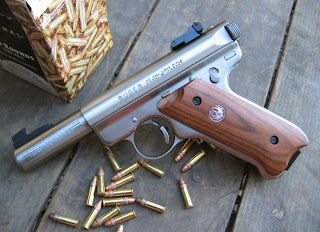
One of the pistols that I make no apologies for enjoying shooting is the Ruger MKII. Click to enlargeRegardless of the misguided statements Bill Ruger made late in life, his rimfire pistol is an American firearms masterpiece. Even though it requires know how similar to a secret handshake to reassemble, the Ruger pistol is a very basic, simple instrument that gets the job done on a budget with a longevity that will outlast most owners.

Several readers have emailed me to ask about the particular pistol that I start new shooters on. Frequently, this Ruger MKII is the first gun they fire. It was a special order gun, a stainless four inch bull barreled model. I installed a Volquartsen sear, hammer, and trigger. The sights are stock.

The Volquartsen trigger group gives the pistol an unmatchable crisp single action trigger pull. The four inch bull barrel gives it a balance like few other 22 pistols I have handled. These qualities plus the low cost of ammunition and near absent recoil make this the ideal pistol for a beginner to learn on.

Being the perfect handgun for a beginner does not mean this pistol is less than what it should be, however. A beginner's pistol should be durable, easy to maintain, easy to use, and reliable. Fighting with contrary equipment is the quickest route to turning off a new shooter. This particular Ruger MKII is extremely accurate as well as being very easy to handle. I frequently use it myself for low cost training. It's an accurate, reliable, portable 22 caliber lead launcher. A hoot to shoot.

One of the things I always wished I could change on the short barreled stainless Ruger though was the grips. The blond grips with the red Ruger medallions were pretty, but they just did not fit my hand the way I wished. Click to enlargeOne would think that as popular as the Ruger MKII is, nice grips would be more common. They can be found, but they frequently top $50 a pair. Thus, when I found a pair of checkered cocobolo grips with palm swells listed at CDNN, I quickly ordered a pair.

It took two days to receive my package from CDNN, and I was surprised to see that they gave me a break on shipping. The one thing that sometimes keeps me from ordering small parts from the Abilene, Texas gun emporium is that they typically use a flat rate for all shipping. A twenty-six dollar set of grips is not that great a deal if the shipping is fifteen bucks. At seven and a half for shipping, the deal becomes tolerable.

I have never been a proponent of thumb rests on handguns. I am of a mind that individual hands are unique, and unless a given grip is crafted for a given hand, protrusions on the grip are as likely to be cumbersome as they are beneficial. Click to enlargeThat being said, when I screwed these grips onto the Ruger MKII this afternoon, they totally transformed the pistol. The grips fit my hands perfectly. The pistol now points like a natural extension of my hand.

Even though the wood is a bit darker than I would have liked, the checkering is nicely cut. The screw holes were in perfect alignment. The real benefit came in the shootability of the pistol. The gun now comes to sights as naturally as pointing my finger. For $26.99, these grips are a fantastic investment in improving a Ruger MKII pistol. My only regret is that they do not have the Ruger medallion inset into them. As soon as I can find a trashed set of Ruger grips, that will change. Next, perhaps I'll install a Hi-Viz fiber optic front sight.......

Nugun agrees on the Ruger 22 pistol as a first gun.

Labels: ,

Friday, October 31, 2008

Ruger LCP Recall

Ruger® Issues Product Safety Warning and Recall Notice of LCP™ Pistol
October 29, 2008
Sturm, Ruger & Company, Inc. (NYSE-RGR) announces that it has recently received a small number of reports from the field indicating that LCP pistols can discharge when dropped onto a hard surface with a round in the chamber. Although no injuries have been reported, we are firmly committed to safety and will retrofit all older LCP pistols (described below). The retrofit involves installation of an upgraded hammer mechanism at no charge to the customer.
As a responsible manufacturer, we want to make our customers aware of this FREE safety upgrade. All LCP pistols bearing the prefix "370" (that is, serial number 370-xxxxx) may be affected. LCP owners can sign up for the safety upgrade or obtain additional information by:

• Visiting our LCP recall website at www.ruger.com/lcprecall
• E-mail: LCPrecall@ruger.com
• Fax: 928-541-8873
• Calling the LCP Recall hotline at 1-800-784-3701

The new parts are being built and we will retrofit LCP pistols on a first-come, first-served basis as soon as they are available. When Ruger is ready to retrofit a consumer's pistol, Ruger will send a shipping label and package with instructions for the FREE return of the LCP pistol to our factory in Prescott, Arizona. Ruger will install the new hammer mechanism, plus some other functional upgrades that have been added since the LCP's introduction, at no charge to the consumer and the pistol will be returned at Ruger expense. All owners will receive a FREE LCP magazine with the new finger grip extension as a "thank you" for their patience and cooperation.
Click to go to the Ruger website

Labels: ,

Sunday, October 12, 2008

The MKII Magazine Tweak

While shooting with QJ yesterday, our Ruger MKII pistol began to have occasional stovepipes with one magazine in particular. Stovepipes in a Ruger rimfire pistol occur when a particular pistol is just a little tighter in tolerances than usual. Click to enlargeThe problem arises with the location of the ejector and the fit of the magazine.

The top of a rimfire magazine has four "lips." The forward lips provide a feed ramp for the rear of the cartridge. The slanted vertical edge lifts the rim of the cartridge up and into alignment with the chamber. Do not mess with it.

The rear lips perform the function of restraining the next round and releasing it at the proper time. In new un-tweaked Ruger rimfire magazines, it can also cause delayed release of the feeding cartridge, and premature ejection of the spent shell casing. These two forces combine to bring about a stove pipe jam.

There is a tweak to be done on the Ruger MKII magazines, that will make every one of them reliable. After a bit of inspection, I realized that I had a "new" un-tweaked magazine in the mix. The rim of the spent casing was striking the left rear lip of this magazine and causing the stove pipes. I took the guilty magazine out of the rotation.

Tonight, while cleaning the pistol, I tweaked the mag. The forward corners of each rear magazine lip required rounding. The Tweak, Click to enlargeI used a Dremel, and was careful to keep the rounded corners equal on each side, and the inward curvature of the lip itself unchanged. I cut the final curve with a jeweler's file. When finished, I burnished them.

This performed two functions. The feeding cartridge would have it's rear portion released earlier, allowing for a straighter feed as the bullet approaches the chamber. More importantly, the corner of the left rear feed lip would no longer eject the casing. The spent casing had to remain in the extractor's grip until the ejector itself dislodged it. I removed the firing pin from the pistol, and checked the feed, extraction and ejection with live ammo. Perfect.

Often these stove pipe jams are blamed on the Ruger MKII pistol. It certainly appears the pistol is at fault when every magazine, even brand new ones from Ruger exhibit the same problem. By tweaking the magazines, they perform flawlessly in the pistol with closer tolerances, and they still work reliably in other Ruger MKIIs too. Why Ruger has not addressed this issue and made the rear lips rounded, I do not know. All I know is that the tweaking works.

Labels: ,

Sunday, October 05, 2008

Fixin' the Fishin' Gun

I spent the evening cleaning pistols and diagnosing the problem that was occurring with my Ruger MKII "fishin' gun." As is often the case, the root of the problem was a combination. The "fishin' gun" has a Volquartsen trigger with an over travel screw. Click to enlargeThe over travel screw prevents excessive trigger travel beyond what is necessary to disengage the hammer and sear.

Over time, the action of the pistol had accumulated soot, grit, and grunge. Some of this was caked on the sear. Once the coating was caked on the sear, the fine adjustment that I had on the over travel screw was not quite sufficient to always drop the hammer. Admittedly, I likely contributed to the problem with my habit of applying a smidgen of Tetra grease to the sear. 95% of all gun problems are related to the gun being dirty.

A good cleaning of the pistol cleared up the problem. I stripped the Ruger to the point shown here, and used brake cleaner and stiff nylon brushes to loosen all the grunge. Then, I reassembled the pistol and readjusted the over travel screw for a bit more play. Finally, since I now had the screw protruding from the face of the trigger slightly, I filed it down flush and repolished the trigger face.

One of the best online resources for field stripping the Ruger MKII can be found here. If you are inclined to detail strip the pistol, this page will help. Enlarge the photos to guide you.

Labels: , ,

Saturday, February 02, 2008

The Ruger LCP™ .380 Auto

It looks as though Sturm Ruger & Co. has finally realized there are a lot of honest citizens packing heat who want something other than a brick on their belt. Somehow, this pistol looks real familiar......

“The development and introduction of the Ruger LCP is in direct response to customer demand,” said Ruger President, Stephen L. Sanetti. “We have not been part of this market, but the growing number of states authorizing the licensed carry of pistols for personal protection by law-abiding citizens, and continued demand by law enforcement for quality back-up guns, cannot be ignored. The Ruger LCP is a .380 Auto pistol with superior ergonomic design and handsome styling. It incorporates state-of-the-art polymers, aircraft quality aluminum alloys and high-grade precision steel components engineered for strength and maximum weight savings.”

MSRP $330. Why couldn't they have done it in 9mm? LCP™, what does that stand for anyway? Little Copy Pistol?

Click to go to the Ruger website

More from Marshal Halloway.

Michael Bane's Range ReportClick to enlarge and compare the specs.

Labels: ,

The Ruger Charger

I know a lot of people are going all googly over Ruger's new 10/22 pistol, but I don't see the point. If you see something out there that needs a little hole in it, then why not punctuate it with a 10/22 rifle? If you want a good 22 caliber pistol, there is the Ruger MKII, or the Browning Buckmark, and neither requires a bipod. If you want a firearm on a bipod, why not chose a rifle? This attenuated rifle is neither a decent rifle, nor a decent pistol.

Or am I missing something here?

Labels: , , ,

Saturday, January 19, 2008

The Red Eagle Ruger

One of the .22 pistols that represents American ingenuity is the Ruger Standard. Approximately 25,500 Red Eagle Ruger Standard pistols were manufactured between October 1949 and November, 1951, before Ruger's business partner, Alexander Sturm died of hepatitis. Click to enlargeAfter Sturm's death, Ruger mandated that the grip medallions be silver and black. The remaining red medallions were depleted by February 1952. The "Red Eagle" pursuit may be a sentimental affection for a long passed plinker, but the red medallion is also indicative of an innovative firearm's first year of production.

Other details of the Ruger Standard pistols include a receiver with no scallops before the bolt knob, a nine round magazine and no bolt hold back mechanism. Very early examples have a square ejection port, and a block rear sight instead of the swept back rear sight shown here.

It is still possible to find Red Eagle Ruger Standards at reasonable prices. I occasionally see one at a gun show, often tired and battered. Not infrequently the seller has heard that he has "something" and on looking the pistol up in the Blue Book, he sees higher listings. He jacks up his asking price accordingly. The red eagle Ruger pistols can still be found through private sales and estate sales. I hope to someday find one at a "take me home price". Maybe at the upcoming gun show.......

Labels: , ,

Friday, January 18, 2008

What Is Xavier Reading?

"Bill Ruger's .22 Pistol" by Don Findley is a wonderful surprise I found at a book fair. I have been unable to locate it on Amazon.com, other than a $100 leather bound version. My lesser quality copy had a $44.95 cover price. The Book Fair price was five bucks.

Don Findley's publication is a coffee table sized book filled with detailed two page spreads of the Ruger Standard, MKI, and MKII pistols. It also contains photos of Bill Ruger's hand tools from his first abandoned business. The large clear photos are accompanied by text that explains the evolution of the little plinker and the myriad variations that collectors relish and justify their latest purchases by. While not a reference book or a definitive anthology of the pistol, the book certainly lives up to it's billing as a "photographic essay of the Ruger Rimfire Pistol." If you enjoy Ruger rimfire pistols, and see the book for an affordable price, do not hesitate to purchase it.

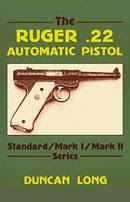
"The Ruger .22 Automatic Pistol" by Duncan Long is available on Amazon.com for $10.88. Click to buy it on Amazon.comIt is a history of Strum Ruger as well, and a good, inexpensive reference to their auto loading pistols.

Duncan Long's book adequately covers the Ruger pistol through the Mark II line. The illustrations obviously can't compare with the coffee table book, but they are sufficient. Long's book also covers the care and maintenance, disassembly and reassembly, accessories, and ammunition.

Both books are certainly worth the price to the Ruger plinker aficionado. The Findley book is certainly directed more towards the collector, with enlarged macro photos. The Long book is more information packed, aimed at another niche in the esoteric world of accumulating firearms. If you accumulate the Ruger pistol, you may as well pick up both books if you have the chance.

Labels: , ,

Friday, December 28, 2007

The Ruger MKII

In 1949, small advertisements appeared in sporting magazines announcing a new pistol. "The first overall improvement in automatic pistol design since the Browning patent of 1905. For simplicity, strength, and handsomeness it has no equal." The pure audaciousness of Bill Ruger's advertisements in retrospect was absolutely on target. The Ruger Standard was a totally new concept for a .22 pistol. It had a tubular receiver with a bolt that fit inside. The receiver was secured atop a grip frame that was reminiscent of a Luger. The bullet exited a tapered barrel that further enhanced the Luger likeness. Some may have been confused over the Ruger name, thinking the pistol was a 22 caliber Luger, but the $37.50 price beat the pants off any other rimfire pistol on the market. Far from being a detriment, the Germanic styling gave the pistol a flair that was quickly assimilated into the American shooting culture. In 1950, the Ruger Target was quickly introduced with a six and 7/8 inch barrel, an adjustable rear sight, an under cut front sight blade to minimize glare, as well as an improved trigger.

The Ruger Standard and Target had no bolt hold back mechanism, and six groove, 1:14 right hand twist rifling in it's barrel. The heel released magazine contained nine rounds. The Ruger Standard stamped and welded grip frame was unique for it's time. It was the tubular receiver and the stamped and welded grip frame that kept the Ruger Standard's price below that of it's competitors. Click to enlargeAdorning the left grip panel was a red eagle medallion, derived from traditional European eagle motifs by Ruger’s partner, Alex Sturm. When Sturm died in 1951, the background for the eagle medallion was changed to black.

Over time, the Standard became available with a variety of barrel lengths, and adjustable sights. In 1971, the dies that the Strum-Ruger corporation used to stamp the grip frames finally wore out. New dies were formed allowing the magazine follower button to be on the left, rather than on the right as was the case with the earlier models. The new style grip frame was designated the A-100. Previous magazines would not fit in the A-100 grip frame, but the newer magazines fit both styles of pistol. The change was a portent of changes on the horizon.

In 1982, Bill Ruger added a bolt hold back mechanism, actuated by the flipped magazine button on the A-100 series pistols, and the Ruger MKII was born. The Ruger MKII, in all it's variations, is considered by many to be the pinnacle of Bill Ruger's achievements. For many older shooters, the Ruger Standard was the first auto-pistol they ever fired. The MKII introduced an entire new generation to the shooting sports. To commemorate the conclusion of the Ruger Standard era, Sturm-Ruger produced 5000 stainless steel Standard pistols engraved with Bill Ruger's signature on the receiver. Click to enlargeThe new MKII Rugers came with ten round magazines, making a dollar box of 50 rounds an even five magazine box. The safety of the MKII was designed as well to allow for a visual inspection of the chamber with the sear locked in place. Stainless steel MKII pistols were introduced in 1982, and a ten inch bull barrel model was added to the line-up in 1984. In 1986, the competition grade Mark II Government Target Model was released along with proof targets confirming it's accuracy. A slab side barreled version of the Government Target Model was introduced in 1991. It was designated the Competition Model.

1993 brought the Ruger 22/45, a polymer framed version with integral grip panels that replicated the grip angle of the venerable 1911. The 22/45 not only mimicked the 1911 in it's grip angle, but the magazine release was moved to the 1911 location, behind the hooked triggerguard.

Finally, in 2004, the MKII was superseded by the Ruger MKIII. The MKIII gave shooters the magazine release where many had wanted it, beside the triggerguard. Click to enlargeThe MKIII also incorporated some less desirable features, however, including a loaded chamber indicator, a magazine disconnect safety, and an internal locking device. While many new shooters may view the new innovations as improvements, older shooters frequently see them as unnecessary and unwanted gilding on a perfect lily.
In 1989, Bill Ruger made some unfortunate statements. In a letter to Congress, he suggested the implementation of a 10 round magazine for all semi-auto handguns, and a ban on the production of full capacity magazines. Bill Ruger later claimed "no honest man needs more than 10 rounds in any gun," in an interview with Tom Brokaw. Congress followed the suggestion and incorporated it into the Assault Weapons Ban of 1994. The AWB sunsetted on September 13, 2004. Bill Ruger died on July 6, 2002. Some gun owners still hold a grudge over those statements, but I figure Bill Ruger is dead and so is the legislation his words helped pass. The pistols his company produced are still some of the most enduring in the world.

Just like in 1949, the Ruger rimfire pistols remain an excellent value. I personally prefer the MKII above all others, but I will not pass on a nice Ruger Standard if I ever see one for sale again while my pockets still jingle. Click to enlargeI own several Ruger MKII's. Some I use to instruct new shooters, one I use for target shooting, and one I carry as a fishing pistol. I like to personalize my handguns a bit, and the MKII allows for that. I like a Volquartsen trigger and sear. I always keep an eye out for interesting grips, as well as used pistols.
When Ruger MKII pistols appear on the used gun market, they generally change hands for between $150 and $200, depending on finish condition. A used Ruger MKII is invariably a safe purchase, assuming the bore is not plugged with rust. The inherent durability and reliability of the design makes for a pawn shop treasure that frequently needs nothing done to it at all. At a time that ammunition costs are escalating with no end in sight, a 22 caliber pistol makes more sense than ever.

50 Years of Ruger Auto Pistols

Ruger MKII Dis/Re-assembly Instructions Detailed

Ruger MKII Internal Disassembly and Reassembly Instructions

Serial Numbers
Ruger Standard
1949 1
1950 2416
1951 11597
1952 32905
1953 49019
1954 68958
1955 97358
1956 115523
1957 128244
1958 148222
1959 169400
1960 179712
1961 194484
1962 217767
1963 239621
1964 250296
1965 276308
1966 406740
1967 436226
1968 463239
1969 10-00001
1970 10-38890
1971 10-75016
1972 11-26288
1973 11-72924
1974 12-22449
1975 12-81988
1976 13-48646
1977 13-99097
1978 14-69121
1979 15-36233
1980 16-06785
1981 16-82837
1982 17-70981

Ruger MKII
1982 18-00001
1983 18-50048
1984 19-31711
1985 211-13150
1986 212-08560
1987 212-91364
1988 213-90898
1989 214-85593
1990 215-61938
1991 216-68349
1992 217-48014 and 218-00001
1993 219-37950 and 218-05550
1994 219-90370 and 218-26000
1995 221-20943 and 218-45600
1996 221-36504 and 218-59250
1997 221-55005 and 218-68650
1998 221-95002 and 218-95440
1999 222-36510
2000 223-42679
2001 224-21283
2002 224-82446
2003 225-18909
2004 225-60111
2005 225-84467

Labels: ,